ADAD
ADAD
Updating your news feed...
NEWS EXPRESS is Nigeria’s leading online newspaper. Published by Africa’s international award-winning journalist, Mr. Isaac Umunna, NEWS EXPRESS is Nigeria’s first truly professional online daily newspaper. It is published from Lagos, Nigeria’s economic and media hub, and has a provision for occasional special print editions. Thanks to our vast network of sources and dedicated team of professional journalists and contributors spread across Nigeria and overseas, NEWS EXPRESS has become synonymous with newsbreaks and exclusive stories from around the world.






Loading banners
Loading banners...

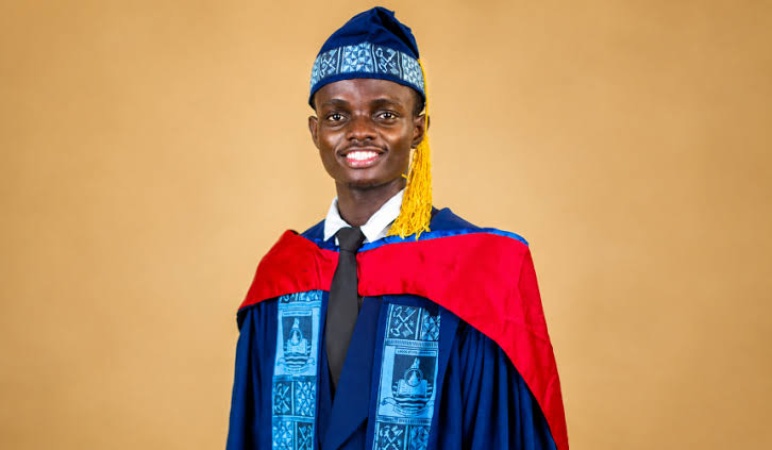
Samuel Adebanjo, LASUs overall best graduating student
Samuel Oluolamide Adebanjo, a graduate of the Department of Aerospace Engineering at Lagos State University (LASU), recently emerged as the overall best graduating student for the 2025/2026 academic session, with an outstanding Cumulative Grade Point Average (CGPA) of 4.97 out of 5.00. At 22, Adebanjo’s achievement makes him the first university graduate in his family and places his CGPA among the highest recorded in LASU’s history. His 4.97 is also the highest ever recorded in the Department of Aerospace Engineering and a joint record in the Faculty of Engineering. In this interview with ADAM MOSADIOLUWA, Adebanjo speaks about his journey from Sango Ota in Ogun State to becoming LASU’s best graduating student.
Congratulations on emerging as the overall best graduating student of Lagos State University (LASU) for the 2025/2026 academic session with an outstanding CGPA of 4.97 out of 5.00. How did you receive the news, and what did the achievement mean to you personally?
I actually first got the news directly from my Head of Department, who reached out to congratulate me as the Overall Best Graduating Student of LASU. I was overjoyed, but honestly, part of me needed to wait for the official announcement just to be sure it wasn’t a dream. When the Vice-Chancellor, Prof. Ibiyemi Olatunji-Bello, formally announced it during the press briefing, it made everything feel so real. Tears of joy fell, knowing that a boy like me, coming from my background, could achieve such a feat and stand in the spotlight.
Personally, this achievement is far more than a record CGPA. As the first university graduate in my family, it stands as proof that where you come from does not determine where you can go. It is a testament to God’s grace, years of silent sacrifices, and the power of believing in your dreams even when the odds seem high.
What touches me most is seeing the smiles this news has brought to so many faces. It reassures me that every sacrifice, every prayer, and every investment made into my life by my family, my teachers, secondary school proprietor, lecturers, mentors, course mates, and friends was entirely worth it
A CGPA of 4.97 is exceptionally rare. At what point during your undergraduate journey did you realise you were on course for something historic, and did that awareness bring any added pressure or motivation?
Honestly, my journey didn’t start at the very top. In my 100-level first semester, I had a 4.81 GP. While it was a First Class, it wasn’t the best in my class. Others had 5.0s and 4.9s. I was disappointed because I constantly aim for excellence in everything I do. When I told my sister, she said something that stuck with me: ‘It is not about how you start, but how you finish.’ Little did I know she was speaking into my future.
In the second semester, God gave me my first 5.0 GP, bringing my CGPA to 4.90. By 200 Level, I had become the top student in my department, but I was never competing with anyone else; my personal goal every single semester was simply to hit a 5.0 and be my best version.
The realisation that this could be historic hit me around 400 Level. By then, I had maintained consecutive perfect GPs, pushing my CGPA to 4.96. Rumors were circulating that I was the highest in the Faculty of Engineering, and when I saw that the Overall Best Graduating Student of the previous session finished with a 4.93, I realised, ‘I could actually graduate as the Faculty Best and Overall Best.’ Winning the OPay Scholarship as the only engineering student selected further signaled that something big was happening.
Heading into 500 Level, the goal was simple: finish strong with another 5.0. Balancing that drive with final-year research, community projects, tutoring, active church leadership, and even working to support myself, all while my dad was going through a health challenge, was intense. But God sustained me. God helped me pull off 5.0s in both final semesters, completing 7 out of 10 perfect semesters and landing at 4.97. The motivation was never just about a title; it was about finishing strong, trusting God through the storm, and giving my absolute best at every stage.
Can you take us through your journey from Sango Ota, Ogun State, to becoming LASU’s overall best graduating student? What were some of the defining moments that shaped your academic path?
My journey began in Sango Ota, Ogun State, where I attended Top’s Bright International School. Growing up, things were financially tough at home. There were days I had to go to school with unpaid fees, but despite those challenges, I remained consistently at the top of my class.
Seeing my dedication, the proprietor of my school did something that changed my life forever: he celebrated my academic consistency, cleared all my outstanding debts, and granted me a full scholarship through SS3. They even went as far as paying for my WAEC registration and UTME, that single act was my biggest defining moment. It proved to me early in life that academic excellence is not a scam, that hard work and diligence genuinely pay off. It sparked a fire in me.
After secondary school, I taught briefly at my alma mater. My teachers, who saw my foundation, encouraged me and said, “Samuel, with your intellect and discipline, you can hit a 5.0 GP in the university.” I took that to heart. Entering LASU, my drive to achieve a First Class wasn’t just about personal pride; it was driven by a deep desire to make my parents, my teachers, my secondary school proprietor, and everyone who invested in me proud and put a smile on everyone’s face. That foundation in Sango Ota set the entire trajectory for where I am today.
You have spoken about your lifelong fascination with flight and aircraft. What first sparked that interest, and when did you realise aerospace engineering was the career path you wanted to pursue?
My passion for flight started in early childhood. Like many kids, I would look up at the sky in total awe whenever an airplane passed by. My father told me about pilots, and back then, my immediate dream was simply to say, “I want to be a pilot!” I was naturally fascinated by anything that could take to the air, even watching birds fly made me ponder the science behind flight and how human innovation turned bird-inspired mechanics into real aircraft.
However, as I grew older and evolved academically, my perspective shifted. I realised that piloting was primarily an operational role, flying an aircraft from point A to point B. But my mind didn’t just want to control the machine; I wanted to know how to build it. I was deeply curious about the physics, the aerodynamics, and how human engineering could defy gravity and bend fluid dynamics principles to keep a massive machine airborne.
Combined with my strong affinity for mathematics and analytical problem-solving, I realised that Aerospace Engineering was my true path. It gave me the scope not just to study airplanes, but to master everything that flies, from autonomous UAVs and experimental rockets to space exploration hardware. Choosing Aerospace Engineering at Lagos State University was the moment I turned childhood wonder into a lifelong commitment to building the future of flight.
You are the first university graduate in your family. How significant is that achievement for you and your family, and how did their support contribute to your success?
Being the first university graduate in my immediate family, and achieving it as Overall Best Graduating Student, is of immense significance to us. It represents a true generational breakthrough. It shifts the narrative for our family line completely and shows my siblings and relatives that with hard work, faith, and dedication, background limitations can be overcome.
My family’s support was the backbone of my success. Even during periods when finances were extremely tight, my parents sacrificed quietly to make sure my education remained a priority. Their constant prayers, emotional grounding, and unshakeable belief in my potential sustained me through long nights, heavy project workloads, and exam pressures. This milestone belongs to them just as much as it belongs to me.
Many students struggle to graduate with a First Class degree, yet you finished with an almost perfect CGPA. What study habits, routines, and principles helped you maintain such an exceptional academic record?
First and foremost, I attribute everything to God’s grace and constant prayer. Achieving this level of excellence is not by human power alone, but by combining deep faith and prayer with intense hard work. My academic approach was guided by a few core routines and principles.
One of these was clear goal-setting and daily prayer. At the beginning of every semester, I would write down every course, its unit load, and my target grade, aiming for a perfect 5.0 GP. I kept this target written down, and every single day, I brought those written goals before God in prayer, asking Him for wisdom, retentive memory, and direction.
Another important approach was the Feynman Technique (Teaching to Learn). One of my biggest secrets to academic mastery was teaching my peers. From my 200 Level onwards, I regularly tutored my classmates before exams. Explaining complex engineering concepts to others forced me to master the material inside out. Putting smiles on my classmates’ faces through teaching always came back as a blessing to my own understanding.
I also made it a point to seek insights from seniors. I never relied solely on my own understanding. I reached out to senior students who had passed through the same courses to learn about lecture dynamics, common pitfalls, and effective study approaches for each specific subject.
During exams, I relied on strategic exam execution, prioritising clarity and detail. I always answered the simplest questions first to build momentum before tackling complex problems. I ensured my explanations were thorough, structured, and grammatically precise so that examiners could see I truly understood the underlying physical principles.
Above all, I maintained a relentless work ethic. When it was time to study, I gave it everything. On exam eves, I engaged in intense overnight study sessions to ensure every potential gap in my knowledge was covered.
Academic excellence often comes with challenges. Was there any particular course or semester that challenged you the most? How did you overcome it?
Every single semester had its own unique hurdles, especially when the goal was to maintain a perfect 5.0 GP. However, two specific instances stand out:
Engineering Drawing in 200 Level: Having not taken Technical Drawing in secondary school, facing Engineering Drawing in my second year was a massive shock. Early on, my initial classwork scores were low. I realised I had to adapt quickly, so I dedicated extra hours to practicing the extensive drawing coursework assigned, covering various projections, sections, and detailed technical drawings and the likes. Through fast adaptation, relentless practice, and God’s help, I aced the course.
300 Level Campus Power Crisis in Epe: Beyond academics, environmental factors were a huge challenge. During 300 Level on the Epe campus, the school generator became faulty, and NEPA wasn’t giving us power. Studying for exams and completing assignments became an uphill task as we struggled daily just to find light to read and charge our devices. It required extreme discipline and sacrifice to study under those tough conditions, but through God’s grace, I still pulled through.
Across all my semesters, my approach to every challenging course was simple: acknowledge the difficulty early, adapt fast, work harder, Do it Diligently (D.I.D) Never Give Up and trust God to crown the effort.
Behind every remarkable achievement is usually a difficult chapter. During your journey to becoming LASU’s overall best graduating student, was there ever a time when you felt like giving up or lowering your ambitions? What kept you moving forward?
Mentally, my personal mantra has always been to never give up and to remain diligent, so giving up on my academic goals was never an option I entertained. However, there was a deeply challenging period that tested me emotionally to my core.
During my university journey, my father fell critically ill. It was a very painful and frightening time for my family. I was barely sleeping, constantly worried that I might lose him, and I had to direct some of my funds I had earned toward supporting his medical treatments and care. The emotional weight was heavy, and I kept praying and thinking, “I want my father to be alive to see me succeed and taste the fruits of my labor.”
That season tested my strength and faith, but keeping my trust in God and focusing on my family kept me anchored. By God’s grace, my father recovered and pulled through. Seeing him healthy and present to witness my success today is one of my greatest blessings. That experience didn’t weaken my ambition; it gave me an even deeper purpose to keep striving, excel, and make him proud.
As an undergraduate researcher, you worked on projects such as SkyClerk, an autonomous delivery quadcopter, and contributed to several innovative engineering initiatives. Which project are you most proud of, and why?
The project I am most proud of is SkyClerk, an autonomous quadcopter UAV system designed for automated office asset delivery across campus.
Building SkyClerk was a massive undertaking that demanded immense sacrifice. To get the exact electronic components and hardware required, I had to travel long distances across town, navigating complex full-stack integration, frame finishing, and software calibration to ensure the drone could navigate set flight paths safely and execute deliveries.
One of the things that makes me particularly proud of the project is its technical complexity and breakthrough. Integrating flight hardware, structural design, and autonomous navigation logic forced me to push my technical limits. Successfully demonstrating autonomous flight proved that aerospace technology can directly solve everyday localised logistics problems.
I am also proud of SkyClerk because it serves as a foundation for future innovation. What makes me proudest is that we built a robust, functional prototype that lays a solid foundation for future researchers or students to build upon. It was an honour to defend this work successfully for my final project defense.
Bringing SkyClerk from raw components to successful flight gave me immense confidence as an engineer. It reinforced my passion for Aero-AstroIntelligence and proved that engineering is at its best when it solves real human problems.
Your primary research interests span Aero-Astro Intelligence, Unmanned Aerial Vehicles (UAVs), Computational Fluid Dynamics (CFD), and Machine Learning (ML). For readers unfamiliar with these terms, how do they connect, and why do you believe they will shape the future?
These fields form a powerful ecosystem for the future of aerospace.
Unmanned Aerial Vehicles (UAVs) are the physical hardware, such as autonomous drones and aircraft designed to operate without human pilots. Computational Fluid Dynamics (CFD) is the virtual wind tunnel. It uses complex mathematical equations to simulate how air, wind, and fluids interact with physical structures like wings or pipelines. Machine Learning (ML) & AI serve as the cognitive brain that learns patterns from data, makes rapid predictions, and enables real-time decision-making.
These fields connect because traditional engineering relies on slow numerical simulations and expensive physical testing. By integrating Machine Learning with CFD, we create hybrid models that can predict complex aerodynamic behaviours in seconds rather than days. When you plug these fast, intelligent models directly into UAV control systems, you get Aero-AstroIntelligence: smart autonomous systems that can continuously adapt to changing environments, detect structural faults like pipeline leaks, and fly efficiently on their own.
They will shape the future because the future belongs to intelligent, autonomous systems. Combining AI with aerospace hardware and fluid dynamics allows us to solve critical global challenges, from rapid disaster response and automated agricultural monitoring to safe pipeline infrastructure inspection and deep space exploration. It shifts aerospace engineering from merely building flying machines to creating intelligent aerial systems that can think, adapt, and protect.
Nigeria’s aerospace and advanced technology sectors are still developing. What opportunities do you see for young Nigerian engineers and innovators in areas such as drones, artificial intelligence, and space technology?
Nigeria’s developing tech space is a massive advantage because it allows us to build solutions designed specifically for our local challenges rather than importing existing templates.
One major opportunity is in precision agriculture and food security. Drones equipped with AI and localised telemetry, such as our AeroAgro Pay framework, can help smallholder farmers monitor crop health, optimise yield, and deliver precision spraying affordably.
There is also an opportunity in critical infrastructure surveillance. Over 80% of our energy sector relies on extensive pipeline networks. Combining UAVs, satellite data, and machine learning for pipeline integrity monitoring provides an opportunity to prevent environmental contamination and curb economic losses.
Another area is localized logistics and emergency response. Autonomous aerial systems can bridge supply chain gaps, delivering vital medical supplies, blood plasma, or critical administrative documents across congested urban centers and remote rural areas.
Young Nigerian innovators have the unique opportunity to lead the global South by building practical, high-impact technologies that directly solve everyday challenges.
Beyond academics and research, you have remained active in church, student leadership, tutoring, and community development initiatives. How has your Christian faith influenced your approach to learning, leadership, and service?
My faith is the central anchor of my life. It completely shapes how I view academic excellence, leadership, and service to others:
I anchor my approach to excellence in Scripture and purpose, particularly Ecclesiastes 9:10 (“Whatever your hand finds to do, do it with all your might”). I strongly believe that as Christians, we are called to embody excellence in everything we do, showing that you can be deeply committed to the things of God while simultaneously excelling at the highest levels of academia, research, and technical innovation.
I also see tutorials as service to humanity. I never wanted to chase grades in isolation; my heart is to be significant in my community and be a direct solution to people’s challenges. Leading tutorials at Departmental and Faculty levels, HesolvesmathsEdhub, NUESA Tutorial, Bunday Tutorial, is my personal service to humanity. Teaching complex concepts, helping peers understand difficult material, and putting a genuine smile on someone’s face when they finally grasp a concept brings me immense joy.
For me, leadership is also about service. Leadership is crucial because it is the ultimate tool for serving others. True leadership isn’t about titles or personal accolades; it is about lifting others up, building platforms for their success, and leading with integrity and grace.
Finally, my faith has given me resilience. When code refused to compile or complex project builds didn’t go as planned, giving up was never an option. To give up is to lose faith. I firmly believe that God works all things together for good, and that conviction gave me the steady peace, patience, and resilience to keep pushing until solutions emerged.
Many students see outstanding results but rarely see the sacrifices behind them. What are some of the personal sacrifices, missed opportunities, or difficult choices you had to make in pursuit of academic excellence?
Behind every headline CGPA and high-profile milestone is an unglamorous reality of intense discipline, grit, and sacrifice that social media never sees.
One of the major challenges I faced was enduring physical and financial hardships. There were times I had to study on an empty stomach due to lack, times I had to trek long distances just to find a place to charge my devices, and nights I studied under streetlights on campus during power outages. Before I had my own laptop, I had to borrow laptops from peers to complete heavy engineering assignments and coursework. Even when my phone was not functioning well, I adapted and ran most of my tasks directly on a laptop. To support myself and meet daily needs, I provided payment processing services, helping fellow students facilitate their tuition payments on the portal in exchange for modest commissions.
I also had to maintain deliberate lifestyle discipline and focus. Achieving excellence requires eliminating distractions. I did not attend parties, and while I followed football passionately as a supporter, I never played, making a conscious effort to protect my time and energy so that no engagement undermined another.
Another sacrifice involved relentless study habits and night classes. While I maintained a steady daily study routine throughout the semester, exam periods required an entirely different level of intensity. I constantly attended overnight study sessions on campus, pushing past physical fatigue to cover vast amounts of syllabus material, perform deep revisions, and achieve complete concept mastery before stepping into the exam hall.
I also had to juggle multiple high-stakes demands. True sacrifice was learning to keep pushing when I was utterly exhausted. I taught tutorials for hours back-to-back, sometimes teaching virtually while simultaneously preparing for my own examinations. I had to juggle a demanding Aerospace Engineering degree at LASU alongside a Data Science Diploma at AltSchool Africa, student leadership, research, and work. Yet, through all the chaos, I made it a strict point never to compromise my faith, keeping my Sundays dedicated to church and trusting God when the load felt overwhelming.
Ultimately, it was a journey filled with deep struggles, sleepless nights, and constant trade-offs, but every single sacrifice laid the groundwork for major wins. It taught me a fundamental truth: there is truly no gain without pain, and true excellence is forged when you choose to keep moving forward when it is toughest.
Balancing academics, research, leadership responsibilities, tutoring, and personal life can be difficult. How did you maintain that balance throughout your undergraduate journey, and what lessons did it teach you?
Balancing all these responsibilities alongside a personal life is extremely difficult, I would never claim it was easy. In reality, when you take on so much, one commitment will inevitably spill over into another. The key is managing those trade-offs so the impact remains minimal.
One of the ways I maintained that balance was through daily prioritisation and intentional scheduling. Every single day, I took time to plan ahead, set clear priorities, and map out a realistic schedule of tasks. My focus was not on achieving unattainable perfection, but on ensuring I consistently executed the majority of my high-impact tasks each day.
I also relied on divine help. Beyond human organisation, my main anchor was continually asking God for help and wisdom to manage my daily activities. Trusting God gave me the mental clarity and grace to handle heavy workloads without losing my peace.
The greatest lesson this journey taught me is that you are capable of achieving far more than you think. You can take on multiple high-stakes endeavours, academics, research, leadership, and service, and excel across all of them. All it takes is the right mindset, ruthless prioritisation, and the discipline to show up every day.
Having achieved this remarkable milestone at just 22 years old, what excites you most about the next phase of your journey, and what advice would you give to young Nigerians who dream of achieving academic excellence despite their circumstances?
Graduating at 22 gives me time and energy to explore, build, and innovate. I am thrilled to dive deeper into artificial intelligence, data science, Aero-Astro Intelligence Engineering, combining research with hands-on projects in the Aerospace industry and teaching. My immediate focus is pursuing international scholarship opportunities to gain global exposure and world-class expertise. My ultimate goal is to bridge local problems with global solutions, taking what I learn on the world stage and applying it back home to push Nigeria forward.
My advice to young Nigerians is never give up, your story isn’t over. No matter how difficult your current situation is, do not write yourself off. Your story is still being written, and it is never too late to do great things, regardless of where you start. You can achieve extraordinary success from a small place.
Also, do your part and work hard. Do whatever your hand finds to do with absolute diligence and consistency. Preparation meets opportunity when you stay committed. Work hard, stay resilient, and keep showing up every day.
And lastly, trust the process and keep the faith. If I could navigate these hurdles to reach this point, you can too. Do your part with relentless effort, and trust God to do what only He can do. Resilience is key; keep pushing forward, and your moment will surely come. (Sunday Tribune)