ADAD
ADAD
Updating your news feed...
NEWS EXPRESS is Nigeria’s leading online newspaper. Published by Africa’s international award-winning journalist, Mr. Isaac Umunna, NEWS EXPRESS is Nigeria’s first truly professional online daily newspaper. It is published from Lagos, Nigeria’s economic and media hub, and has a provision for occasional special print editions. Thanks to our vast network of sources and dedicated team of professional journalists and contributors spread across Nigeria and overseas, NEWS EXPRESS has become synonymous with newsbreaks and exclusive stories from around the world.

















Loading banners
Loading banners...

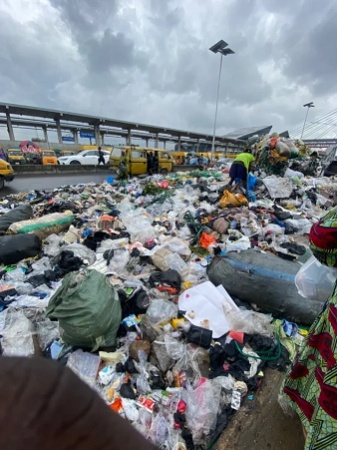
Lagos garbage heap
By CASMIR IGBOKWE
Chimezie and some other residents of an estate in the Ago area of Lagos heaved a sigh of relief last Friday. That was when the Private Sector Participant (PSP) waste collector visited to evacuate the mountain of garbage that had defaced the beauty of the estate. Before then, Chimezie had been forced to engage a waste picker to decongest his overfilled waste bin. He complained that for over one month, the PSP waste collector had not come to pick up their waste.
The young man further lamented that in the Ojuelegba area of Lagos where his business is located, the authorities of the Lagos State Waste Management Authority (LAWMA) imposed a fine of over N1 million on some shop owners. This is because some people dumped garbage on the road.
Initially, the shop owners resisted paying the penalty. They mulled going to court. But knowing the nature of many Nigerian courts when it comes to dispensing justice on time, they later decided to pay and have their peace.
It is an understatement to say that garbage heaps have taken over Lagos. The situation has become very embarrassing. Many streets now contend with rats scavenging through the refuse heaps for food, constituting environmental and health hazards. This is what many residents get after paying not less than N4,000 per flat per month for refuse disposal. Typical of Nigerians, some residential areas now give tips to PSP operators to give their area priority in evacuation of waste. They know that confronting a government agency may not yield any positive dividend.
Rather than admit its failures and apologise to residents, the Lagos State Government resorted to fishing for excuses. Recently, the Deputy Governor of the state, Obafemi Hamzat, told Nigerian Info 99.3FM that they thought they were generating 13,000 tonnes of waste on a daily basis. “It turns out we are generating about 17,000,” he noted. This, he added, had affected proper planning and management of refuse collection in the state.
Besides, the deputy governor said some of the 420 PSP operators no longer have the required number of functional waste collection trucks. Each of these operators is supposed to have at least two trucks for refuse evacuation. But for some of them, the trucks have broken down. Some have reportedly shut down business. Rising operational costs and population explosion in Lagos are also part of the problem.
The Managing Director and Chief Executive Officer of LAWMA, Muyiwa Gbadegesi, came with his own excuse. According to him, some of the landfills in Lagos are approaching their end of life. Hence, their capacity to receive waste has dwindled. This is worsened by flooding of access roads and disposal platforms.
Most annoyingly, LAWMA has not provided alternatives for residents on how and where to dump their domestic waste. But it has threatened serious sanctions against whoever is caught dumping refuse at inappropriate places. As Gbadegesi, put it, “The policy is zero tolerance for indiscriminate waste disposal. We do not want anyone in Lagos dumping waste in public spaces, and anyone who does so, we will enforce that to the fullest extent of the law.”
Gbadegesi should tell Lagos residents what to do when some PSP operators have failed in their duties. Should they begin to burn their waste? Should they dump it inside their sitting rooms or kitchens? The point is, when the relevant city authorities fail to do what they are set up to do, they should not turn around to blame or punish the citizens.
Many questions beg for answers here. For instance, were Hamzat, Gbadegesi and other public officials meant to give excuses or find solutions to problems? Why would the LAWMA boss tell us about the problem posed by the ageing landfills when the state government could have taken a proactive action to get alternatives? How could the state have handled waste management without accurate data?
Besides, when will the two major transfer loading stations reportedly being developed at Olusosun and Solous start work? When will the material recovery facilities being developed in Ikorodu and Badagry to process bulk waste start operations? When will the recycling and waste-to-energy plants the state intends to use to replace ageing landfills be put to use? And why resort to a knee-jerk reaction to a problem that announced its existence years back?
Effective waste management was a major problem during the administration of Akinwunmi Ambode in Lagos. The former governor inherited a near seamless waste disposal process from his predecessor, Raji Fashola, who had involved PSP operators in his time. But Ambode tried to introduce a novel system called Cleaner Lagos Initiative (CLI) in 2016.
He contracted a foreign environmental utility company called Visionscape Sanitation Solutions to handle residential waste collection and asked the PSP operators to focus on commercial waste. This failed. Garbage took over Lagos then. He reverted to the PSP arrangement later in his tenure. The situation gradually normalized when Sanwo-Olu took over in 2019 and retained the PSP arrangement. The current system has also failed, prompting some residents to now patronize cart-pushers.
Lagos prides itself as a megacity and centre of excellence. It is home to many multinationals and small-scale businesses. These companies pay a lot of tax to the state. Invariably, the state has a lot of money. Unfortunately, many intra-city roads are dilapidated. They cause serious damage to vehicles, including those of the PSP operators. Some drainage channels are blocked with garbage such that when it rains, the roads are flooded. All these, combined with the mega garbage, have made the state very unhealthy and stressful to live in for many residents.
Hamzat said the state government expected that the 100 trucks it had earlier ordered would arrive in July. But the arrival date has been shifted to September. So, what should the residents do in this circumstance? Swallow back their garbage? Or sue the state government for negligence?
Lagos residents deserve an unreserved apology from Governor Babajide Sanwo-Olu. He should order that all the people punished for dumping refuse at unauthorized places due mainly to poor waste management should be refunded. It is morally wrong to penalize people when you as a government have not done your own part of the bargain.
The state should study how other major cities around the world successfully evacuate their waste. The city of Indore in India had the same problem that Lagos is having now. It tackled it headlong by using GPS-tracked trucks to collect waste daily from every home. Today, Indore has been adjudged the cleanest city in India for eight consecutive years.
Lagos should incorporate technology into waste management in the state. That is what many advanced countries do now. They have reduced the need for manual trash collection by using smart sensors, pneumatic underground tubes, AI-powered sorting robots, and solar-powered compactors to manage waste.
Smart bin sensors measure trash levels or container fullness so that trucks can only service full bins and stop going out unnecessarily. Solar compactors compress waste automatically thereby cutting down on the number of times trucks come to pick it up.
Pneumatic underground waste pipes suck waste away from buildings or street inlets to designated collection points with high-speed air vacuum systems. This is used more in cities such as Barcelona, Seoul, Helsinki, and London. Artificial Intelligence (AI) and robots are also used to identify, separate and sort plastics, metals and paper. In some European Union member states, landfills have been prohibited. What they have in place are organic waste incineration, recycling, and composting.
Lagos should also embark on public awareness campaign to sensitise people on how to separate and sort their waste. It helped a lot in the implementation of the plastic bags ban in Rwanda in 2008. The country’s Ministry of Environment had launched nationwide campaigns from about 2004 to highlight how plastic waste damages soil, water, and health.
Generally, less than 20 per cent of the large volume of solid waste Nigeria produces is reportedly collected through a formal system. In Europe and North America, the collection rate is said to be about 90 per cent. Nigerian cities, especially Lagos, should go beyond manual collection of waste. They should adopt digitalized waste management system to minimize the problems associated with the current waste management system.
Lagos cannot be called a mega city or centre of excellence with dilapidated roads and garbage heaps. It must lead the way in every aspect of development. It has the resources to do it. What is required to get things going is effective and accountable leadership. Sanwo-Olu, please clear the filth and let the people breathe!
•Igbokwe is a Lagos-based senior journalist and mediapreneur.