ADAD
ADAD
Updating your news feed...
NEWS EXPRESS is Nigeria’s leading online newspaper. Published by Africa’s international award-winning journalist, Mr. Isaac Umunna, NEWS EXPRESS is Nigeria’s first truly professional online daily newspaper. It is published from Lagos, Nigeria’s economic and media hub, and has a provision for occasional special print editions. Thanks to our vast network of sources and dedicated team of professional journalists and contributors spread across Nigeria and overseas, NEWS EXPRESS has become synonymous with newsbreaks and exclusive stories from around the world.



.webp)



Loading banners
Loading banners...

The federal government has stepped up efforts to unlock its estimated 3,500 megawatts small hydropower potential as stakeholders seek to expand electricity access, support agro-industrial development and stimulate economic activities in underserved communities.
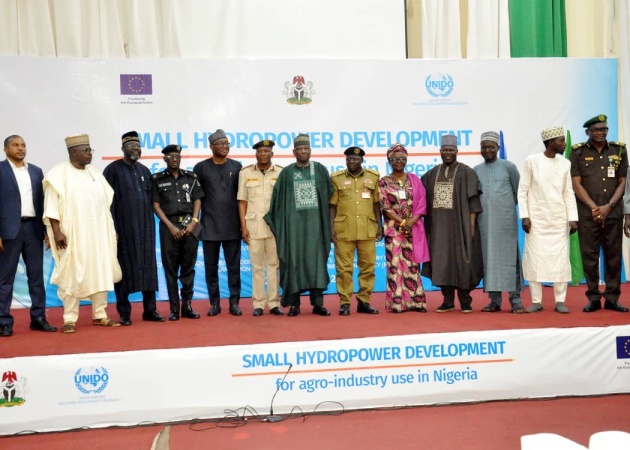
The initiative received a boost in Gombe State on Monday as the state government reaffirmed its commitment to the speedy completion of the Balanga Small Hydropower Project, now reportedly 60 per cent complete.
The Deputy Governor, Dr Manassah Daniel Jatau, who represented Governor Muhammadu Inuwa Yahaya at a capacity-building workshop on Small Hydropower Development, said the project remained strategic to the state’s development, energy access and water security.
The workshop was organised by the United Nations Industrial Development Organisation (UNIDO) and European Union (EU), in collaboration with the Gombe State Government.
Jatau said the project, initiated in 2024, would support agro-processing clusters expected to serve as major off-takers of the electricity generated.
He said the Balanga Dam, commissioned about 38 years ago, had not fully achieved its potential, with only 2,200 hectares of its 11,000 hectares of available farmland currently being utilised.
“Beyond generating clean electricity, it supports irrigation, fisheries, tourism, water supply, flood control, and other forms of livelihoods for our people,” he said.
Jatau said Nigeria had more than 300 potential small hydropower sites, but less than five per cent had been developed, stressing that the workshop would help build the capacity needed to replicate the Balanga model nationwide.
“By building the capacity of engineers, project developers, policymakers and communities using the Balanga Dam as a model, we are creating a template that can be replicated across Nigeria,” he said.
He assured stakeholders that the state would integrate small hydropower into its rural electrification and irrigation master plans while promoting community ownership.
UNIDO Representative and Sub-regional Director, Ambassador Philbert Johnson, said Nigeria had an estimated 24,000MW hydropower potential, with small hydropower accounting for about 15 per cent.
He said electricity access remained below 60 per cent, underscoring the need to develop alternative renewable energy sources.
Johnson said the workshop was designed to raise awareness among policymakers, developers and financial institutions on the viability of small hydropower for electricity generation and economic development.
The Acting Permanent Secretary, Federal Ministry of Water Resources and Sanitation, Engineer Ibrahim Ali, said Nigeria’s dams and water resources offered significant opportunities for expanding renewable energy through small and mini hydropower projects.
He urged stakeholders to explore investment opportunities and strengthen public-private partnerships to accelerate development in the sector. (The Sun)