ADAD
ADAD
Updating your news feed...
NEWS EXPRESS is Nigeria’s leading online newspaper. Published by Africa’s international award-winning journalist, Mr. Isaac Umunna, NEWS EXPRESS is Nigeria’s first truly professional online daily newspaper. It is published from Lagos, Nigeria’s economic and media hub, and has a provision for occasional special print editions. Thanks to our vast network of sources and dedicated team of professional journalists and contributors spread across Nigeria and overseas, NEWS EXPRESS has become synonymous with newsbreaks and exclusive stories from around the world.























HIV testing
Nigeria recorded about 45,000 new HIV infections in 2025, with the National Agency for the Control of AIDS (NACA) attributing the trend, in part, to inadequate prevention information among young people.
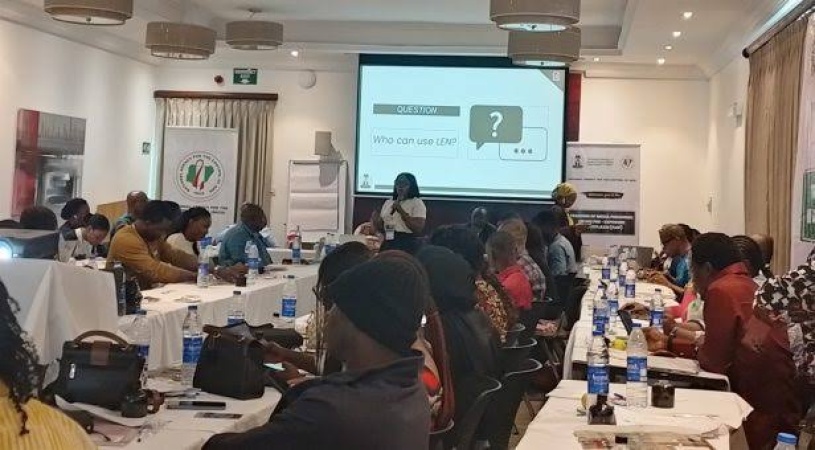
The NACA Director-General, Dr Temitope Ilori, disclosed this on Thursday in Lagos at a two-day workshop for media executives on HIV pre-exposure prophylaxis (PrEP), organised by NACA in collaboration with the World Health Organisation (WHO).
The workshop was designed to strengthen media professionals’ capacity to accurately report and communicate information on HIV prevention and PrEP, with the aim of increasing public awareness, reducing stigma and misinformation, and promoting informed uptake of prevention services.
Ilori said that although new infections had been declining, recent figures indicated the need to intensify prevention efforts, particularly among young Nigerians.
“Last year we had about 45,000 new infections because it’s reported across the federation. I’m happy to say that it was declining, but recently we’re beginning to see some new figures popping up, and it’s because, particularly among our young people, they do not have the right information about HIV,” she said.
She said NACA was engaging journalists, social media influencers and other media practitioners to improve the HIV information available to the public.
“We’re still gathering information regarding this year, and therefore AIDS is real, HIV is real, people come down with HIV, but the good news is that it’s not a death sentence,” Ilori said.
She stressed that HIV has no cure but can be effectively treated and prevented through several options, including PrEP, condoms, abstinence and mutual faithfulness.
“We don’t want to emphasise the medicalisation of PrEP,” she said, explaining that oral PrEP is taken daily, while cabotegravir long-acting (CAB-LA) is administered every two months and long-acting injectable lenacapavir (LEN-PrEP) every six months.
Ilori said PrEP was intended for HIV-negative people at higher risk of infection and was not a universal medication.
“We are not saying every Nigerian should use PrEP, but we’re saying those who are most at risk, most vulnerable to contracting HIV, will have this option of using PrEP and staying safe,” she said.
She said LEN-PrEP remained in pilot implementation in selected states and was not yet commercially available.
“It is not available on the market because, as we said, it’s still a pilot study. We are working together with partners, donor partners, international partners, to bring in these injections into the country,” she added.
According to her, the injectable PrEP provided under the pilot programme was free, while NACA was working with partners to expand access.
On safety, Ilori said no major side effects had been recorded among participants, although they were being closely monitored.
“As of today, we do not have any major side effects. Of course, like every medication, there might be some discomfort, but that’s why we said it’s a clinical trial,” she said.
The NACA chief urged Nigerians to know their HIV status and encouraged people living with HIV to remain on treatment, noting that effective antiretroviral therapy could suppress the virus to undetectable levels and prevent sexual transmission.
She also urged the media to counter misinformation about HIV transmission and challenge stigma against people living with the virus.
“There is a lot of misinformation; there are a lot of myths saying that you can contract HIV from hugging people, from shaking hands, from sharing the same offices with them. It’s negative; it’s no, no, no. Mosquitoes cannot transmit HIV,” she said.
Ilori identified sexual contact, exposure to infected blood and mother-to-child transmission, where appropriate treatment is not received, as established routes of infection.
“Stop stigma, avoid discrimination, let’s treat people with HIV as human beings because anybody could be affected,” she said.
She also expressed concern over declining condom use, particularly among young people, urging sexually active Nigerians to use condoms as part of combination HIV prevention.
“Recent studies have shown us that the use of condoms is declining. People are no longer using condoms the way they should, particularly young people,” she said.
“For young people, particularly those who are sexually active, we say, please play safe, wear condoms,” she added, while advocating abstinence among younger people.
Ilori said Nigeria remained on course towards epidemic control but would need sustained efforts in testing, prevention, treatment adherence and accurate public information.
“Regarding epidemic control, we are on target, but to stay on target we need everybody on deck. We need everybody to work together,” she said.
Also speaking, WHO Technical Officer for HIV, Viral Hepatitis and STI, Dr Oluwafunke Odunlade, said PrEP uses antiretroviral drugs to prevent HIV from establishing infection when taken correctly by an HIV-negative person.
She stressed that people must test for HIV before starting PrEP because those already living with the virus require treatment rather than PrEP.
Odunlade said available options included daily oral PrEP, CAB-LA every two months and LEN-PrEP every six months, stressing that adherence to the prescribed schedule was essential.
She said healthcare providers should determine the most suitable option based on individual circumstances, including other health conditions.
Odunlade urged journalists and social media influencers to help correct misinformation, reduce stigma and provide evidence-based information that would improve public understanding and uptake of HIV prevention services. (The Nation)