ADAD
ADAD
Updating your news feed...
NEWS EXPRESS is Nigeria’s leading online newspaper. Published by Africa’s international award-winning journalist, Mr. Isaac Umunna, NEWS EXPRESS is Nigeria’s first truly professional online daily newspaper. It is published from Lagos, Nigeria’s economic and media hub, and has a provision for occasional special print editions. Thanks to our vast network of sources and dedicated team of professional journalists and contributors spread across Nigeria and overseas, NEWS EXPRESS has become synonymous with newsbreaks and exclusive stories from around the world.











Loading banners
Loading banners...

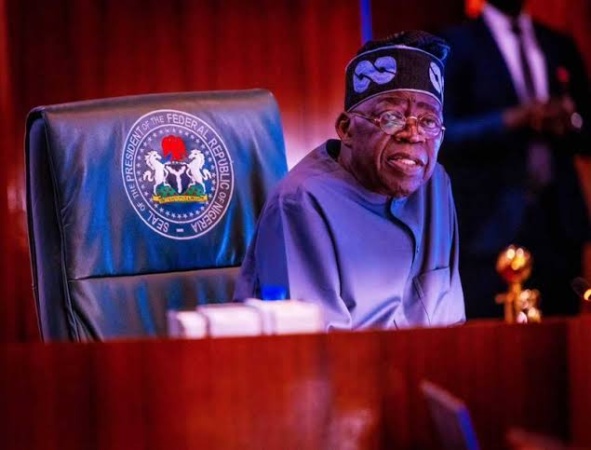
President Tinubu
President Bola Ahmed Tinubu has challenged religious and spiritual leaders across Africa and beyond to speak forcefully and consistently against terrorism, kidnapping, banditry and the manipulation of religion to justify violence.
The President said no genuine service to God could be advanced through the killing of innocent people, urging religious institutions to deploy their considerable influence and networks to promote peace, justice, tolerance and responsible citizenship.
Tinubu made the call on Sunday in Kano, in a goodwill message delivered on his behalf by the Secretary to the Government of the Federation (SGF), Senator George Akume, at the Grand Maulud of Sheikh Ahmad Al-Tijani.
Addressing the World Khalifa of the Tijjaniyya Order, scholars, spiritual leaders and adherents from Nigeria and other countries, the President said faith leaders had a critical responsibility to confront extremism, violence and the exploitation of religion for destructive purposes.
In a statement issued by Special Adviser to the Secretary to the Government of the Federation on Media and Publicity, Yomi Odunuga, Tinubu urged religious institutions to strengthen advocacy for peace education, religious literacy and scholarship, while paying greater attention to the moral formation of young people.
“Your voices must be raised consistently against the murder of innocent people, against terrorism, kidnapping, banditry and the misuse of religion to justify cruelty. Your institutions and networks must become stronger in the advocacy for peace education, religious literacy, scholarship and the formation of upright young men and women.
“You must also remind political leaders of justice, responsibility and compassion, while reminding citizens that legitimate grievances must never become permission for lawlessness or violence. Above all, our spiritual fathers must continue to teach that no genuine service to Allah is advanced by destroying the innocent human life that Allah has made sacred”, Tinubu said.
The President noted that the gathering was taking place at a consequential period in human history, when societies across the world were grappling with conflicts, uncertainty, climate shocks, food and energy crises, violent extremism, terrorism, transnational crimes and increasingly dangerous manipulation of identity and religion.
Citing a report by the United Nations High Commissioner for Refugees, Tinubu said 117.8 million people were forcibly displaced worldwide at the end of 2025, arguing that the magnitude of contemporary global challenges had made the intervention of spiritual leaders increasingly indispensable.
According to him, spiritual leaders “guard the frontiers of conscience” and possess the capacity to heal wounds, resolve grievances and dissolve deep-seated hatred and bitterness within societies.
He said the Tijjaniyya community, with extensive spiritual networks across West Africa, North Africa and beyond, possesses relationships and moral capital that could be deployed towards reconciliation, countering violent extremism, guiding young people and strengthening humanitarian solidarity across the Sahel, West Africa and the wider world.
Tinubu said the Federal Government recognises the critical roles of religious and traditional leaders in deepening tolerance, countering misinformation and identity-based divisions, strengthening grassroots peacebuilding and promoting peaceful coexistence.
The President also reaffirmed Nigeria’s commitment to regional cooperation, counter-terrorism, maritime security, economic integration and dialogue, noting that Nigeria’s strategic location at the intersection of West Africa, the Sahel, the Lake Chad Basin, the Gulf of Guinea and the wider Atlantic world meant that its stability had implications beyond its borders.
“Our position means that peace in Nigeria has consequences far beyond Nigeria. It also means that religious communities with deep transnational connections, such as the Tijjaniyya, can be valuable partners in building an architecture of social peace that complements the work of governments and regional institutions,” he said.
Tinubu explained that such partnership should harness the ethical resources of religion, including truthfulness, compassion, justice, restraint, service and respect for the sanctity of human life, for the common good.
Describing Nigeria’s diversity and plurality as among its greatest strengths, the President assured that the Federal Government would continue to protect Nigerians’ freedom to practise their faith while deepening collaboration with religious and traditional institutions to promote peace, mutual respect and national cohesion.
He welcomed the World Khalifa of the Tijjaniyya Order and scholars, spiritual leaders and other guests who travelled from Algeria, Morocco, Senegal, Egypt and other countries for the Maulud.
Tinubu described Nigeria as a country where the Tijjaniyya tradition had established deep roots in scholarship, remembrance, service, moral instruction and peaceful community life.
He recalled recently receiving a high-level delegation of the Supreme Council of Tijjaniyya at the State House in Abuja, where prayers were offered for Nigeria’s peace, unity and prosperity, as well as for the enduring relationship between Nigeria and Algeria.
According to the President, the Maulud provided adherents with an opportunity for reflection, renewal and recommitment to the teachings of Islam, the love of Prophet Muhammad and the spiritual legacy of Sheikh Ahmad Al-Tijani, particularly the virtues of humility, mercy, wisdom, service and giving comfort to others.
Tinubu also paid tribute to the late Sheikh Dahiru Usman Bauchi, whose foundation played a significant role in organising the Maulud, describing him as one of the towering figures whose absence was deeply felt at the gathering.
He recalled describing the late Islamic scholar, following his death in November 2025, as “a teacher, a father and a voice of moderation and reason, and as an advocate of peace and piety.”
The President said the most enduring monument that could be built in honour of Sheikh Dahiru Bauchi would be the preservation of his legacy of Qur’anic scholarship, moral instruction, devotion to Allah, respect for learning, peaceful coexistence and concern for the wellbeing of society.
Tinubu expressed appreciation to the Supreme Council of the Tijjaniyya, the Sheikh Dahiru Usman Bauchi Foundation, the Kano State Government and people, scholars, traditional rulers, security and emergency services, organisers and volunteers for their roles in successfully hosting the event.
“Nigeria is honoured by your presence, and we pray that you return to your homes safely, carrying with you the affection and hospitality of the Nigerian people. May Almighty Allah accept the prayers and acts of devotion offered at this Maulud,” the President said. (The Nation)