ADAD
ADAD
Updating your news feed...
NEWS EXPRESS is Nigeria’s leading online newspaper. Published by Africa’s international award-winning journalist, Mr. Isaac Umunna, NEWS EXPRESS is Nigeria’s first truly professional online daily newspaper. It is published from Lagos, Nigeria’s economic and media hub, and has a provision for occasional special print editions. Thanks to our vast network of sources and dedicated team of professional journalists and contributors spread across Nigeria and overseas, NEWS EXPRESS has become synonymous with newsbreaks and exclusive stories from around the world.







.webp)






Loading banners
Loading banners...

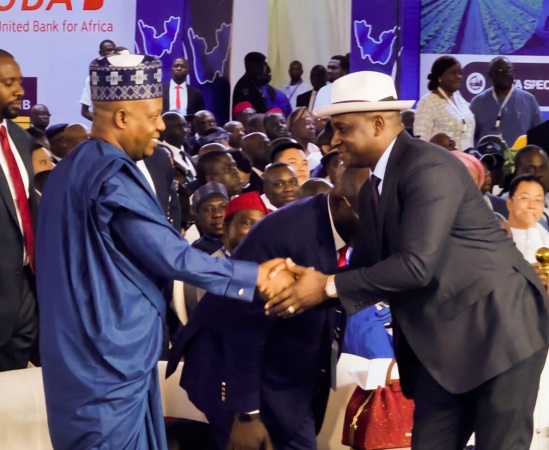
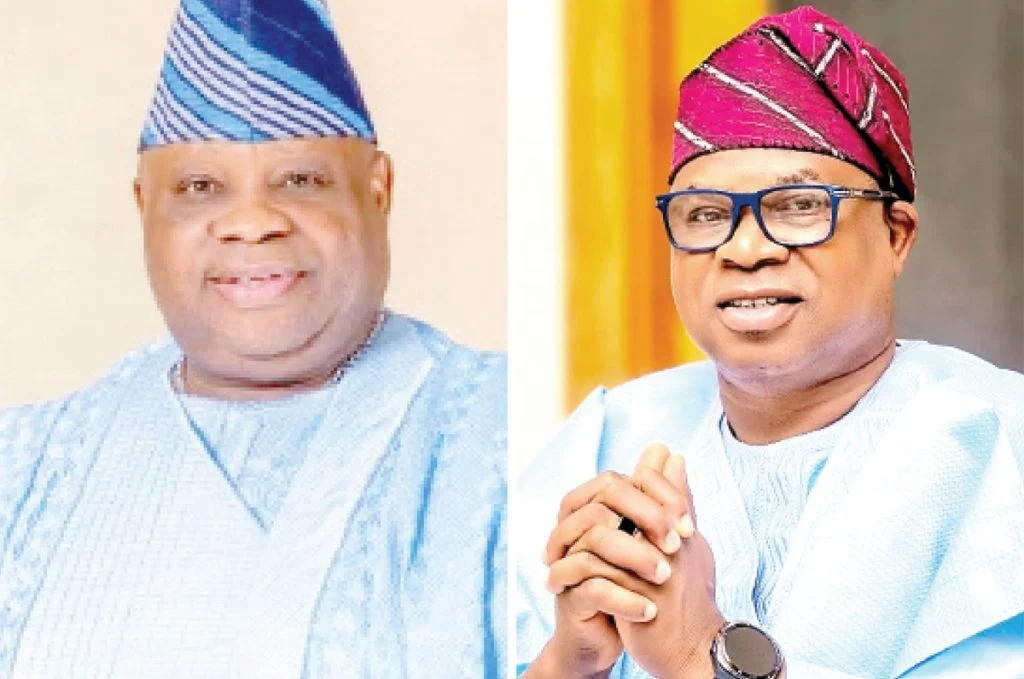
Governor, Ademola Adeleke and Bola Oyebamiji
Adeolu Adeyemo, in this piece, examines the scenarios building up around the off-season governorship election in Osun State, which will hold on August 15, 2026, and submits that the much-talked-about election would shape the political future of the state in no small ways
WHEN history eventually records the story of Osun State’s 2026 governorship election, it may describe it as more than another democratic exercise. This is because the race is already shaping up as a defining political battle that could redraw alliances, test the popularity of the incumbent Governor, Ademola Adeleke, who is flying the flag of Accord political party, the challenge the resilience of the opposition against him, led by All Progressives Congress (APC) candidate, Munir Bola Oyebamiji, and perhaps, redefine the future direction of one of Nigeria’s most politically sophisticated states.
Across the 30 local governments of Osun State, politics has become the dominant topic of discussion in the last few months. At motor parks, markets, universities, civil service offices, palaces and village squares, conversations revolve around a single question: Who will occupy Government House, Osogbo, after August 15?
The answer lies with more than two million registered voters, but the journey to that verdict has been marked by shifting political alliances, dramatic defections, heated campaigns, growing security concerns and an electorate determined to make its voice heard.
Although several political parties are fielding candidates, events of the past few months have gradually narrowed the race into a contest between Governor Ademola Adeleke of the Accord political party, also called Imole, and APC’s Asiwaju Munirudeen Bola Oyebamiji, also known as AMBO.
This does not diminish the constitutional right or political relevance of the other contestants. Rather, it reflects the reality of political mobilisation across Osun today. Campaign visibility, organisational structures, financial capacity, media attention and grassroots mobilisation have largely centred on the two dominant camps.
Yet, elections are rarely won by appearances alone. Political history is replete with examples of underdogs upsetting established calculations when voter behaviour changed unexpectedly.
Osun is unlike many states where voting patterns remain permanently tied to one political party. The electorate has repeatedly demonstrated an independent political culture over time, often rewarding performance while punishing perceived underperformance.
Political loyalty exists, but it is rarely unconditional. From the Alliance for Democracy (AD) era, through the Action Congress (AC), Action Congress of Nigeria (ACN), APC, the Peoples Democratic Party(PDP), and now Adeleke’s Accord, Osun voters have shown their willingness to embrace change whenever they believe circumstances demand it.
This makes predicting electoral outcomes particularly difficult. Unlike states where incumbency almost automatically guarantees victory, Osun voters have cultivated a reputation for closely scrutinising those seeking their mandate.
Governor Ademola Adeleke approaches the election from a position of considerable strength, and his greatest campaign message is simple: continuity.
His administration argues that the past four years have produced measurable improvements in infrastructure, education, healthcare, workers’ welfare, pension administration and rural development.
Supporters frequently point to completed and ongoing road projects, rehabilitation of schools, improved salary payments, pension settlements and social intervention programmes as evidence that the administration deserves another term.
Equally significant is the governor’s relationship with ordinary citizens. Unlike many politicians who become increasingly inaccessible after assuming office, Adeleke has largely retained an image of simplicity and public accessibility. Observers believe that the personal connection has become one of his strongest political assets.
To many, another advantage for Adeleke’s cause lies in incumbency itself.
It is observed that incumbents usually possess greater visibility than challengers because government activities constantly place them before the public through official engagements, project commissioning and policy announcements. However, some others would observe that incumbency also creates higher expectations. Every unresolved community need, abandoned project, or public complaint becomes campaign material for the opposition.
Consequently, the governor’s greatest strength may also become one of his greatest electoral tests.
For the APC, the election represents an opportunity to return to Government House after its defeat in 2022.
Its candidate, Asiwaju Munirudeen Bola Oyebamiji, has built his campaign around economic renewal, agricultural expansion, industrial development, investment attraction and employment generation.
The APC believes that public demand for faster economic growth provides an opportunity to convince voters that fresh leadership would better position Osun for future development. Perhaps the party’s greatest organisational advantage lies in its long-established grassroots network.
Years of political organisation by the party, including its leadership of the state under Rauf Aregbesola and Gboyega Oyetola, have produced experienced ward leaders, local government coordinators and campaign structures capable of reaching virtually every community. The fact that the structure did not go into the usual post-election dilemma disorientation after the 2022 defeat may also serve as an advantage to its organisational capabilities going into the 2026 polls.
If effectively coordinated, this machinery could become decisive during voter mobilisation. Nevertheless, rebuilding public confidence after electoral defeat remains a demanding assignment. The task before the APC, however, remains how to convince voters not only that it deserves another opportunity but also that it has learnt valuable lessons from previous political experiences.
Close observers of the emerging Osun scenario would ask the question: do defections win elections? This is because one striking feature of the current campaign has been the steady stream of defections.
Almost every week, political parties announce the arrival of new members from rival organisations. Yet history suggests that defections do not always produce proportional electoral gains. It is obvious that political parties engage in such defections as a psychological boost over their rivals, but analysts would say the strength of the defectors remains in the votes they can mobilise.
It is believed that while many politicians are loud enough to command influence, not all such persons are trusted vote banks that can guarantee the candidate a sure victory. While many politicians command influence within party structures, they eventually turn out to possess limited electoral value outside their immediate communities. Ultimately, elections are decided not by the number of press conferences announcing defections but by the number of genuine voters persuaded to support a candidate.
The true electoral impact of recent political realignments will only become clear when votes are counted.
Every election has battlegrounds, and Osun is no exception. Political observers expect fierce competition in Osogbo, Ife, Ilesa, Iwo, Ikirun, Ejigbo, Ila, Ede, Ikire and several other strategically important areas.
Ede remains Governor Adeleke’s political base, where strong support is expected. The APC will equally seek commanding performances in areas traditionally favourable to the party while attempting to reduce the governor’s margins in his strongest locations.
Victory may ultimately depend less on winning individual local governments than on the size of victory recorded in each. Large margins in political strongholds can offset narrow defeats elsewhere.
Young voters could become one of the election’s most decisive constituencies. Their concerns extend beyond party slogans.
Employment opportunities, entrepreneurship, digital economy, education, infrastructure and security dominate their priorities.
Whichever candidate successfully convinces this demographic that his administration offers realistic solutions may enjoy a significant electoral advantage.
Women remain another influential voting bloc. Across Osun’s markets, farming communities and civil service, women continue to play significant roles in shaping political opinion.
Similarly, rural communities often determine election outcomes because of their numerical strength. Campaign promises relating to roads, healthcare, agriculture, water supply and education therefore carry particular significance in these areas.
Perhaps no issue has generated greater concern than election-related violence. Several incidents reported during the campaign have heightened anxiety among citizens.
Civil society organisations, religious leaders and traditional rulers have consistently appealed to political actors to avoid inflammatory rhetoric capable of provoking confrontation. The E.U backed Civil society bodies released a statement identifying 13 local governments as potential crisis zones, while the police have also identified over 200 dark spots. The Accord has been loudly making claims that more than 86 of its chieftains have been arrested without trial. The APC also came out recently to claim that it lost 25 persons in the 2022 election process and will not relent in prosecuting the culprits. So, it has been claims and counterclaims from the major parties.
Their professionalism, neutrality and prompt response to security threats may significantly influence public confidence in the electoral process. Peaceful elections benefit every political party because violence rarely produces legitimate democratic victories.
INEC has a duty to deliver in this election. Being the last off-season election before the 2027 general election, it would provide another insight into Prof Joash Amupitan’s readiness for the 2027 polls. The Independent National Electoral Commission (INEC) also confronts enormous expectations. For instance, efficient logistics, timely arrival of election materials, functionality of technology, transparent collation procedures and adherence to electoral guidelines will determine public confidence in the process. A credible election strengthens democracy irrespective of who eventually wins. It is expected that officials at the polls will not be linked with any untoward issues that would affect voter confidence or reduce the credibility of the all-important poll.
Several factors are likely to shape the outcome. The first is the voter turnout. Enthusiastic campaign crowds do not automatically translate into votes. Another is the issue of grassroots mobilisation. Elections are won polling unit by polling unit.
Third is the performance of each candidate in traditional political strongholds.
The fourth issue is the influence of undecided voters, many of whom often make their decisions only days before the election.
Finally, the credibility of the electoral process itself will determine whether the outcome enjoys broad public acceptance.
Based on current political realities, Governor Ademola Adeleke appears to benefit from incumbency, visible governmental presence and an established grassroots support base.
The APC, however, remains a formidable challenger with extensive political structures, experienced campaign organisation and determination to regain power. Neither side enters the election as an overwhelming favourite. The APC wants to win the election to showcase its prowess in the South West, while Adeleke believes his service delivery so far should earn him re-election. The verdict surely remains with the people.
Neither party can be dismissed.
The key contenders appear evenly matched. While the APC has its strongholds, the Accord equally possesses its. The APC claimed that most of the assured vote banks in the PDP who ensured Adeleke’s victory in 2022 have defected to its fold, while Adeleke’s Accord is equally insisting that some aggrieved chieftains of the APC are working for the party’s victory. The two candidates, Adeleke and Oyebamiji, are also from Osun West senatorial district, which means that the battlegrounds remain in Osun East and Central. How the candidates go about marketing their wares ahead of the August 15 date will showcase the impact and results that would be displayed by the electoral commission thereafter. The eventual winner will likely be the candidate who best combines effective mobilisation, voter confidence, polling-unit organisation and election-day turnout.
Political analysts will continue to publish projections. Opinion polls will circulate. Party leaders will express confidence. Supporters will predict victory. Yet none of these determines election results. Only the ballot does.
Until that moment arrives, every analysis remains exactly what it should be: an informed assessment based on available evidence, not a declaration of the future.
Whatever the outcome, one reality is already certain. The 2026 Osun governorship election has become one of the most consequential political contests in the state’s democratic journey, and its outcome will shape Osun’s political, economic and social direction for years to come. (Nigerian Tribune)