Updating your news feed...
NEWS EXPRESS is Nigeria’s leading online newspaper. Published by Africa’s international award-winning journalist, Mr. Isaac Umunna, NEWS EXPRESS is Nigeria’s first truly professional online daily newspaper. It is published from Lagos, Nigeria’s economic and media hub, and has a provision for occasional special print editions. Thanks to our vast network of sources and dedicated team of professional journalists and contributors spread across Nigeria and overseas, NEWS EXPRESS has become synonymous with newsbreaks and exclusive stories from around the world.

Nkechi Triumph
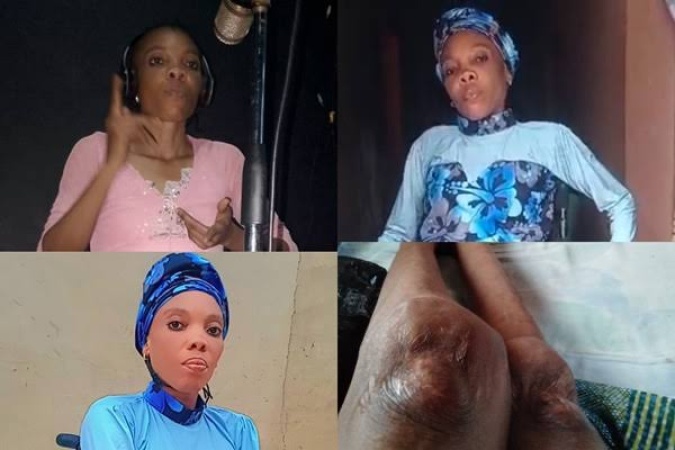
What began as a routine Sunday evening in January 2000 became the turning point in Nkechi Triumph’s life. Twenty-six years later, the Enugu State-born woman is opening up about the mysterious illness that struck her at the age of 20, the frightening experiences that followed and the resilience that has sustained her through decades of hardship.
In the warmth of her Ibadan home, Nkechi Triumph, née Okafor Nkechi Agnes, recounts a story of adversity, faith and resilience.
The 45-year-old, who hails from Enugu State but was raised in Ekiti State, told The Nation that she was a promising young athlete and a recent secondary school graduate when a sudden illness in January 2000 altered the course of her life. Newspapers
Speaking with YEWANDE FASAN, Nkechi said the ordeal began on Sunday, January 9, 2000, shortly after she returned from church with her family.
She recalled that while preparing her mother’s belongings for a business trip to Onitsha the following day, she suddenly felt what she described as a sharp sensation, like a gust of wind or an invisible object, enter her body.
“On January 9, 2000, it was a Sunday. We came back from church, and in the evening I started arranging my mum’s things because she was travelling to Onitsha the next day. Around 7 p.m., something like a breeze entered my body like a sharp object. Not long after, I started shivering,” she said.
Nkechi said her family gave her medication and she went to bed, but her condition deteriorated the following day after her mother travelled.
According to her, by Tuesday, her tongue had turned black, prompting relatives to administer herbal medicine.
“They bought medicine for me, and I slept. The following day, which was Monday, my mum travelled to Onitsha to buy goods, but I wasn’t feeling well at all. I was weak and couldn’t do anything until Tuesday.
“I was given herbal medicine because they discovered my tongue was a bit black. Yoruba people call it ‘Ahon dudu’. Instead of vomiting, I fainted and was rushed to the hospital before I regained consciousness.
“The doctor said it was typhoid, but not a serious case. I was discharged on Wednesday,” she said.
However, Nkechi said her condition worsened after she returned home.
She recalled that her neck suddenly became stiff and painful, leaving her unable to move until her younger brother carried her to the residence of an older sibling, where she experienced temporary relief.
She said her mother immediately cut short her trip and returned home after learning of her worsening condition.
Nkechi further recounted an experience she described as deeply frightening, saying she saw a woman appear in her room who allegedly declared that she would not survive the illness.
According to her, the figure disappeared the moment her mother entered the room.
“On getting home and entering our building, my neck was locked in my body. I could not move it from left to right. By 10 pm, my condition had worsened. All I could do was cry, and my younger brother accompanied me to our brother’s house nearby because the pain was unbearable. On getting there, surprisingly, I was fine. My mum was returning that day, but she had been told I was terribly sick. So, together with the driver and some people in the vehicle, they followed her to where I was. But something terrifying happened. Immediately, my brother went out to open the main gate for them. In the middle of the room, a woman appeared, as it always happens in movies, and I wasn’t dreaming. She told me, I quote, ‘NKECHI, YOU WON’T SURVIVE IT.’ I wanted to respond, but my mum came in, and she vanished,” she added.
Taken to a nearby church on Thursday, January 13, Nkechi said she could barely move her right leg without support. The following day, she collapsed while trying to ease herself, and her stomach swelled dramatically, like that of a nine-month pregnant woman.”
“I was taken to a nearby church on Thursday, the 13th, 2000. I could not move my right leg anymore, but I was supported with a stick. On Friday, the 14th, I was about to ease myself outside, but I fell down and could not stand up again. My stomach swelled up like a 9-month pregnancy”.
Speaking further, Nkechi said that by Sunday, January 16, while breathing with great difficulty, she was admitted to what is now the Specialist Hospital in Ikole Ekiti through the intervention of a compassionate Rev Father.
After one week, her condition deteriorated further, and on Sunday, January 23, she slipped into a deep coma that lasted two full weeks, during which she had vivid spiritual encounters. She saw three figures dressed in black enter her ward, with the same woman among them pointing to a grave on the right, where her own legs were already inside, as the men prepared to bury her, prompting her to shout Jesus, causing them to disappear instantly.
“On Sunday, the 16th, I was taken to the General Hospital in Ikole Ekiti, but now the Specialist Hospital, because I could not breathe much again. But as God may have it, I was attended to because of my Rev Father, and after one week of staying in the hospital, something terrible happened, for me to be in a coma for two (2) weeks. That Sunday, on the 23rd, I saw (3) people entering my ward room wearing black. I started calling the nurses, but by the time those people got to me, I could not see anyone except them. The woman I had seen earlier was among them, and she told me to look to my right. Then I saw a grave, and in a commanding tone, the other two (2) men with her were about to throw me inside the grave. My two (2) legs were in the grave, leaving the one carrying my head, and I shouted JESUS, and they vanished.”
In another profound moment, she described floating above her body, hearing her mother’s desperate cry in their dialect, ‘Nkechi, are you going to leave me?’ before something like lightning struck her chest, bringing her back.
She awoke two weeks later to the joyful celebration of doctors and nurses who had kept treating her, because her body remained warm throughout the midnight crisis.
“All this while, the doctors and nurses were with me. I told them what happened, but not long after, as I was told when I woke that I had given up the ghost, on my own side I saw myself lying on the bed and moving out, but my legs could not touch the ground. I heard my mum calling me in our dialect, saying NKECHI ARE GOING TO LEAVE ME “Nkechi I ga rapu m). On getting to the seven hill, as if I was flying, something like lightning struck my chest. That’s all I know until after two weeks, when I woke up. I asked my mum where I was, and everyone in the ward started shouting that she had woken up. One of the doctors told me I had been in a coma for two weeks.”
Three months after regaining consciousness, complete paralysis set in. She said she was transferred to three different hospitals, but a doctor concluded it was likely a spiritual attack.
That marked the point at which Nkechi lost the use of both legs, leaving her confined to a wheelchair to this day.
“After he went through my medical report, he told my mum it wasn’t ordinary; it was a spiritual attack. I should be taken home for spiritual solutions. That is how I lost my two legs, confined to a wheelchair till date,” she continued.
The following years brought even more heartache, including the death of her father in March 2002 while she was hospitalised and her inability to view his corpse. Returning to Ekiti in September 2003, she faced painful abandonment from family, friends, and even her mother, though church members stepped in with food and support, often responding to letters she wrote herself.
In December 2002, her knees swelled, burst, and became infested with maggots, prompting doctors to recommend amputation, which could not be carried out due to lack of funds. A turning point came in January 2003 during Reinhard Bonnke’s crusade in Ado Ekiti, when the stinking water and maggots flowed out in large numbers, allowing the wounds to begin healing, though scars remain visible today.
Financial struggles and emotional isolation persisted, with her mother offering limited care under the influence of relatives who labelled her an ‘ogbanje’. When her mother later fell seriously ill, Nkechi said she cared for her devotedly until her passing on August 23, 2023.
Overwhelmed by despair, she made multiple suicide attempts, including one in September 2007 when she mixed various medications, but a timely divine intervention through a song heard in her isolation stopped her, while a church brother’s visit and a Bishop’s counsel ignited fresh purpose, asking pointedly if she knew what God wanted to do next.
“Many times I have tried to end everything by committing suicide, and I made many attempts. That was when my immediate younger brother decided to take care of me.
“I decided to poison myself to give way for them. I packed some of the medicine, hydrogen water, sterile salt water, and everything around me, including the batteries I had used for my radio, and mixed everything together. When I used a sharp object last, they took it away from me. But suddenly I started crying. I didn’t know for how many hours. No one was at home except me. My younger brother had gone to the farm to fetch what I would eat. Then I started hearing someone singing a Yoruba song,” she said.
This encounter sparked her musical calling. Nkechi began translating and composing inspiring songs, releasing her first Catholic highlife album in 2008 at a studio in Onitsha.
“I turned my experience into music when I see people passing through what I have overcome, either physically, spiritually, financially, emotionally and mentally.”
According to her, pastors and choristers eagerly sought her compositions, and she produced more Yoruba songs drawn from Scripture and her own experiences.
Nkechi added that many listeners have shared powerful testimonies, including a barren woman who conceived, marriages that were restored, and faith among the discouraged strengthened.
Her central message is to trust completely in God and depend on Him fully.
She added that songs such as ‘Ore kan wa’, ‘Agbara Oluwa F ohun’, and ‘Blowing Wind’ continue to encourage those facing trials.
Speaking on ‘disability is not inability,’ she asserts firmly, urging people with disabilities to discover their God-given skills, reject laziness, and rise above societal stigma, where the physically challenged are too often viewed as worthless or approached only for potential benefit.
“Yes, disability is not inability. For example, you can’t say that because you are disabled, you will turn yourself into a lifelong miserable person, like turning yourself into a lazy person who doesn’t want to work or just wants to be begging. In Nigeria, it doesn’t work. No one is useless, but we refuse to discover that we can do something meaningful and useful, like business or skills. If you see someone who is willing to help.”
In Nigeria, they see us as worthless people. They look down on us and don’t help us like they do able-bodied people. They always tell me, “What can we benefit from you, and what are you going to give us in return?” she added.
Nkechi added that challenges remain significant, including the search for sponsors to produce music videos and enable streaming, the high cost of accessible transport, and recurring health and financial crises.
“My challenges are numerous, especially in financial aspects, going to the studio, and streaming our songs. They even compare me to other artists who have two legs, and I’m not a match for them, but they forget that people sponsor and finance them too. So saddened.
“Moving from one place to another is a major deal because of my wheelchair. They will overcharge me. It is easy if someone has their own car, but truthfully, it has not been easy.
An inferiority complex is a key word in our feelings. Crossing the road is a big problem. The cars will not even stop until a kind-hearted person stops them,” she continued.
Now living in Ibadan, Nkechi looks forward with hope to greater heights in the next five years, desiring her music to reach far beyond Nigeria and bring renewed strength to the faint-hearted.
“My vision in the next 5 years is greater heights in all areas of life. Though no one knows tomorrow, I pray and wish my music gets across not only in Nigeria but worldwide and to make a positive impact in my life and in the faint-hearted people across the globe,” she said.
She appeals for financial assistance to produce videos, explaining that while audio touches the ear, seeing her in the wheelchair, testifying to God’s enduring goodness, can powerfully renew hope for the hopeless.
“I need financial assistance. It is a major challenge. I want to do the videos of my songs, but I cannot afford it. Listening to the audio only, they may not be able to get out of their shell, understand the message very well, or find focus in life and assurance. But with the video, their hope will be restored, and those who think the end has come will find renewed hope seeing me in the wheelchair and testifying to the goodness of God, so reaching out to the hopeless. I need financial helpers to do the videos.”
From a vibrant young athlete to a wheelchair-bound gospel songwriter and composer, Nkechi Triumph’s journey stands as a deeply moving proof of pain, perseverance and redemptive faith, demonstrating that the fiercest storms, however violent, do not have the final say. (The Nation)