ADAD
ADAD
Updating your news feed...
NEWS EXPRESS is Nigeria’s leading online newspaper. Published by Africa’s international award-winning journalist, Mr. Isaac Umunna, NEWS EXPRESS is Nigeria’s first truly professional online daily newspaper. It is published from Lagos, Nigeria’s economic and media hub, and has a provision for occasional special print editions. Thanks to our vast network of sources and dedicated team of professional journalists and contributors spread across Nigeria and overseas, NEWS EXPRESS has become synonymous with newsbreaks and exclusive stories from around the world.

















Loading banners
Loading banners...

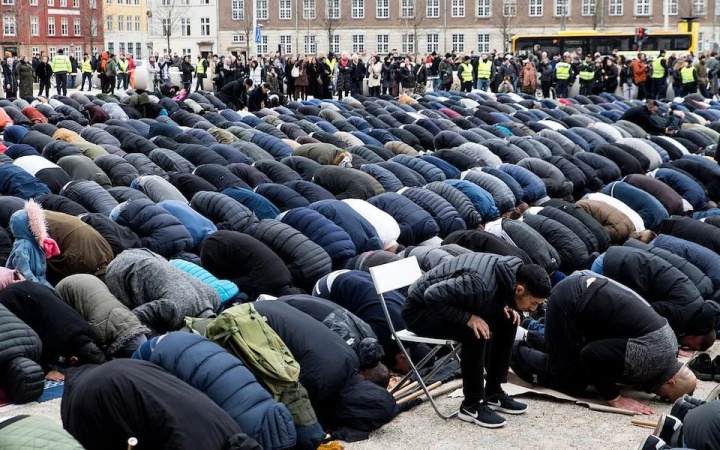
Denmark’s immigration minister, Morten Bødskov, has announced plans to prohibit the Islamic call to prayer, saying it should not be heard across the country and arguing that some areas were beginning to resemble “a suburb of Islamabad”.
Bødskov, who belongs to the centre-left Social Democrats party, said the government would reopen an investigation into whether a legal framework could be created to support such a ban.
“The call to prayer should not be heard over Danish rooftops,” the minister told news outlet Ritzau. “It has no place in Denmark, and you shouldn’t be in any doubt whether you’ve ended up in a suburb of Islamabad when you walk around Denmark.”
Several parts of Denmark, including Copenhagen, already restrict the broadcasting of the call to prayer through loudspeakers because of local noise regulations.
The minister also argued that what he described as a gradual “Islamisation” of the country was occupying too much public space.
Known as the Adhan, the Islamic call to prayer is recited five times daily to invite Muslims to worship at the mosque and is traditionally delivered through loudspeakers mounted on minarets.
The latest proposal marks the third effort by a Danish immigration minister to establish legal grounds for banning the call to prayer, following similar initiatives by the Social Democrats in 2020 and 2025.
Denmark has adopted some of Europe’s strictest immigration policies under Prime Minister Mette Frederiksen, who recently began her third term in office.
Under the country’s controversial “ghetto” legislation, authorities can require migrants to move out of neighbourhoods considered to have excessive concentrations of foreign residents.
The government has also introduced measures requiring some asylum seekers to surrender jewellery and other valuables to help pay for accommodation costs, while applicants whose asylum requests are denied are not entitled to financial assistance.
During the 2015 refugee crisis, when more than one million people arrived at Europe’s borders from the Middle East, Denmark accepted significantly fewer asylum seekers than many neighbouring countries.
Any move to outlaw the call to prayer is expected to face legal scrutiny, as officials assess whether such restrictions would conflict with constitutional protections for religious freedom and public worship.
Although Denmark’s constitution guarantees the right to worship publicly, existing laws allow restrictions in specific circumstances, including prohibitions on anti-democratic preaching and support for banned organisations.
Other European countries, including Germany and Britain, regulate mosque broadcasts through restrictions on timing and sound levels to minimise disturbance to nearby residents.
Denmark has a population of about six million people, including an estimated 270,000 Muslims.
The country is also home to roughly 100 mosques, among them the Grand Mosque of Copenhagen, which does not broadcast the call to prayer outdoors under an agreement with local authorities. (Tribune)