ADAD
ADAD
Updating your news feed...
NEWS EXPRESS is Nigeria’s leading online newspaper. Published by Africa’s international award-winning journalist, Mr. Isaac Umunna, NEWS EXPRESS is Nigeria’s first truly professional online daily newspaper. It is published from Lagos, Nigeria’s economic and media hub, and has a provision for occasional special print editions. Thanks to our vast network of sources and dedicated team of professional journalists and contributors spread across Nigeria and overseas, NEWS EXPRESS has become synonymous with newsbreaks and exclusive stories from around the world.


















Loading banners
Loading banners...

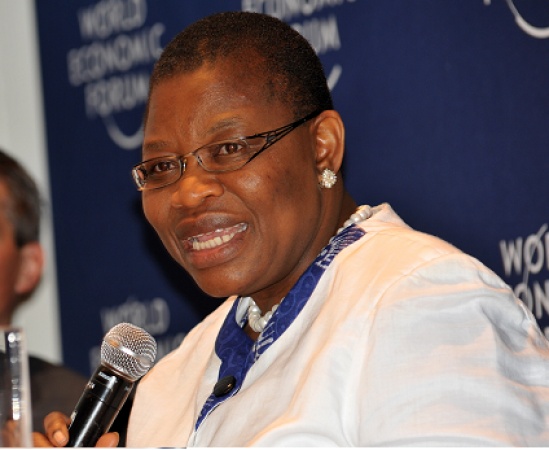
Former Education Minister Oby Ezekwesili
The founder of the School of Politics, Policy and Governance, Obiageli Ezekwesili, has recommended restructuring as the answer to Nigeria's security challenges instead of state police, which has assumed popularity among citizens.
In a Public Memorandum to President Bola Tinubu, the National Assembly, the governors and the Nigerian people, the former minister noted that the Tinubu administration's renewed push for state police reopened one of the most consequential public policy debates in Nigeria's democratic history.
She noted: "The proposal has gained momentum because it speaks directly to a painful reality confronting millions of Nigerians. The country's security architecture is failing. Terrorism, banditry, kidnapping, violent extremism, communal conflicts and organised criminality have overwhelmed the capacity of a centrally controlled police force to secure lives and property across a country of more than 230 million people. For many citizens, therefore, state police appear to be an obvious and long overdue solution."
According to her, the attraction of the proposal is understandable, adding, "Recent Afrobarometer findings show that 79 per cent of Nigerians consider kidnapping and abduction a serious national problem; 33 per cent personally know someone who has been kidnapped within the last five years; and 63 per cent say they or a family member felt unsafe in their home or neighbourhood during the previous year. These are not merely security statistics; they are indicators of a profound crisis of state effectiveness and citizen confidence."
While agreeing that state police are necessary, she argued that necessity does not mean sufficiency.
The danger confronting Nigeria today, she added, is that the country may once again mistake a symptom for the disease itself.
"The security crisis is real, but it is not fundamentally a policing crisis; it is the manifestation of a deeper constitutional, governance and political economy crisis that has steadily eroded state capacity, weakened accountability and undermined the effectiveness of public institutions.
"The central question before Nigeria should not be whether governors ought to control police forces; the more important question is whether the constitutional architecture governing the Nigerian federation remains fit for purpose. It is this broader question that must frame the state police debate. The evidence increasingly suggests that Nigeria's insecurity is inseparable from the country's dysfunctional federal arrangement," she said.
At the heart of the problem, she asserted, lies a constitutional order that concentrates excessive authority, fiscal resources and political power at the centre.
For her, although Nigeria describes itself as a federation, many of its institutional arrangements bear the characteristics of a highly centralised state.
"The Constitution allocates powers among the Exclusive Legislative List, the Concurrent Legislative List and residual powers reserved for the states. In principle, such arrangements are common in federations. In practice, however, Nigeria's distribution of powers is exceptionally skewed towards the Federal Government. The Exclusive Legislative List contains 68 items reserved solely for the Federal Government, while the Concurrent List contains only a limited number of shared subjects. Constitutional scholars have long observed that this structure gives the Federal Government overwhelming dominance over governance and development functions.
"This imbalance matters because the state police debate focuses on only one item among dozens. Police are merely one of 68 subjects constitutionally monopolised by the Federal Government," she noted.
Ezekwesili argues that Nigeria does not merely need a new policing architecture, but a comprehensive restructuring agenda anchored on a new constitutional settlement: one that rebalances the Exclusive, Concurrent and Residual lists; devolves powers to the lowest effective level of government; strengthens fiscal federalism; guarantees equal citizenship; promotes productivity and competitiveness; and restores sovereignty to the Nigerian people through a citizens-led Sovereign National Conference and a referendum on a new constitution. "That is the true restructuring agenda."
She urged the Federal Government and stakeholders to move immediately on the restructuring agenda through a brand new citizens-led constitutional process and "save our beleaguered country and people."