ADAD
ADAD
Updating your news feed...
NEWS EXPRESS is Nigeria’s leading online newspaper. Published by Africa’s international award-winning journalist, Mr. Isaac Umunna, NEWS EXPRESS is Nigeria’s first truly professional online daily newspaper. It is published from Lagos, Nigeria’s economic and media hub, and has a provision for occasional special print editions. Thanks to our vast network of sources and dedicated team of professional journalists and contributors spread across Nigeria and overseas, NEWS EXPRESS has become synonymous with newsbreaks and exclusive stories from around the world.



















Loading banners
Loading banners...

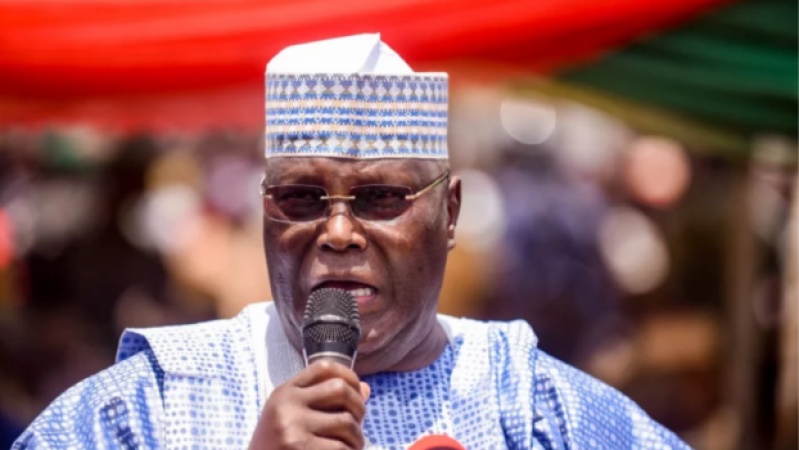
Former Vice President Atiku Abubakar
Former Vice President Atiku Abubakar on Thursday raised concerns over Nigeria’s counterterrorism strategy, questioning why terrorist groups appear to adapt faster than the government’s response to evolving security threats.
In a statement issued by his Senior Special Assistant on Public Communication, Phrank Shaibu, Atiku warned that the growing spread of terrorism, banditry, and kidnapping from the North to other parts of the country shows that Nigeria’s counterterrorism framework is failing to evolve in line with the threats it was designed to confront.
According to the former Vice President, Nigeria can no longer continue with a business-as-usual approach to insecurity, stressing that the country’s security architecture must be urgently recalibrated to reflect a threat landscape that is increasingly sophisticated, decentralised, and geographically widespread.
He said:
“The terrorists are learning from every attack. They study their successes and failures. They refine their tactics. They identify vulnerabilities. They adapt and strike again.
“The question Nigerians must ask is simple: Why isn’t the government doing the same?
“From Chibok to Oyo, from countless villages in the North-West to communities across the Middle Belt and beyond, the pattern has become tragically familiar. An attack occurs. The nation mourns. Promises are made. Committees are announced. Then another attack follows.
“A nation that refuses to learn from its tragedies is condemned to relive them.
“The disturbing expansion of banditry, terrorism, and kidnapping across different parts of the country clearly demonstrates that our current counterterrorism framework is no longer adequate for the scale and complexity of the challenge before us.”
Atiku, who is the presidential candidate of the African Democratic Congress (ADC), said Nigeria’s counterterrorism efforts have for too long relied on centrally designed and often imported frameworks that fail to reflect the lived experiences of communities directly affected by violence.
He argued that one of the greatest failures of the current approach is the inability of government institutions to systematically document lessons from past attacks and apply them to prevent future incidents.
“It is now imperative that the Federal Government immediately initiates a comprehensive review of Nigeria’s National Counterterrorism Policy. Such a review must be rooted in Nigeria’s own experiences, drawing lessons from communities that have suffered attacks and developing context-specific, adaptive, and community-driven solutions rather than depending largely on foreign templates.
“We went through the harrowing tragedy of the Chibok schoolgirls’ abduction. The pain of that national trauma remains etched permanently in our collective memory. Yet years later, schoolchildren and teachers are still being abducted in different parts of the country.
“We ought to have drawn critical lessons and early warning indicators from Chibok and other similar incidents to ensure that what recently happened in Oyo State and elsewhere never happened again.”
The former Vice President proposed the establishment of a Terrorism Violence Peer Review Mechanism, a structured platform where communities, local leaders, security personnel, and stakeholders from previously affected areas can share experiences, document lessons, and contribute practical insights to national security planning.
He said such a mechanism would strengthen grassroots intelligence gathering, improve early warning systems, enhance community resilience, and deepen collaboration between citizens and security agencies.
Atiku also called for a multi-layered counterterrorism strategy that prioritises intelligence, technology, local participation, and the disruption of terror financing networks.
“The battle against terrorism cannot be won solely through military deployments. While kinetic operations remain necessary, the government must aggressively target the financial lifelines of terrorist groups. We must identify and dismantle the networks that fund, equip, transport, and shelter these criminal elements.
“Every successful counterterrorism campaign around the world has relied heavily on intelligence superiority. Nigeria must therefore invest massively in intelligence gathering, surveillance technology, aerial monitoring systems, communication interception capabilities, and data-driven threat analysis.
“Communities must become active partners in national security. Citizens are often the first to notice suspicious movements long before security agencies arrive. We need structured community intelligence programmes backed by trust, incentives, and witness protection mechanisms.
“The Federal Government should establish specialised Counterterrorism Fusion Centres in each geopolitical zone where intelligence from the military, police, DSS, civil defence, immigration, customs, local vigilantes, and community leaders can be pooled, analysed, and acted upon in real time.
“Equally important is the need to strengthen border security. Nigeria’s porous borders have become highways for the movement of terrorists, arms traffickers, and transnational criminal networks. A nation that cannot effectively monitor who enters and exits its territory will continue to face serious security vulnerabilities.”
Atiku further noted that terrorism thrives where governance is weak and citizens feel abandoned by the state.
“We must recognise that terrorism is not merely a security challenge; it is also a governance challenge. Communities plagued by poverty, unemployment, illiteracy, and state neglect become fertile ground for recruitment by violent groups.
“Government must therefore invest in education, youth employment, rural development, and targeted rehabilitation programmes in vulnerable communities. It is far cheaper to prevent radicalisation than to fight insurgency after it has taken root.”
He also proposed a National Victims and Survivors Support Framework to provide psychosocial support, education, rehabilitation assistance, and economic recovery for communities affected by terrorist attacks.
“A nation that fails to care for victims of terrorism inadvertently strengthens the objectives of terrorists. We must ensure that victims are not forgotten once the headlines disappear.”
Atiku criticised the Tinubu administration for what he described as an opaque approach to counterterrorism financing, arguing that transparency and accountability are essential to effective security management.
“What is particularly troubling is that despite trillions of naira budgeted for defence and security over the years, Nigerians are less secure today than they were a decade ago. Terrorists have become more mobile, bandits more audacious, kidnappers more sophisticated, and communities more vulnerable. This is not merely a failure of resources; it is a failure of strategy, coordination, accountability, and leadership.
“The government must increase investment in intelligence-led policing, surveillance capabilities, and community engagement initiatives. Equally important, it must eliminate corruption from the security value chain and ensure that personnel risking their lives to defend the country are adequately equipped, motivated, and supported.
“The time has come to institutionalise learning from our own painful experiences. Nigeria cannot continue to treat every terrorist attack as an isolated event disconnected from previous incidents.
“We must build a security framework that accumulates knowledge, shares lessons, strengthens preparedness, and prevents the recurrence of avoidable tragedies.
“I therefore call on the Federal Government to immediately constitute a high-level technical committee to review and update the National Counterterrorism Policy and establish the proposed Terrorism Violence Peer Review Mechanism within the shortest possible time.
“Nigerians deserve nothing less than a counterterrorism framework that is proactive, evidence-based, transparent, and firmly rooted in our domestic realities. The security of our citizens is too important to be sacrificed on the altar of complacency, bureaucracy, and outdated thinking.”
Atiku stressed that the protection of lives and property remains the primary responsibility of government and urged the administration to implement urgent reforms capable of restoring public confidence in Nigeria’s security system. (TRIBUNE)