Updating your news feed...
NEWS EXPRESS is Nigeria’s leading online newspaper. Published by Africa’s international award-winning journalist, Mr. Isaac Umunna, NEWS EXPRESS is Nigeria’s first truly professional online daily newspaper. It is published from Lagos, Nigeria’s economic and media hub, and has a provision for occasional special print editions. Thanks to our vast network of sources and dedicated team of professional journalists and contributors spread across Nigeria and overseas, NEWS EXPRESS has become synonymous with newsbreaks and exclusive stories from around the world.























Loading banners
Loading banners...

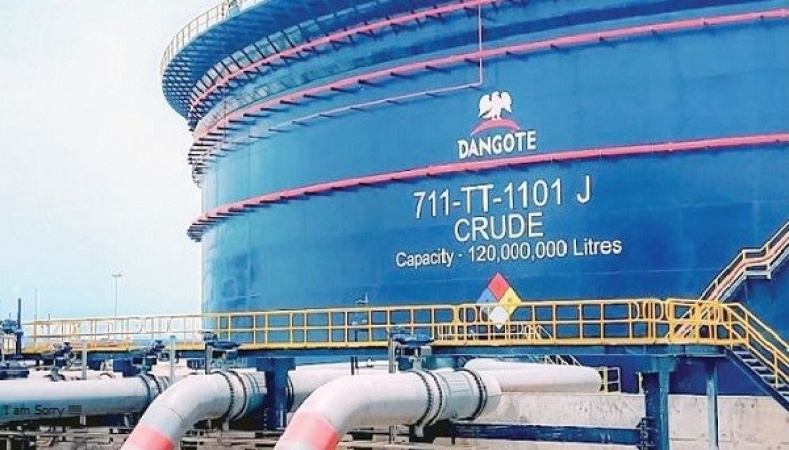
Dangote Refinery
Dangote Refinery and fuel marketers have resumed fresh hostilities over the new import licenses the Federal Government recently granted the former to ship petroleum products outside the shores of the country.
The largest private refinery in Nigeria is already in court to contest the act it believed
undermines its operations and contravene the law which allows imports only when domestic supply couldn’t fill the gap.
Stakeholders have expressed that the renewed hostilities between the Dangote Refinery and the marketers is not in the best interest of consumers, especially now that fuel prices have reached the rooftops on account of the price volatility in the global oil market.
The Nigerian Midstream and Downstream Petroleum Regulatory Authority, had recently given NIPCO, AA Rano, Matrix, Shafa, Pinnacle, and Bono licences for the importation of 720,000 metric tonnes of premium motor spirit (petrol).
According to the permit, NIPCO will import 120,000 metric tonnes; AA Rano, 150,000MT; Matrix, 150,000MT; Shafa, 120,000MT; Pinnacle, 120,000MT; and Bono, 60,000MT.
In the fresh suit, the Dangote Petroleum Refinery asked the Federal Government in order to cancel fuel import licences issued to marketers and the Nigerian National Petroleum Company Limited.
The Federal Government fouled an earlier order to maintain the status quo, the company said, asking the court to set aside import permits issued or renewed by the Nigerian Midstream and Downstream Petroleum Regulatory Authority
The refinery had last year withdrawn a similar case against the NNPC and other marketers after the intervention of the Federal Government.
In the fresh suit, the Federal High Court in Lagos set aside import permits issued or renewed by the Nigerian Midstream and Downstream Petroleum Regulatory Authority, adding that they breach an earlier order to maintain the status quo.
Although regulators and marketers have previously argued that imports are needed to ensure adequate supply and prevent shortages in line with the dictate of the Petroleum Industry Act, the NMDPRA had in its latest industry fact sheet disclosed that the Dangote Petroleum Refinery now supplies over 90 per cent of Nigeria’s daily petrol consumption.
Nigeria’s daily consumption of Premium Motor Spirit (PMS) increased significantly to 51.1 million litres per day in April 2026, marking a notable surge from the 47.3 million litres per day recorded in March, it said in the fact sheet
The agency said that actual fuel importation by marketers dropped sharply by 37.3 percent, falling to 3.7 million litres per day in April compared to the 5.9 million litres per day imported in March.
According to the data, domestic refining output, heavily led by the Dangote Refinery, displaced the largest portion of these foreign imports by supplying 40.7 million litres daily to the local market, demonstrating the capacity of local production to handle national consumption.
Reacting, Dr. Billy Gillis-Harry, the National President of The Petroleum Products Retail Outlets Owners Association of Nigeria (PETROAN), stated that while every corporate organisation has the constitutional right to seek legal redress, the downstream petroleum sector must continue to encourage healthy competition, market stability, and energy security in the overall interest of Nigerians.
Competition, he said, remains a critical pillar for ensuring product availability, price moderation, efficiency, and sustainability within the petroleum distribution value chain.
He emphasised that Nigeria’s energy market must not be allowed to tilt towards monopoly, regardless of the scale of investment or refining capacity of any single operator.
Dr. Billy Gillis-Harry further noted that PETROAN acknowledges the significant investment made by the Dangote Refinery and commends its contribution to local refining capacity, job creation, and reduction in fuel import dependence.
However, he stressed that a liberalised downstream market remains essential, where multiple operators can function fairly under the regulatory supervision of the Federal Government.
He reaffirmed that PETROAN will continue to advocate strongly for a competitive downstream petroleum sector, warning that any attempt to create monopoly structures could lead to exploitative pricing, reduced consumer choice, and instability in fuel supply and distribution.
He highlighted the benefits of healthy competition in the downstream petroleum sector including reduction in fuel prices through competitive pricing; improved product availability and nationwide distribution; better customer service and operational efficiency; prevention of supply disruptions and artificial scarcity; encouragement of innovation and investment in the sector; and protection of consumers from exploitative market practices.
The association therefore frowns at any form of monopoly in the downstream petroleum sector, stating that monopoly tends to encourage exploitative pricing, while healthy competition naturally helps to bring down prices for the benefit of consumers and the Nigerian economy.
He clarified that the Petroleum Industry Act (PIA) 2021 provides a clear statutory framework empowering the regulatory authority to ensure energy security and uninterrupted petroleum product supply in Nigeria.
According to him, section 317 (Supply Shortfall and Importation Powers) provides that where there is a shortfall in domestic supply of petroleum products, the Authority shall take necessary measures to bridge the gap, including authorising importation.
Faulting Dangote’s fresh suit, the Depot and Petroleum Products Marketers Association of Nigeria (DAPPMAN) argued that the licences being challenged were not mere administrative favours, but legal instruments issued under the Petroleum Industry Act (PIA) to guarantee the country’s fuel supply security.
The marketers maintained that the NMDPRA acted within its statutory powers in approving the licences, emphasizing that its responsibility was to ensure uninterrupted product availability for Nigerian consumers and not to protect the commercial interests of any single refinery, regardless of its size.
The association stated that its members had invested billions of Naira in petroleum depots, logistics systems and compliance infrastructure based on the understanding that the licences granted to them were lawful, valid and protected under the law.
Any attempt to void those approvals, the marketers said, would create uncertainty across the downstream petroleum sector at a time when stability in fuel supply remains critical.
“The news that Dangote Petroleum Refinery has filed a fresh lawsuit seeking to set aside fuel import licences issued by the NMDPRA to marketers and the NNPC demands a clear response from this association.
“The import licences at the centre of this lawsuit are not administrative courtesies. They are the legal instruments through which Nigeria’s fuel supply chain functions. They were issued under a regulatory framework established by the Petroleum Industry Act, by an authority empowered to make exactly this kind of determination. The NMDPRA has consistently maintained, correctly, that these licences exist to protect supply security, not to disadvantage any single producer, however large.
But in a communique, Executive Secretary, Jetties and Petroleum Tank Farm Owners of Nigeria (JETFON), Mr. Olayiwola Temitope, insisted that local refining output can fully satisfy domestic demand, rendering foreign imports economically counterproductive considering the growing number of refineries in Nigeria.
The Tank Farm owners also implored the Federal Government and the Nigerian Midstream and Downstream Petroleum Regulatory Authority (NMDPRA) to stop importation, cancel all active fuel import licences to safeguard the national economy and foster industrial growth.
They argued that continuously granting import permits undercuts domestic production and devalues massive local investments like the Dangote Refinery.
They maintained that absolute reliance on local refining capacity is the ultimate path to true economic independence and energy security.
They added: “Relying on foreign refined products leaves the local economy vulnerable to external supply chain shocks, international logistics disruptions, and continuous foreign exchange pressures that weaken the Naira.”
“By prioritizing local refineries, Nigeria can build a self-sustaining and secure domestic fuel supply ecosystem.”
Stakeholders advised that the current row should be nipped in the bud by the appropriate agencies and the parties in dispute with a view to preventing it from escalating beyond bearable proportion.
Energy expert, Rasheed Komolafe told Daily trust only the issue should be solved within the prism of the law. (Daily Trust)