ADAD
ADAD
Updating your news feed...
NEWS EXPRESS is Nigeria’s leading online newspaper. Published by Africa’s international award-winning journalist, Mr. Isaac Umunna, NEWS EXPRESS is Nigeria’s first truly professional online daily newspaper. It is published from Lagos, Nigeria’s economic and media hub, and has a provision for occasional special print editions. Thanks to our vast network of sources and dedicated team of professional journalists and contributors spread across Nigeria and overseas, NEWS EXPRESS has become synonymous with newsbreaks and exclusive stories from around the world.




Loading banners
Loading banners...

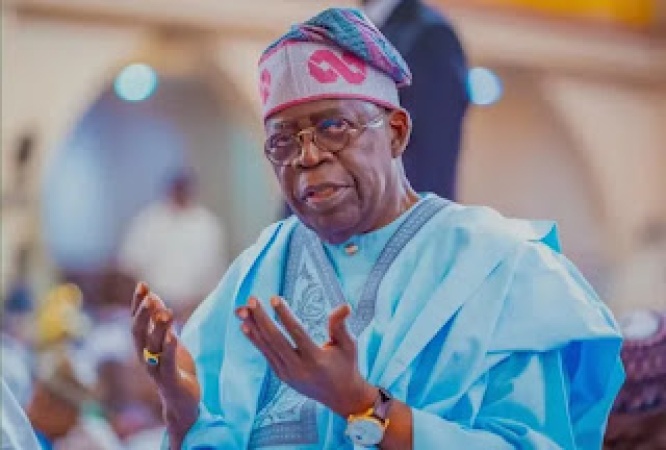
President Tinubu
President Bola Ahmed Tinubu has declared that the first two years of a possible second term in office would be devoted to “more work,” insisting that his administration would continue to pursue difficult but necessary reforms aimed at resetting Nigeria’s economy and securing the future of coming generations.
Speaking during an interview session at the just concluded Africa CEO Forum in Kigali, Rwanda, President Tinubu said the philosophy guiding his administration was rooted in decisive leadership and the courage to take difficult decisions in the interest of the people.
“Do more work. More challenges are there. The world won’t wait for anybody. You have to continue to reset and rethink, challenge our intellectual curiosity as a government,” the President said when asked what he would focus on if re-elected for a second term.
“The philosophy I came with in governance is believing that the hallmark of a transformative leader is the ability to take decisions, do what you’ll do, at the time it has to be done, on behalf of the people,” he added.
Tinubu defended the removal of fuel subsidy and the unification of the foreign exchange markets, describing both measures as painful but unavoidable decisions needed to rescue the country from economic collapse.
According to him, continuing with the old subsidy regime would have amounted to spending the future of unborn generations.
“It is a fake life to think you can, in a global economy, continue the subsidy that is wasteful. It’s an encouragement to falsification of papers, smuggling, and that is a very critical situation for the country,” he said.
The President recalled that before the reforms, many states were struggling to meet basic obligations, including salary payments.
“Of the 36 states, 27 of them were unable to pay the salaries of their workers. Where is the money? You are oil producing, you are earning, you are given fuel, you have no refinery that is functional. It is not possible to continue that trend,” he stated.
He likened the pains associated with the reforms to childbirth, saying temporary hardship would ultimately produce long-term benefits for Nigerians.
“It is difficult, it is painful, but it is just like the human reproduction process. A woman carries a pregnancy, enjoys the pain of labour, and has a very big smile when she sees a live child,” Tinubu said.
The President also strongly defended taxation as a necessary instrument for development, arguing that citizens who demand modern infrastructure and social services must be prepared to contribute through taxes.
“Nobody wants to pay taxes ordinarily. Taxation is not friendly to the wealthy, to the middle class, and to the poor. Every human being expects development, but the question they don’t answer is, how do you pay for it?” he asked.
“You want a very good highway, but you don’t want it to go through your land. You want a good hospital and don’t want to pay taxes. How do you care for the vulnerable? How do you protect the future of the children?” he queried.
He added that tax-paying was a critical civic responsibility, declaring that “a citizen that pays taxes is a citizen, whether corporate or individual.”
Highlighting what he described as early gains from the reforms, Tinubu said the economy had become more stable and predictable, enabling better planning by businesses and households.
“Today there is a very bright light at the end of the corner; the economy is stable, the Naira is stable, predictable, planners can do a reasonable budget, they can plan their lives well,” he said.
He disclosed that the government was implementing direct cash transfers to poor households while also supporting education through grants and allowances for indigent students.
“For those students ordinarily who would stay out of school because their parents cannot afford school fees, they are now in school. I’m even giving them allowances and upkeeps for their school,” he said.
On industrial policy, the President said his administration’s focus was not necessarily on “protection” but on support for businesses capable of creating jobs and stimulating domestic production.
Tinubu cited the Dangote Refinery and BUA Group as examples of local enterprises deserving government backing.
“What should my government do? Support him, encourage him,” the President said in reference to Dangote Refinery.
He explained that his administration approved the sale of crude oil to the refinery in Naira to ease operational difficulties and reduce pressure on foreign exchange.
“You don’t have to go through letter of credit and bureaucracy and make foreign exchange difficult for him. Give it to him in Naira,” he said.
Tinubu also defended the ongoing Lagos-Calabar Coastal Highway project, describing it as part of a broader national integration and economic inclusion agenda.
He said the road would connect Nigeria’s eastern corridor to Lagos and unlock tourism and investment opportunities across the coastline.
“My philosophy is Nigeria first,” the President declared, explaining that locally produced cement and steel were deliberately prioritised for the project to stimulate domestic industries.
Speaking on national unity, Tinubu said Nigeria’s diversity should be a source of strength rather than division.
“All of us together as Nigerians must be patriotic to understand that you have no control where you are born. Your parents could be Igbo, my parents could be Yoruba, you have no control of that. Where you find yourself is your home. This country is ours. We must build it together,” he said.
On regional security and diplomacy, the President stressed the importance of pragmatic partnerships and collaboration with neighbouring countries and global powers.
“Security challenges will always be there. Those are things you cannot do alone. You can’t operate the world in isolation,” he said.
Tinubu maintained that Nigeria still retained its strategic influence and leadership role in West Africa and on the continent.
“In ECOWAS, Nigeria is a big brother; in Africa, we are the fat lady. We must sing the tune, we must sing the right tune for others to pay attention to,” he said.
The President also dismissed suggestions that Nigeria had lost diplomatic relevance in recent years, insisting that the country remained central to regional peace and stability efforts.
“Nigeria is still there. Collaboration with trainings and support. Yes, challenges will always be there; there are troublemakers all over,” he said.
“But you have to just be focused and be alert. Nigeria is ready,” Tinubu added. (The Nation)