 ADAD
ADAD
Updating your news feed...
NEWS EXPRESS is Nigeria’s leading online newspaper. Published by Africa’s international award-winning journalist, Mr. Isaac Umunna, NEWS EXPRESS is Nigeria’s first truly professional online daily newspaper. It is published from Lagos, Nigeria’s economic and media hub, and has a provision for occasional special print editions. Thanks to our vast network of sources and dedicated team of professional journalists and contributors spread across Nigeria and overseas, NEWS EXPRESS has become synonymous with newsbreaks and exclusive stories from around the world.

.webp)
.webp)

Loading banners
Loading banners...

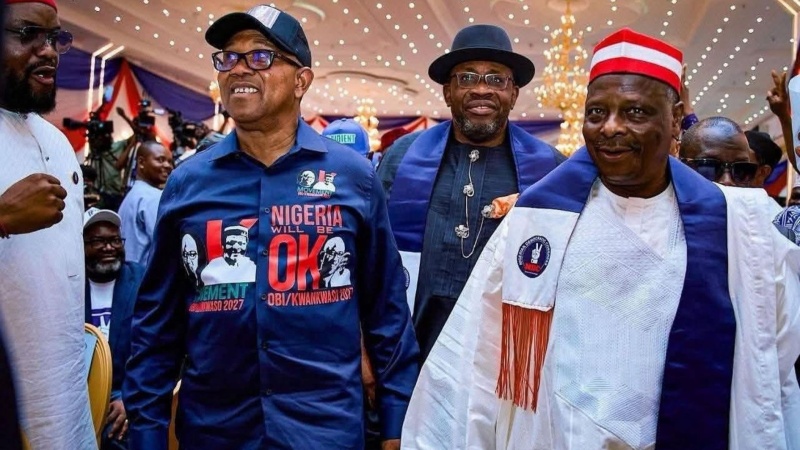
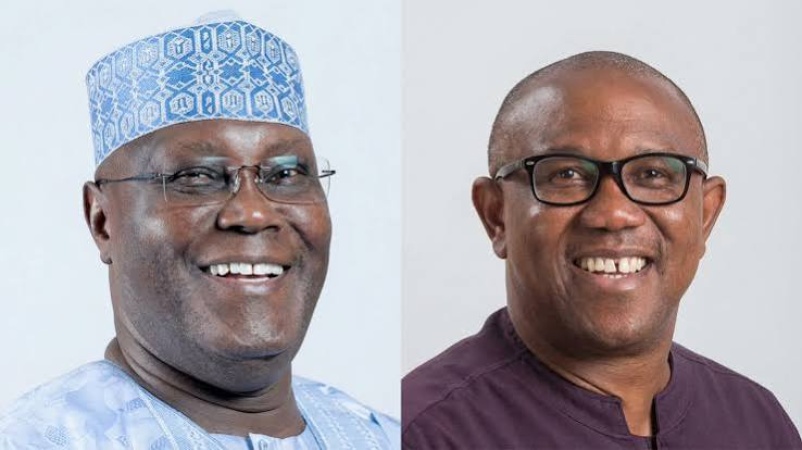
As political activities ahead of the 2027 elections gradually gather momentum, former presidential candidates Peter Obi and Gbenga Olawepo-Hashim yesterday raised separate issues concerning electoral credibility, governance failures and tensions within the political system.
Obi expressed confidence that Nigerians would participate in free, fair and credible elections in 2027, insisting that accountable leadership and a production-driven economy remain critical to resolving the country’s challenges.
He spoke at the national convention of the Nigeria Democratic Congress (NDC), where he addressed members on the state of the nation and the need for reforms ahead of the next general election.
He attributed Nigeria’s worsening economic and security situation to years of systemic looting rather than a shortage of resources.
“The country is not poor. Nigeria has been looted into poverty,” he said. “Every Nigerian is worried. No Nigerian knows where the next meal will come from. But we will change it.”
The former presidential candidate said millions of Nigerians were contending with rising poverty, unemployment and insecurity despite the country’s vast potential.
Citing official statistics, Obi said more than 140 million Nigerians were living in multidimensional poverty, while over 80 million young people were unemployed or underemployed, stressing that leadership priorities must change.
He dismissed concerns over the credibility of the 2027 general election, maintaining that voters would have the opportunity to choose their leaders freely.
“Those who think we will not have free and fair elections in 2027 should rethink now. In 2027, we are going to have a free, fair and credible election,” he declared.
Obi also called for a transition from what he described as a consumption-driven economy to one centred on production and job creation, arguing that such a shift would improve living standards and reduce youth unemployment.
He defended his decision to join the NDC, saying his political decisions had always been guided by principle rather than personal interest.
Quoting Winston Churchill, Obi said: “Some men change their party for the sake of their principles; others their principles for the sake of their party.”
According to him, his defection was motivated by a desire to work with leaders committed to rebuilding the country before the 2027 elections.
Hashim faults INEC timetable, warns of tension ahead of 2027 polls
THIS came as former presidential candidate Gbenga Olawepo-Hashim renewed criticism of the timetable released by the Independent National Electoral Commission, describing it as unlawful, unworkable and insensitive to Nigeria’s political and religious realities.
Hashim said the current schedule was creating avoidable tension within the political system and could destabilise party structures ahead of the 2027 general elections.
Speaking on the development, he argued that the compressed electoral calendar does not give political parties enough time to properly conduct primaries and other internal democratic processes.
According to him, the situation is already placing unnecessary pressure on parties and contributing to rising internal conflicts across the political landscape.
Hashim disclosed that he had earlier written an open letter to President Bola Ahmed Tinubu, urging intervention to ensure INEC strictly adheres to the provisions of the Electoral Act.
He, however, noted that no response had been received.
The former presidential candidate also faulted INEC for scheduling politically intensive activities, including party primaries, around sensitive religious periods such as Hajj and Ileya (Eid al-Adha).
According to him, the periods already come with significant logistical and security demands, warning that combining them with political primaries could heighten tensions and trigger avoidable disruptions.
“Combining election primaries with periods like Hajj and Ileya, which already carry security and mobility challenges, is unreasonable,” he said.
Hashim added that party primaries often generate political tension and security concerns, insisting that such activities require adequate spacing and proper planning.
He maintained that compressing religious and political activities unnecessarily increases national risk and could undermine stability within political parties.
Hashim further argued that the Electoral Act already provides sufficient timelines for parties to conduct nominations without resorting to what he described as a “chaotic timetable.”
Citing Section 29(1) of the Electoral Act, he said political parties are required to submit nominations no later than 120 days before elections, a provision he argued effectively allows parties until mid-September to conclude their nomination processes.
“Why adopt a chaotic timetable that circumvents the provisions of the Act?” he queried.
He warned that failure to review and adjust the timetable could deepen political tensions and erode public confidence in the electoral process ahead of the 2027 elections.
Tinubu sent envoys to Atiku after inauguration, says Bwala
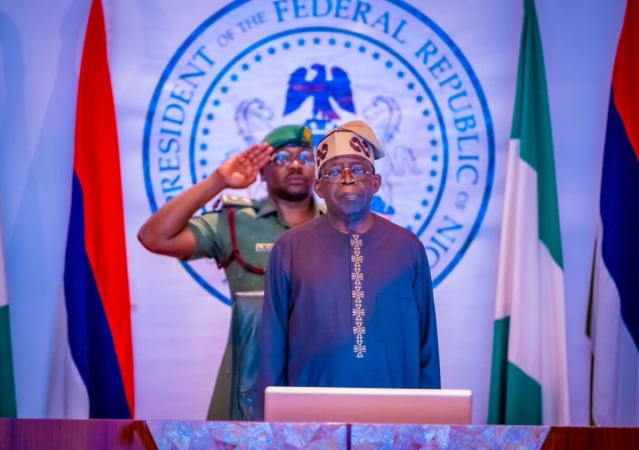
MEANWHILE, the Special Adviser to President Bola Ahmed Tinubu on Policy Communication, Daniel Bwala, has claimed that the President made early efforts to engage opposition leaders, including former Vice President Atiku Abubakar, shortly after assuming office.
Bwala disclosed this during an interview on Symfoni TV on Saturday.
According to him, emissaries were sent to Atiku’s residence in a bid to initiate dialogue, but the effort did not succeed.
“When President Tinubu took the oath of office, by the time I was still with Atiku, I can tell you this because I was close to Atiku, envoys from President Bola Ahmed Tinubu were sent to meet Atiku Abubakar,” he said.
Bwala alleged that the delegation was denied access to the former vice president.
“They came to the gates of Atiku, but Atiku ordered that the gate should not be opened to them,” he stated.
He added that Tinubu made efforts to maintain communication with opposition figures, including former Kano State governor, Rabiu Musa Kwankwaso.
“Asiwaju Bola Ahmed Tinubu made the effort. Do you know how many times Kwankwaso has seen the President until recently?” he said.
Atiku says Morocco trip was personal, not political
THE claim came as Atiku moved to dismiss recent speculations surrounding his political engagements abroad, insisting that his recent trip to Morocco was personal and bore no political undertone.
In a statement issued by his Senior Special Assistant on Public Communication, Phrank Shaibu, Atiku dismissed speculation that the visit was politically motivated.
According to the statement, the former vice president travelled to Marrakech to attend and preside over a wedding ceremony held on Saturday.
Atiku chaired the wedding ceremony of Cherina and Muna Okey Ezeibe in the Moroccan city, an event his aide said was rooted in a long-standing personal relationship and unrelated to politics.
Shaibu explained that the groom’s father, Mr Okey Ezeibe, had maintained a close relationship with Atiku for many years.
Speaking at the ceremony, Atiku described marriage as a sacred institution founded on love, patience, sacrifice and mutual respect.
He also prayed for peace, happiness and prosperity for the couple.
The wedding attracted dignitaries and guests from across Africa, including the bride’s father, Lassina Zerbo.
Shaibu described the gathering in Marrakech as a celebration of African unity, friendship and shared cultural ties.
Group urges universities to study Tinubu’s political trajectory
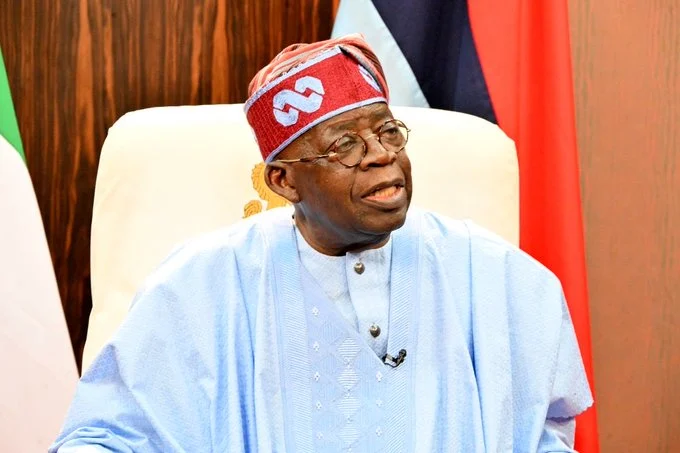
AS political realignments and debates over leadership continue ahead of the next general elections, the Grassroots Mobilization Initiative (GMI) yesterday urged universities and political leaders to study President Tinubu’s political trajectory as a model for nation-building and governance.
The group said Tinubu’s political style, which it described as a blend of strategic resilience, fiscal innovation, coalition-building and long-term planning, should become a major case study for students of political science and leadership studies in Nigeria.
In a statement issued by the National Coordinator of GMI, Samaila Musa, the organisation described Tinubu as one of the most influential and polarising figures in contemporary Nigerian politics.
Musa called for a shift in political engagement, arguing that Tinubu’s political career offers practical lessons in leadership, governance and political survival.
According to the statement, Tinubu’s rise from corporate accountant and pro-democracy activist to Nigeria’s 16th President represents “a masterclass in political engineering and long-term networking.”
The group maintained that for Nigeria to achieve lasting stability, both the academic community and political leaders must study and emulate what it described as the strategic depth that has defined Tinubu’s three-decade political career.
“To understand where Nigeria is going, we must understand the man who spent thirty years mapping the route. We are calling on our universities to move beyond theory and analyse the practical mechanics of how Tinubu built power, maintained a regional stronghold, and eventually captured the centre through the most successful opposition merger in African history,” Musa said.
GMI identified resilience rooted in activism and democratic struggle as one of the defining pillars of Tinubu’s political career.
The organisation recalled his involvement in the June 12 pro-democracy movement and his role in the National Democratic Coalition (NADECO), stating that his political background demonstrates that leadership requires sacrifice and courage.
It said, “As governor, Tinubu transformed Lagos into Africa’s 5th largest economy by pioneering an aggressive internal revenue generation drive when federal funds were withheld.”
The organisation added that Tinubu’s recruitment of technocrats, including Babatunde Fashola and Yemi Osinbajo, demonstrated the importance of building what it described as a “political family” capable of sustaining governance continuity.
GMI also cited the 2013 merger of the Action Congress of Nigeria (ACN), Congress for Progressive Change (CPC) and All Nigeria Peoples Party (ANPP) that led to the formation of the All Progressives Congress (APC), describing it as the first opposition alliance in Nigeria to defeat an incumbent government.
The group urged politicians to prioritise strategic alliances across ethnic and religious divides rather than regional isolation.
It further defended Tinubu’s economic reforms, including the removal of fuel subsidies and the unification of exchange rates, describing them as examples of political will aimed at addressing long-standing structural distortions.
Among the study points suggested by the organisation was Tinubu’s ability to remain politically relevant for more than 30 years in Nigeria’s volatile political environment.
GMI also urged opposition parties to focus on strategy and alliance-building rather than what it described as reactionary rhetoric that can overheat the polity.
“True opposition is built on superior strategy and patient alliance-building, not on destabilising the nation. It is time for all political actors to learn that power is a product of deliberate engineering, not accidental noise,” Musa said. (Daily Trust)
•PHOTO:Former Labour Party presidential candidate, Peter Obi (left); Former Bayelsa State Governor, Seriake Dickson, and past Kano State Governor, Rabiu Kwankwaso, during the Nigeria Democratic Congress (NDC) Convention in Abuja, at the weekend.



