Updating your news feed...
NEWS EXPRESS is Nigeria’s leading online newspaper. Published by Africa’s international award-winning journalist, Mr. Isaac Umunna, NEWS EXPRESS is Nigeria’s first truly professional online daily newspaper. It is published from Lagos, Nigeria’s economic and media hub, and has a provision for occasional special print editions. Thanks to our vast network of sources and dedicated team of professional journalists and contributors spread across Nigeria and overseas, NEWS EXPRESS has become synonymous with newsbreaks and exclusive stories from around the world.




Loading banners
Loading banners...
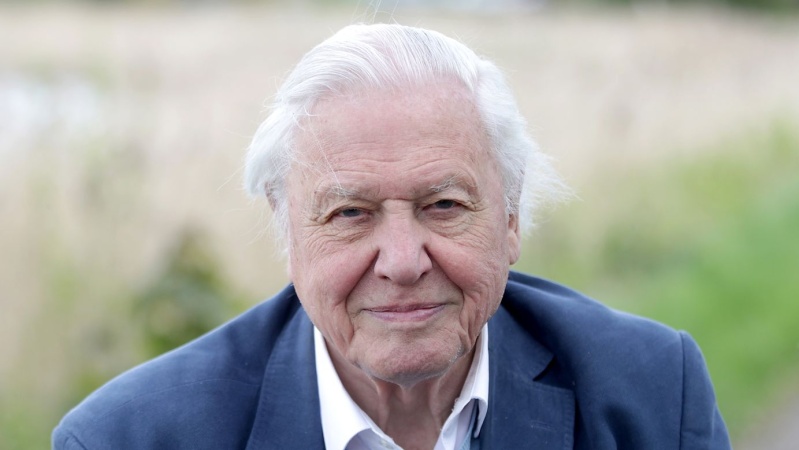
David Attenborough has now lived on Earth for a century.
In that stretch of time, he’s journeyed through forests and oceans, bonded with a family of gorillas, collected fossils, visited hidden tribes, overseen the first color TV broadcasts in Europe, narrated inspiring documentaries to hundreds of millions of viewers, collected numerous accolades, had dozens of species named after him and sounded the alarm on climate change.
Here are some key highlights from the renowned environmental broadcaster’s busy and extraordinary life, which he has spent with humans, animals and plants alike.

Then-Prince Charles and Princess Anne meet naturalist David Attenborough at Lime Grove Studios on January 4, 1958. The young royals are introduced to a cockatoo captured on Attenborough's last "Zoo Quest" expedition.
The TV personality developed his hallmark charismatic style of gentle humor, warmth and curiosity in his famous 1954 “Zoo Quest” series, which made him a recognizable figure. In 1958, Attenborough introduced a 3-year-old cockatoo, named Cocky, which he captured during his last “Zoo Quest” expedition, to child members of the British royal family – a young Prince Charles and Anne, Princess Royal.
Recounting the experience in an interview with the BBC ahead of Charles’ coronation in 2023, Attenborough said that the cockatoo was sitting on the prince’s hand and the animal had a “very powerful beak and a very powerful bite. And, although I was fairly confident about Cocky, it could actually have removed Charles’ little finger.”

Television presenter Attenborough pictured following his appointment as the new controller of BBC 2. He was photographed for Radio Times in connection with the series 'The Tribal Eye' in April 1974.
Attenborough’s career at the BBC only catapulted from there, and he became controller of the BBC’s newly-launched second channel, BBC 2, in 1965. He launched a range of innovative productions, even introducing audiences to the unconventional comedy series “Monty Python’s Flying Circus.”
The broadcaster then served as director of television programming from 1968 to 1972, later resigning to make his own television programs.

Attenborough communicates with members of the Biami tribe in New Guinea during 1971 BBC documentary "A Blank on the Map."
During an expedition in a remote part of New Guinea, aired in 1971, Attenborough and his BBC crew made contact with the previously unknown Biami tribe. Attenborough communicated with the tribe using gestures, looked at their personal ornaments and enquired about the pegs in the ritual punctures in the nose of one of the men.
Reflecting on that moment in an interview with CNN’s Christiane Amanpour in 2016, Attenborough said, “It is a remarkable thing. Surprisingly, how eloquent you can be to somebody who doesn’t know a single word of your language, or indeed hasn’t met your kind before.”

Attenborough developed a connection with a group of mountain gorillas he met in Kenya in the 1970s.
The personable presenter not only got on with people but managed to befriend a family of gorillas in the forests of Rwanda’s Virunga Mountains. While filming “Life on Earth” in 1978, a 3-year-old Gorilla named Pablo took a liking to Attenborough and playfully laid on him.
The scene captured hearts globally, later leading to “one of the greatest conservation success stories that I’ve witnessed,” Attenborough said in the April 2026 film “A Gorilla Story,” in which he tells the story of the same group of gorillas from the 1970s to the present day. He added that his connection with gorillas is “a connection that has stayed with me my whole life. And it all began with one special little gorilla.”

Attenborough attempts to converse with a blind rhino in Kenya during 2013 BBC documentary series "Africa."
The naturalist’s keenness to engage with the animals he observes is also evident in his interaction with a blind baby rhino at Lewa Wildlife Conservancy in Kenya in episode six of the 2013 BBC documentary series “Africa.”
After being approached by the rhino during filming, Attenborough got down on all fours, looked at the rhino in the face and began exchanging squeaks with the animal. Attenborough went on to describe the rhino as an “enchanting creature.”

Brothers Richard Attenborough and David Attenborough pose together as they are awarded the title of Distinguished Honorary Fellowships from the University of Leicester in Leicester, England, on July 13, 2006.
Attenborough and his brother, the late actor and film producer Richard Attenborough, grew up living on the campus of the UK’s University of Leicester, since their father was a principal there.
Richard Attenborough once mischievously locked his brother inside a padded cell in a building on campus that was once a Victorian lunatic asylum, according to the university. In 2006, the institution awarded the brothers its highest honor, Distinguished Honorary Fellowships.

Attenborough wins at the British Academy Television Awards for his narration in "Blue Planet II"
Attenborough’s work rose to global prominence in the 2000s, after he explored the world’s oceans in “The Blue Planet,” as well as wildlife across various waters, forests, caves, mountains and icy terrains in “Planet Earth.”
The appeal of his inspiring nature programs has earned him three Emmys – the first one being in 2018 for Outstanding Narrator for “Blue Planet II.” The same series won him a BAFTA.

Attenborough poses for a photo after being appointed a Knight Grand Cross of the Order of St. Michael and St. George at Windsor Castle, in Windsor, England
Attenborough was first knighted by Britain’s late Queen Elizabeth II in 1985 for his services to television broadcasting. King Charles III then awarded him a second knighthood – the prestigious Knight Grand Cross – in 2022 for his services to television broadcasting and conservation.
Attenborough holds the longest career as a TV presenter, spanning more than seven decades, according to Guinness World Records. Along with William, Prince of Wales, Attenborough helped to set up in 2019 the Earthshot Prize, which celebrates innovative environmental solutions.
Attenborough had a long friendship with Queen Elizabeth. He produced some of her Christmas Day broadcasts for several years and the monarch was comfortable enough to crack jokes with him during a stroll through Buckingham Palace Garden for a TV documentary aired in 2018.
“I suppose the most precious things were hearing her laugh,” Attenborough said of the Queen in an interview with ITV News after her passing in 2022.
Attenborough’s voice made its Netflix debut with “Our Planet” in 2019. Again, his narration for the eight-part series, which used captivating cinematography and told dramatic stories of animals traversing the natural world, won an Emmy.
At the premiere of the series at London’s Natural History Museum, Prince Charles paid tribute to Attenborough “for all he has done over so many years to bring the wonder, the fascination and, increasingly, the desperate plight of the natural world to our attention.” (CNN)