ADAD
ADAD
Updating your news feed...
NEWS EXPRESS is Nigeria’s leading online newspaper. Published by Africa’s international award-winning journalist, Mr. Isaac Umunna, NEWS EXPRESS is Nigeria’s first truly professional online daily newspaper. It is published from Lagos, Nigeria’s economic and media hub, and has a provision for occasional special print editions. Thanks to our vast network of sources and dedicated team of professional journalists and contributors spread across Nigeria and overseas, NEWS EXPRESS has become synonymous with newsbreaks and exclusive stories from around the world.


























Loading banners
Loading banners...

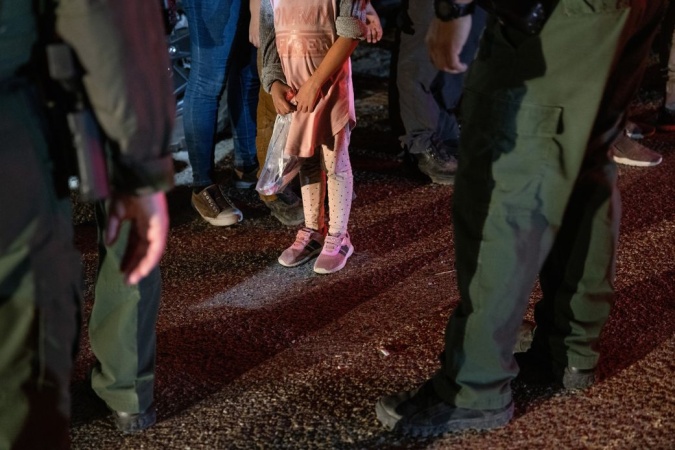
The Trump administration is taking steps to accelerate the deportations of migrant children in US custody amid White House pressure to quickly move kids through the system, according to administration officials and lawyers for the children.
Immigration hearings, where a judge will eventually decide whether a child can stay in the US or be deported, are being moved up by weeks or even months, making it more difficult for attorneys to obtain immigration relief for kids in an already-cumbersome process.
Children as young as four years old are being forced to repeatedly appear in court and provide updates on the status of their case, at times without legal help, within a matter of weeks.
The frequent court hearings are alarming to kids who are just getting acquainted with courts and the immigration system. Children are frequently feeling “enormous pressure” and some wet their pants when they have to go to court, according to Emily Norman, regional director for the east coast at Kids in Need of Defense.
It’s the latest in a series of moves to focus immigration enforcement on minors who arrived in the United States unaccompanied or have returned to government custody because of Immigration and Customs Enforcement operations that resulted in their guardians being detained. The push has raised alarm among attorneys and advocates who argue the rushed timelines could result in vulnerable children being sent back to the conditions they were fleeing.
“They’re all some combination of confused, scared and frustrated,” Scott Bassett, managing attorney of the Children’s Program at Amica Center for Immigrant Rights.
A 5-year-old who arrived unaccompanied to the US was scheduled for an immigration hearing within a week or two from arrival. In Texas, 300 children residing in shelters had their hearings abruptly moved up —sometimes with little notice. One case was moved up by weeks on a Thursday to the following Tuesday. Norman shared that a hearing scheduled for 2027 was suddenly scheduled for less than a week away.
In a statement to CNN, Andrew Nixon, a spokesman for Department of Health and Human Services, said the department “is focused on resolving cases involving unaccompanied children as quickly and efficiently as possible, consistent with the law.”
“Many of these children are at risk of trafficking and exploitation, and in some cases are brought across the border by cartels under dangerous and coercive conditions. Moving cases forward helps disrupt those networks and ensures children are returned to safe environments as quickly as possible. Reducing time in custody also lowers taxpayer costs and ensures the system is operating as intended,” Nixon added.
A White House official told CNN the Trump administration “is working to disrupt cartel plots and humanely return trafficked children to their homes and families as expeditiously as possible.”
CNN also reached out to the Justice Department, which oversees the nation’s immigration courts, for comment.
Trump administration officials have frequently talked about the whereabouts of unaccompanied minors who entered the US under former President Joe Biden, arguing that thousands of them are missing and need to be accounted for. Former Biden officials and several experts in the field refute the claim that there are large numbers of children missing from the system, arguing that the claims are exaggerated or based on mischaracterizing data.

A U.S. flag lies on the ground while people protest hours after five-year-old Liam Conejo Ramos and his father, Alexander Conejo Arias, returned home after a judge ordered them to be released from Immigration and Customs Enforcement detention at the South Texas Family Residential Center in Dilley, Texas
But as the administration has touted its work to locate children, they’ve also moved toward placing kids on a path toward deportation if they can’t obtain relief in the United States.
Some children who arrived in the US alone and have been released to reside with a parent or guardian are being returned to government custody, joining more recent arrivals in shelters. As that’s happened, it’s become increasingly difficult for kids to be released to US-based relatives, leaving them languishing in custody for months.
Advocates and attorneys who work with children say the expedited immigration hearing timelines are exacerbating the already-difficult circumstances for kids who don’t know if and when they’ll be released, whether they’ll obtain immigration relief, and now, whether they’ll be deported before they can get any of those answers.
“It’s driving toward getting these kids out of the country,” Bassett said. “They feel the walls are closing in because they are.”
Unaccompanied migrant children are an especially vulnerable population, often having gone through trauma in their home country or during the journey to the US. For that reason, attorneys say it takes time to build a relationship with them and understand their histories to eventually apply for the immigration relief they’re eligible for. But the expedited timelines undercut those efforts, they say.
“When you’re working with especially children who survive trauma, it takes time to build trust with them to get the information you need to get,” said Alexa Sendukas, a managing attorney at Galveston-Houston Immigrant Representation Project who oversees legal services for immigrant children.
Once that relief is identified, though, it can be another several months to apply and obtain it to eventually ask an immigration to terminate removal proceedings. In the absence of that, the expedited hearings are headed toward a deportation order.
Migrant children are spending nearly seven months in custody on average, according to the latest available federal data, far exceeding the time kids have previously been in custody.
Health and Human Services officials are tracking the longer stays in custody, aware of the toll it can take on children over time. White House deputy chief of staff Stephen Miller also recently pressed HHS officials to move faster on cases to get migrant children out of custody and sent back to their origin country, a US official told CNN.
As of March, there were more than 2,000 migrant children in the custody of HHS, which funds facilities and programs across 24 states for the care of unaccompanied migrant children.

A sign is displayed outside of the U.S. Department of Health and Human Services (HHS) headquarters at the Hubert H. Humphrey Building
The tight deadline, long stays in custody and uncertainty are weighing on children, some of whom are opting to voluntarily depart the country. Advocates and attorneys have argued that administration efforts should be focused on releasing children from custody to US-based sponsors such as a parent, as has been protocol, but that has become more challenging amid new restrictions over who’s qualified to receive their children.
“When we originally had our hearing, we had until June. I thought that was a tight timeline but doable. Now, they’re moving things up to mid-May without warning,” said Steven Wright, a clinical professor at the University of Wisconsin-Madison’s Immigrant Justice Center who is representing three unaccompanied minors.
One type of relief that often applies to migrant children is special immigrant juvenile status, which provides a pathway to a green card for youth who have been abused, neglected or abandoned. But to obtain it, kids must go to state court and ask for a finding from a judge that they fit the criteria, then take that finding to US Citizenship and Immigration Services for adjudication. That whole process can take months — and may, at times, be interrupted if a child is transferred to another shelter because of state rules.
“In order to stop the government from removing the kids, I need to have that SIJ piece of paper. And they’ve given me a deadline that’s made it extremely difficult for me to get that SIJ piece of paper,” Wright added. (CNN)