 ADAD
ADAD
Updating your news feed...
NEWS EXPRESS is Nigeria’s leading online newspaper. Published by Africa’s international award-winning journalist, Mr. Isaac Umunna, NEWS EXPRESS is Nigeria’s first truly professional online daily newspaper. It is published from Lagos, Nigeria’s economic and media hub, and has a provision for occasional special print editions. Thanks to our vast network of sources and dedicated team of professional journalists and contributors spread across Nigeria and overseas, NEWS EXPRESS has become synonymous with newsbreaks and exclusive stories from around the world.

.webp)




















Loading banners
Loading banners...

Mounting legal battles, institutional friction and a compressed electoral timetable have placed the African Democratic Congress (ADC) under severe pressure, with its participation in the 2027 elections now uncertain and broader questions emerging about opposition strength and democratic integrity.
The decision of the Supreme Court of Nigeria yesterday to adjourn the ADC leadership dispute to April 22 introduced a new layer of uncertainty over the party’s preparedness to meet the timetable of the Independent National Electoral Commission (INEC) for the 2027 general elections.
At stake is not only the immediate fate of the party but also broader concerns about party legitimacy, coalition politics and the integrity of Nigeria’s electoral calendar. Questions persist over whether opposition parties can resolve lingering internal disputes, organise credible primaries, meet INEC’s strict timelines and conclude ongoing litigation before critical deadlines expire.
According to INEC’s schedule, presidential and National Assembly elections are slated for January 16, 2027, while governorship and State Houses of Assembly elections will follow on February 6, 2027. Party primaries are expected to be held between April 23 and May 30, 2026, with the submission of nomination forms fixed for June 27 to July 11, 2026.
Campaign activities for presidential and National Assembly elections will run from August 19, 2026, to January 14, 2027, while governorship and state assembly campaigns are scheduled from September 9, 2026, to February 4, 2027.
With INEC’s timetable requiring parties to conclude primaries, submit candidate lists and clarify leadership structures within strict deadlines, the April 22 hearing leaves the ADC with a narrow compliance window. Observers warn that even if judgment is delivered promptly, any directive requiring fresh congresses, conventions or ratification processes could push the party beyond regulatory limits.
More critically, if the apex court nullifies the party’s recent National Convention held in Abuja, similar to its intervention in the Peoples Democratic Party (PDP) convention dispute in Ibadan in November 2025, the ADC could be forced to restart its internal processes, thereby risking its ability to meet INEC’s May deadline.
The Convener of the Movement for Credible Elections, Wale Okunniyi, said timing remains critical. He warned that if the judgment is not immediately executable or requires further procedural steps, the ADC could be technically locked out of the process, regardless of the merit of its case.
Officials within INEC have consistently maintained that the commission is bound strictly by its timetable and cannot accommodate parties entangled in unresolved disputes.
A senior official of the commission, who declined to be named, reiterated that INEC deals only with legally recognised party leaderships and validly conducted primaries, stressing that any party that fails to meet the deadline risks exclusion, regardless of circumstances.
Within the ADC, the adjournment has heightened anxiety among stakeholders, particularly aspirants who fear being shut out of the process. A member of the party’s National Working Committee described the situation as “a race against time,” expressing hope that the court would deliver a clear and final judgment that does not require further internal procedures.
Some aspirants are already exploring fallback options, including quiet negotiations with larger parties, amid fears that prolonged litigation could render their ambitions void.
The ADC has recently been touted in political circles as a potential platform for opposition realignment ahead of 2027. However, the ongoing litigation and its timing may weaken that prospect.
A governorship aspirant in Imo State, David Mbamara, expressed concern over the implications for the opposition, noting that no serious coalition would anchor itself on a party facing existential legal uncertainty so close to a major electoral deadline. He added that key actors may reconsider their strategies or migrate to more stable platforms, a development that could benefit dominant parties such as the All Progressives Congress (APC).
He also stressed that internal democracy remains critical, arguing that parties should resolve disputes early rather than test legitimacy in court on the eve of deadlines.
Legal observers note that the Supreme Court now faces a delicate balancing act, ensuring that justice is served while avoiding a situation where its decision inadvertently sidelines a political party due to timing constraints. The adjournment, they argue, places pressure on the court to deliver a decisive and implementable ruling within days of the hearing.
As the April 22 date approaches, attention remains on the apex court. For the ADC, the outcome could determine not only its participation in the 2027 electoral cycle but also its viability as a political platform.
If the court delivers a clear ruling that affirms a recognised leadership without requiring further processes, the party may still salvage its position. However, any ambiguity or any directive necessitating fresh internal exercises could sideline the ADC at a critical political moment.
In the final analysis, the case underscores a recurring lesson in Nigeria’s electoral politics: timing is decisive.
ADC expels ex-vice chairman, lawmaker, others over anti-party activities
MEANWHILE, the ADC has expelled a former national vice chairman of the party, Nafiu Bala Gombe, along with four other members, over alleged anti-party activities.
Those expelled include a member of the House of Representatives, Leke Abejide, as well as Kenneth Ehiator, Stella Chukwu and Elias Adiukwu.
The decision was taken at the party’s national convention held in Abuja yesterday, where delegates approved a motion for their expulsion. The motion was moved by Senator Binos Yaroe, who represents Adamawa South, and was adopted unanimously by the convention.
Party officials said the action followed allegations that the affected members engaged in conduct considered detrimental to the party’s unity and internal processes.
Bala was accused of instituting a court case against the party’s leadership, in which he sought recognition as the authentic national chairman of the ADC. Party sources said the move was viewed as a violation of internal dispute resolution mechanisms.
Abejide was also cited for comments perceived as critical of the party and for expressing support for Bala’s actions.
Although the motion did not outline specific details of each allegation, it broadly referenced anti-party behaviour and disregard for established procedures for resolving internal disputes.
ADC convention begins without INEC presence amid legal, venue concerns
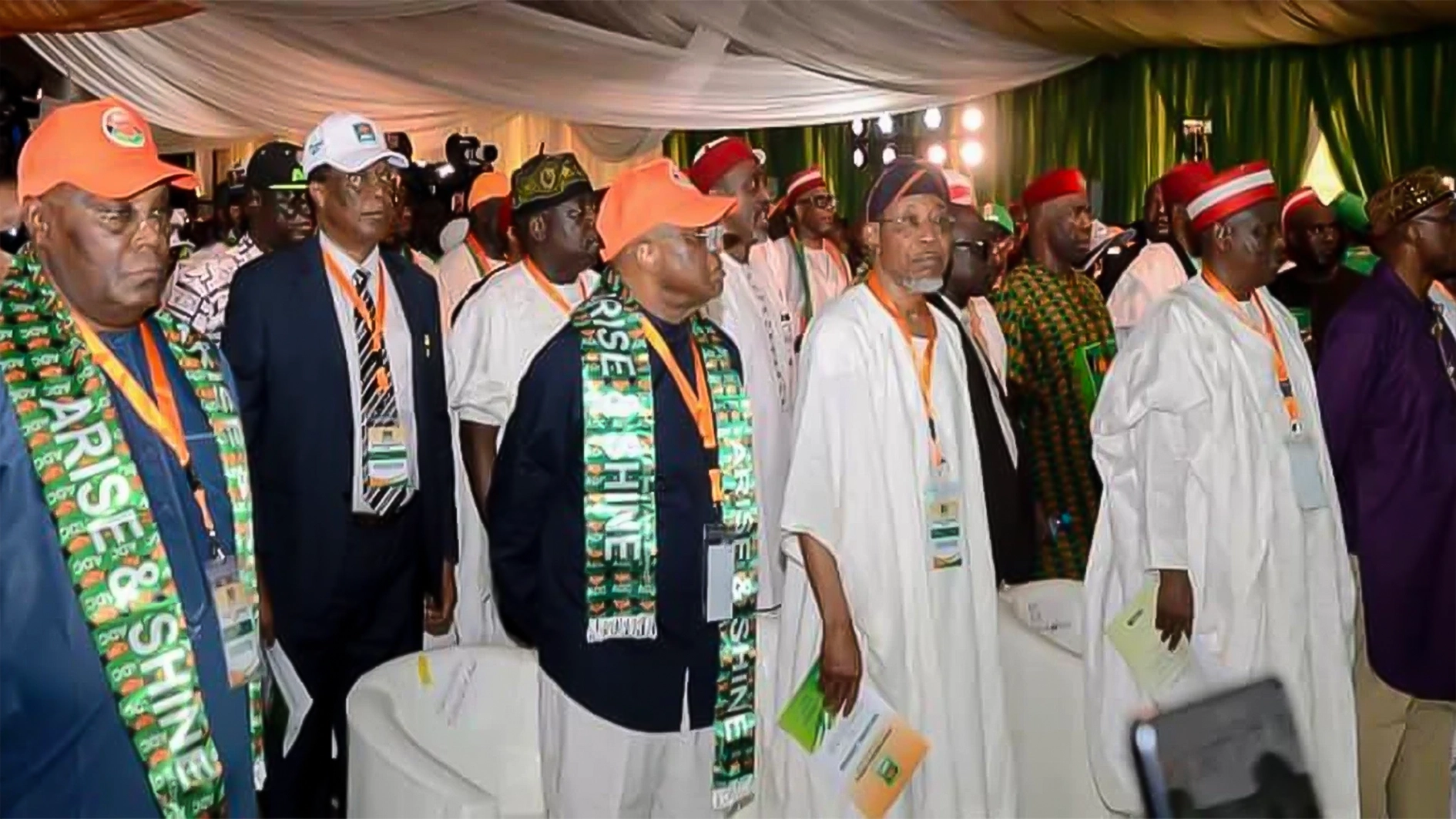
The national convention of the ADC commenced yesterday at the Rainbow Event Centre in Abuja without INEC officials present, heightening concerns among party members as proceedings began under tense conditions.
The development came against the backdrop of recent disputes between the commission and the party over leadership recognition.
On April 1, INEC announced it would no longer recognise the ADC leadership led by Senator David Mark, citing an interim ruling of the Court of Appeal directing parties to maintain the status quo ante bellum pending the determination of a suit before a Federal High Court.
Tension had also surrounded the convention in the days leading up to the event, particularly over the choice of venue. There were claims that attempts were made to prevent the event centre from hosting the gathering, although details of such efforts remained unclear.
Despite these concerns, party members and delegates proceeded with the convention, which is a key step in the ADC’s preparations ahead of the 2027 general elections.
INEC’s absence drew attention because the commission is statutorily empowered to monitor party conventions and related activities. Political parties are expected to notify the electoral body of such events to enable oversight and ensure compliance with regulations.
The situation has also reignited debate over the courts’ role in political party affairs. In recent years, internal disputes within parties, ranging from leadership contests to candidate nominations, have frequently been taken to court, sometimes influencing electoral outcomes.
Analysts say the ADC convention, held without INEC’s presence, highlights the complexities arising from the intersection of party politics, electoral regulation and ongoing litigation.
ADC convention marks turning point in opposition politics, says David Mark
The National Chairman of the African Democratic Congress, David Mark, has described the party’s national convention in Abuja as a defining moment in Nigeria’s democratic journey, saying it represents the resilience and survival of opposition politics.
Speaking at the convention yesterday, the former Senate President said the significance of the gathering would be appreciated more in the years ahead.
“Great moments of transformation do not announce themselves with a bang. They reveal themselves through the decisions that people make and the direction that political parties and politicians choose to take,” he said.
Mark added that Nigerians would reflect on the event in the future and recognise it as a moment when the party and its supporters took a stand. “Years from now, Nigerians will look back at this day, Tuesday, April 14, 2026, and ask: where were you when the ADC stood up?” he said.
He told party members that their presence at the convention symbolised courage and commitment to democratic values, particularly at a time he described as challenging for opposition politics.
The ADC chairman said the convention, the first under his leadership, would rank among the most significant political gatherings in recent Nigerian history, not because of the personalities involved but because of what it represents.
According to him, the party was founded on the belief that politics should be driven by service rather than personal ambition, adding that his leadership would focus on repositioning the ADC as a platform for national renewal.
“I am deeply honoured by the confidence reposed in me to lead this great party at this critical time. I accepted this responsibility with humility, a clear sense of duty and an unshakable commitment to reposition the ADC,” he said.
Mark acknowledged that the party had faced challenges, including internal difficulties and external pressures, which he said tested its cohesion.
He also referred to recent developments involving the Independent National Electoral Commission, noting that they had raised questions about democratic processes.
“Forces that feared what a united ADC represents came for us through the courts, institutions and bureaucratic obstruction. They sought to stop this convention from happening,” he said.
Despite these challenges, Mark said the successful conduct of the convention demonstrated the resilience of the party and its members.
“We are here. Every attempt to suppress this party has only deepened the resolve of our members and widened our coalition,” he added.
He maintained that the ADC would remain firm in defending democratic principles and would not yield to pressure.
“At a time when democratic space is shrinking, the ADC will not bow, will not cower and will not retreat,” he said.
The former Senate President warned that the stakes extend beyond party politics, stressing that the survival of democracy itself is involved.
“What is at stake is not just about the ADC or the opposition. It is the survival of our democracy,” he said, adding that yielding to pressure would amount to complicity in undermining democratic governance.
Mark said the party was emerging as a credible alternative in response to growing public demand for accountable leadership, particularly among younger Nigerians.
“Across the country, there is a growing awareness by a generation that desires a different Nigeria. They are asking tough questions, and we are encouraged that the ADC is emerging as a credible alternative,” he said.
He described the moment as both an opportunity and a responsibility for the party, emphasising that its objective goes beyond winning elections.
“Our goal is to demonstrate that politics can deliver a better life for Nigerians,” he said.
Mark also called for collaboration among opposition leaders across party lines, urging them to work together in the national interest.
“The challenges before us go beyond partisanship. It is a patriotic duty to work together to rescue our country,” he said.
He commended party members for the successful conduct of congresses nationwide, noting that the process reflected the party’s growing grassroots presence.
“This shows that we are planting our roots in communities across the country and providing platforms for people to participate in governance,” he said.
Mark congratulated those who emerged as leaders at various levels, urging them to prioritise service, accountability and inclusiveness.
“Leadership within this party must be defined by service and accountability. You must lead with openness and a commitment to unity,” he said.
He also appealed to those who were unsuccessful in the internal contests to remain committed to the party’s goals, stressing the importance of unity.
“Political contests are part of democratic life, but the unity and progress of the party must always come first,” he said.
The ADC chairman reaffirmed the party’s commitment to transparency, accountability and participation, describing them as guiding principles rather than abstract ideals.
“In the ADC, the constitution will be supreme, and every member will be accountable to the rules and values that define us,” he said.
He added that no individual would be placed above the party, regardless of position, and assured members that inclusiveness would remain central to its operations.
Mark further said the party would focus on improving the welfare of Nigerians, noting that governance should be centred on delivering tangible benefits to citizens.
“In the ADC, we shall return politics to its true purpose, which is to improve the lives of the people,” he said.
He pledged that elected and appointed officials on the platform of the party would be held accountable for their actions and commitments.
“To fly the banner of the ADC is to commit to service. We will insist that those who represent us deliver on the promises made to the people,” he said.
The convention brought together delegates and party stakeholders from across the country, reinforcing the ADC’s efforts to consolidate its position ahead of future elections.
Atiku, Aregbesola raise alarm over democracy, economy at ADC convention
Former Vice President Atiku Abubakar and leaders of the African Democratic Congress have criticised the Independent National Electoral Commission and the Federal Government, raising concerns about the state of Nigeria’s democracy, economy and governance.
They spoke yesterday at the party’s national convention held at the Rainbow Event Centre in Abuja, where party officials also outlined their position on recent political developments and the direction of the opposition.
Atiku, a chieftain of the ADC and former presidential candidate of the Peoples Democratic Party (PDP), alleged that INEC was being used in a manner that undermines democratic processes.
“I will not end these remarks without indicting the chairman of INEC and INEC itself,” he said, adding that “it is clear… INEC is being used to scuttle democracy in this country.”
He urged the Federal Government to safeguard democratic institutions, recalling the role played by pro-democracy actors in ending military rule. He also said the party and its supporters would continue to push for what he described as a return to “true democracy” and national development.
The comments come amid recent tensions between the ADC and INEC, particularly following the commission’s decision to suspend recognition of the party’s leadership under Senator David Mark in line with a court ruling.
In his remarks, the National Secretary of the ADC, Ogbeni Rauf Aregbesola, said the party’s existence is rooted in the Nigerian Constitution, which guarantees freedom of association.
Presenting the secretariat report at the party’s 8th National Convention, Aregbesola said the ADC derives its legitimacy from Nigerians seeking an alternative political platform.
“The ADC does not owe its existence to any individual or institution,” he said, adding that the party is anchored on constitutional provisions and the aspirations of citizens.
He also addressed INEC’s absence at the convention, describing it as a failure of responsibility. According to the report, the electoral body is empowered by law to monitor party conventions and related activities.
“As a party, we have fulfilled our obligations. It is now the responsibility of INEC to attend and monitor our convention,” the report stated.
The party maintained that it has not been proscribed by any court or law and therefore retains the right to carry out its activities. It also expressed concern that recent actions by INEC could be interpreted as partisan, calling on the international community to take an interest in what it described as emerging anti-democratic tendencies.
Aregbesola said the ADC is positioning itself as a platform to address what he termed governance challenges in the country. He described the party’s mission as a “rescue effort” aimed at restoring public confidence in leadership.
On the economy, the party questioned the Federal Government’s claim that recent movements in the exchange rate reflect improved economic management. The report noted that the naira, which traded at about N700 to the dollar in 2023, now stands at around N1,400.
“This amounts to a 100 per cent devaluation. In an import-dependent economy, this is devastating,” the report stated.
It also highlighted rising fuel prices, noting that petrol, which previously sold between N185 and N238 per litre, now costs about N1,400 in many parts of the country, with implications for transportation and living costs.
On electricity supply, the party said many communities continue to experience limited or inconsistent power, with some areas reportedly receiving only a few hours of electricity daily, while others face extended outages.
The report further raised concerns about social indicators, including education and poverty. It stated that the number of out-of-school children has increased from 18.3 million to about 20 million, while millions of Nigerians face multidimensional poverty.
Also, Aregbesola criticised the Federal Government’s “Renewed Hope” agenda, describing it as ineffective in addressing current challenges.
“Three years into its tenure, the promise of renewed hope remains unfulfilled,” he said, questioning when the expected improvements would materialise.
He expressed concern over insecurity and recent violent incidents across the country, describing the situation as indicative of broader governance challenges.
Aregbesola alleged that opposition parties face pressure and attempts to weaken their activities, warning that such trends could affect the country’s democratic system.
He called for greater unity among opposition figures and urged Nigerians to engage actively in efforts to strengthen democratic institutions.
“Once again, the country is drifting, and we cannot allow this continued drift,” he said, reiterating the party’s position that it is committed to offering an alternative direction.
The ADC said it has spent recent months strengthening its structures nationwide in preparation for the 2027 general elections, expressing confidence in its growing support base.
“Our party has, within nine months… transformed into a major opposition force and a source of hope for Nigerians,” the report stated.
Party leaders maintained that despite current challenges, they remain committed to democratic principles and believe that sustained engagement by citizens will shape the country’s political future.
HURIWA cautions judiciary over handling of political party affairs
The Human Rights Writers Association of Nigeria (HURIWA) has raised concerns over what it described as a growing pattern of judicial interference in the internal affairs of political parties, warning that such actions could threaten Nigeria’s democracy and the rule of law.
The group said some actions within the judiciary risk undermining political pluralism, stressing that courts should not be perceived as instruments for advancing partisan interests or weakening opposition parties in favour of the All Progressives Congress (APC).
HURIWA cited Section 83 of the Electoral Act, 2026, which provides that courts shall not assume jurisdiction over matters relating to the internal affairs of political parties.
The law also bars courts from granting interim or interlocutory injunctions in such cases and prescribes financial penalties for litigants and counsel who file actions in violation of the provision.
The association, however, noted a rise in judicial pronouncements and orders that appear to contradict the provisions of the Electoral Act, raising concerns about compliance, judicial discipline and institutional integrity.
It warned that sustained judicial involvement in party matters could create the impression of weakening multiparty democracy and erode public confidence in the independence of the judiciary.
HURIWA urged judicial officers to remain guided by the Constitution and existing laws, noting that actions perceived as partisan could affect both individual credibility and the integrity of the judiciary.
The group also emphasised that the judiciary, regarded as the last hope of the common man, should uphold fairness, neutrality and constitutional order.
It called for strict adherence to the Electoral Act, respect for party autonomy and a renewed commitment to justice and the rule of law.
The National Coordinator of HURIWA, Comrade Emmanuel Onwubiko, urged stakeholders to safeguard democratic institutions from actions capable of undermining their legitimacy.
Court orders status quo in ADC leadership dispute, adjourns case to April 23
A High Court sitting in Abuja has ordered all parties involved in the leadership dispute within the African Democratic Congress to maintain the status quo pending the determination of a substantive suit.
The case, marked FHC/ABJ/CS/58/2026, was filed by Don Norman Obinna, Johnny Tovie Derek, Obah C. Ehigiator, Hon. Olona Yinka, Dr. Charles Idowu Omideji, Samuel Pam Gyang and Obianyo Patrick, who are suing on behalf of state chairmen and state executive committees of the party.
Listed as defendants are the ADC; its National Chairman, Senator David Mark; Senator Patricia Akwashiki; Mallam Bolaji Abdullahi; Ogbeni Rauf Aregbesola; Prof. Oserheimen Osunbor, sued on behalf of the caretaker or interim National Working Committee; and the Independent National Electoral Commission.
In the suit, the plaintiffs are seeking judicial interpretation of provisions relating to the tenure and powers of party organs, particularly amid the ongoing leadership crisis and planned state congresses.
They contend that the tenure of the party’s state working and executive committees remains valid until properly constituted congresses and a national convention are held. They also challenge the legality of actions taken by the caretaker committee, arguing that it is not recognised under the party’s constitution.
Specifically, the plaintiffs are asking the court to determine whether the interim body has the authority to appoint committees to conduct state congresses. They further seek to nullify such appointments and restrain INEC from recognising any congress conducted under its supervision.
In a ruling delivered on Monday, Justice J. O. Abdulmalik directed all parties to refrain from actions that could undermine the proceedings, effectively halting moves that may escalate the dispute.
The court also ordered parties to file necessary processes ahead of the next hearing and indicated that all applications would be considered alongside the substantive suit.
The matter was adjourned to April 23, 2026, for hearing. (Guardian)
•PHOTO: Former Vice President Atiku Abubakar (left); former Edo State Governor Prof. Oserheimen Osunbor; National Chairman, African Democratic Congress (ADC), David Mark; National Secretary of the Party, Rauf Aregbesola; former Governor of Kano State, Rabiu Kwankaso and ex-Governor of Rivers State, Rotimi Ameachi, during the ADC National Convention in Abuja.



