Updating your news feed...
NEWS EXPRESS is Nigeria’s leading online newspaper. Published by Africa’s international award-winning journalist, Mr. Isaac Umunna, NEWS EXPRESS is Nigeria’s first truly professional online daily newspaper. It is published from Lagos, Nigeria’s economic and media hub, and has a provision for occasional special print editions. Thanks to our vast network of sources and dedicated team of professional journalists and contributors spread across Nigeria and overseas, NEWS EXPRESS has become synonymous with newsbreaks and exclusive stories from around the world.
























Loading banners
Loading banners...

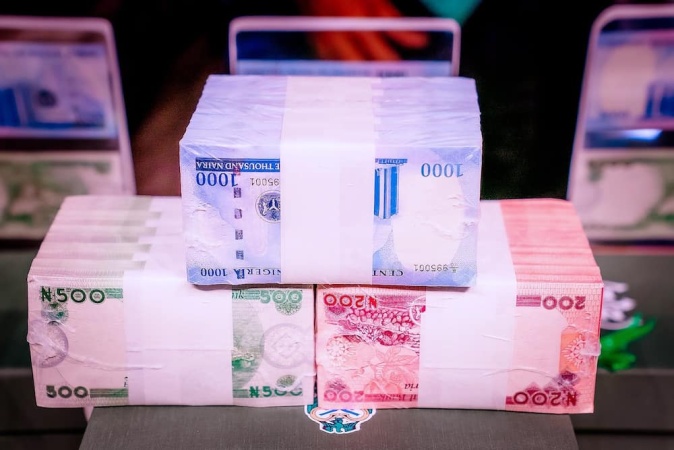
The Naira on Wednesday rebounded in the official foreign exchange market, reversing the previous day’s losses even as Nigeria’s external reserves declined by $1.08 billion amid slowing inflows linked to Middle East tensions.
Data from the Central Bank of Nigeria (CBN) showed the naira appreciated by N14.84 to close at N1,371.82 per dollar, a gain of 1.08 percent compared with N1,386.66 quoted on Tuesday at the Nigerian Foreign Exchange Market (NFEM).
In the parallel market, the local currency held steady at N1,405 per dollar. This left the gap between the official and parallel markets wider at N34, or 2.5 percent, from N19 recorded a day earlier.
Nigeria’s external reserves, which provide the Central Bank with the buffer to support the currency, have continued on a downward trend. Data published on the CBN website showed reserves declined by 2.16 percent to $48.94 billion as of April 7, 2026, from $50.02 billion recorded on March 11, 2026.
The decline in reserves comes at a time of heightened global uncertainty, with the International Monetary Fund urging emerging and developing economies to strengthen their external buffers against potential shocks.
Speaking at the Al-Ula conference in Saudi Arabia, participants highlighted the improved resilience of emerging markets since the global financial crisis, supported by stronger macroeconomic frameworks. However, the IMF cautioned that many countries still lack adequate reserves to withstand major disruptions.
According to the Fund, countries with weak reserve positions remain particularly exposed to sudden shifts in capital flows and external shocks. Low reserve levels can erode investor confidence, constrain policy flexibility, and heighten exchange rate volatility.
While global reserves have expanded significantly over the past 25 years, they remain unevenly distributed. Some countries hold reserves well above adequacy thresholds, while many low-income economies continue to fall short of IMF benchmarks, often due to political and structural constraints that limit their ability to build buffers.
IMF noted that reserve accumulation is typically a gradual process anchored on fiscal discipline, current account surpluses, and flexible exchange rate regimes, rather than short-term borrowing or volatile capital inflows. Countries that rely on unstable sources of funding, it warned, risk seeing stabilisation efforts unravel when external conditions tighten.
However, maintaining large reserve buffers comes with trade-offs. Reserve assets are usually invested in low-yield, highly liquid instruments, making them costly relative to alternative investments. Without proper sterilisation, reserve accumulation can also add to inflationary pressures.
To address these challenges, the IMF called for stronger global cooperation to reduce the cost of holding reserves. Proposed measures include expanding the range of eligible reserve assets beyond short-term U.S. Treasuries to more diversified, longer-term instruments managed through collective investment frameworks.
Such reforms, the Fund said, could improve returns on reserves while preserving liquidity, helping countries better balance stability with growth objectives. It added that building resilient reserve buffers should be treated as a core component of economic policy, alongside investments in infrastructure and human capital.
As global risks intensify, the IMF stressed the need for coordinated efforts to make reserve accumulation more sustainable, particularly for vulnerable economies seeking to safeguard stability and navigate future shocks. (BusinessDay)