ADAD
ADAD
Updating your news feed...
NEWS EXPRESS is Nigeria’s leading online newspaper. Published by Africa’s international award-winning journalist, Mr. Isaac Umunna, NEWS EXPRESS is Nigeria’s first truly professional online daily newspaper. It is published from Lagos, Nigeria’s economic and media hub, and has a provision for occasional special print editions. Thanks to our vast network of sources and dedicated team of professional journalists and contributors spread across Nigeria and overseas, NEWS EXPRESS has become synonymous with newsbreaks and exclusive stories from around the world.











Loading banners
Loading banners...

Nigeria is marking this year’s World Health Day under the shadow of a fresh nationwide strike by resident doctors, a development that emphasises deep-rooted challenges in the country’s health sector, particularly chronic underfunding and weak policy implementation.
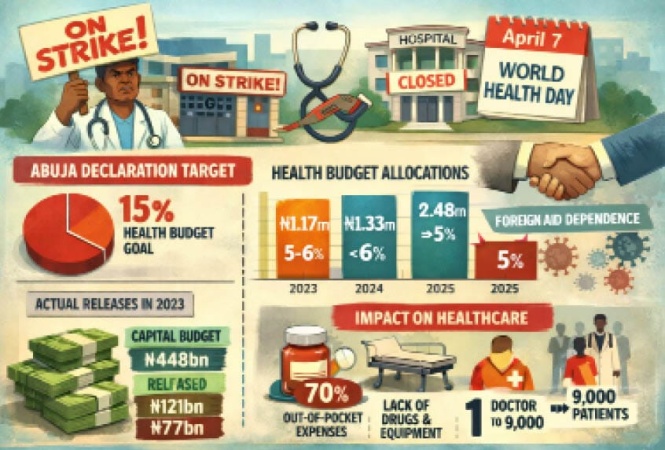
The Nigerian Association of Resident Doctors (NARD) has declared an indefinite strike beginning at 12am on April 7, coinciding with the global observance themed “Together for Health. Stand with Science.”
The industrial action, triggered by disputes over unpaid arrears and the suspension of the revised professional allowance structure, threatens to disrupt services across public hospitals nationwide.
These disputes over allowances and welfare have been a recurring issue in Nigeria’s health sector, contributing to frequent strikes by medical unions, including the Nigerian Medical Association. These disruptions often reduce access to healthcare services, particularly in public hospitals that cater to the majority of Nigerians.

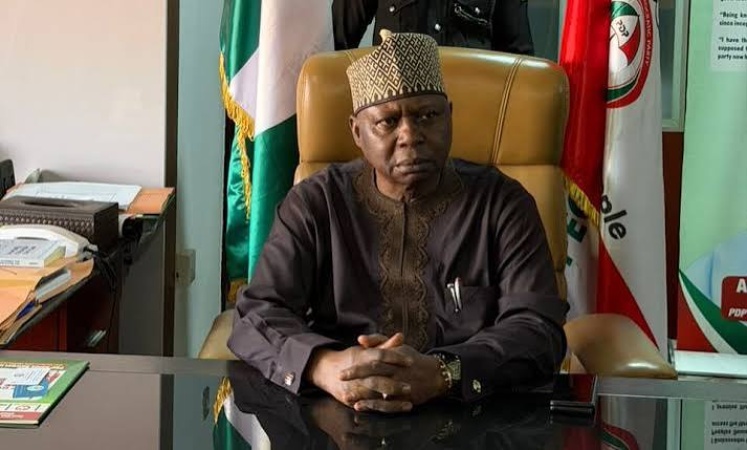
Announcing the decision, NARD’s Secretary-General, Shuaibu Ibrahim, described the federal government’s move to halt implementation of the revised allowance table as “unfortunate,” warning that it risks pushing the sector into another prolonged crisis. The dispute centres on allowances tied to call duty, rural postings and training, many of which doctors say remain unpaid.
The timing is symbolic. On a day when countries are urged to strengthen health systems through science, collaboration and sustained investment, Nigeria is grappling with a crisis driven largely by unresolved welfare and funding issues.
Funding crisis at the core
Beyond the immediate trigger of the strike lies a deeper structural problem: persistent underinvestment in the health sector.
The global community marks World Health Day every April 7 to reflect on the state of health systems and the policies that shape them. For Nigeria, the theme highlights a longstanding contradiction—strong commitments on paper but limited financial backing in practice.
At the centre of this disconnect is a fundamental question that stakeholders in the health sector have consistently put forward: how much does the country truly invest in the health of its people, and what does that mean for access to care?
Nigeria’s funding gap is most evident when measured against its own commitments.
In April 2001, the country joined other African nations in adopting the Abuja Declaration, pledging to allocate at least 15 percent of its national budget to health. The goal was to strengthen systems and tackle major diseases while positioning healthcare as a pillar of development.
More than two decades later, that target remains unmet.
Recent figures from 2023 to 2026 show that health sector allocations have consistently remained below six percent of total government spending. While the proposed 2026 budget allocates about N2.48 trillion to health, the highest in nominal terms so far, the sector’s share has declined from roughly 5.5 percent in 2025 to about 4.2 percent in 2026.
Experts say this level of funding is inadequate when adjusted for inflation, population growth and the country’s rising disease burden.
Budgets versus actual releases
A closer look at recent trends shows a pattern of modest increases in allocations without a corresponding improvement in actual funding.
Health spending was estimated at about N1.17 trillion in 2023, representing roughly five to six percent of the budget. This rose to about N1.33 trillion in 2024, still below six percent, before increasing further to around N2.48 trillion in 2025, maintaining a similar proportion.
However, analysts note that what is approved on paper often differs from what is eventually released.
A senior official at BudgIT Nigeria said, “In Nigeria, what is appropriated is not always what is released. Health, like many social sectors, is vulnerable to under-release, which directly affects service delivery.”
While the 2025 budget raised total health allocations to over N2 trillion, yet capital project releases were just N36 million out of N218 billion, a drastic shortfall hindering key projects.
In 2023, a document by development Research and Projects Centre (dRPC), out of a total capital allocation of N448 billion for 2023, only N120.96 billion (26.99%) was released, and of this, only N77.49 billion (17.29% of the annual appropriation) was utilized.
Government initiatives such as the Basic Health Care Provision Fund (BHCPF), alongside interventions like free caesarean section services and subsidised dialysis programmes in some states, are intended to improve access. Yet, implementation remains inconsistent.
Paul Ajasa, a resident doctor at Kubwa General Hospital, Abuja, said financing remains central to outcomes. “You cannot separate health outcomes from health financing. The consistency of funding, more than just announcements, is what determines whether policies reach people,” he said.
A public health physician and former hospital administrator in Abuja, who requested anonymity, added that policy announcements often fail to translate into reality.
“We see programmes like free maternal services or dialysis support announced, but in practice, patients still pay out-of-pocket for consumables, drugs or lab tests. That gap is the real issue,” the source said.
The Nigerian Medical Association (NMA) has also stressed that funding must translate into tangible outcomes. A senior official said the real issue goes beyond budget figures to whether funds are released on time, facilities are equipped and health workers are supported.
Civil society organisations share similar concerns. Tajudeen Salau, CEO of Glide Health Foundation, noted that while frameworks such as the BHCPF have improved access in some areas, coverage and efficiency remain uneven across states.
Impact on patients and access
The consequences of underfunding are most visible at the point of care.
Nigeria continues to record high out-of-pocket health expenditure, estimated at over 70 percent of total health spending. For many households, this means difficult decisions, whether to seek care, delay treatment or rely on informal providers.
In many hospitals, patients are required to purchase basic supplies before receiving treatment. In primary health centres, essential drugs are often unavailable, while equipment is outdated or non-functional. Access to care remains uneven, frequently determined by income rather than need.
Although frameworks such as the BHCPF aim to expand access to primary healthcare and reduce financial barriers, their impact varies significantly across states. In rural communities, many facilities remain under-equipped or non-functional, limiting access to basic services.
Workforce strain and migration
Experts also noted that the funding gap is also driving a deepening human resource crisis.
Nigeria’s doctor-to-patient ratio remains far below global standards, with estimates from NARD putting it at about one doctor to over 9,000 patients. The shortage is exacerbated by the migration of healthcare professionals seeking better pay and working conditions abroad.
Those who remain are often overstretched and undercompensated, a situation that continues to fuel industrial unrest, now culminating in the latest strike.
The current disruption, analysts say, is not an isolated incident but part of a broader pattern reflecting systemic weaknesses in how the health sector is funded and managed.
Beyond workforce challenges, Nigeria’s health system is also vulnerable due to its reliance on external funding for key programmes, particularly in areas such as HIV, tuberculosis and malaria. Fluctuations in donor support have raised concerns about potential disruptions to treatment and prevention services.
While emergency responses have sometimes mitigated these risks, experts say they highlight the need for sustainable domestic financing.
The World Health Day theme’s call to “stand with science” speaks directly to these issues, stakeholders say. Science-driven healthcare requires systems that are adequately funded, data-driven and accountable. Without these, even well-designed policies struggle to produce meaningful outcomes. (Daily Tust)