Updating your news feed...
NEWS EXPRESS is Nigeria’s leading online newspaper. Published by Africa’s international award-winning journalist, Mr. Isaac Umunna, NEWS EXPRESS is Nigeria’s first truly professional online daily newspaper. It is published from Lagos, Nigeria’s economic and media hub, and has a provision for occasional special print editions. Thanks to our vast network of sources and dedicated team of professional journalists and contributors spread across Nigeria and overseas, NEWS EXPRESS has become synonymous with newsbreaks and exclusive stories from around the world.











Loading banners
Loading banners...

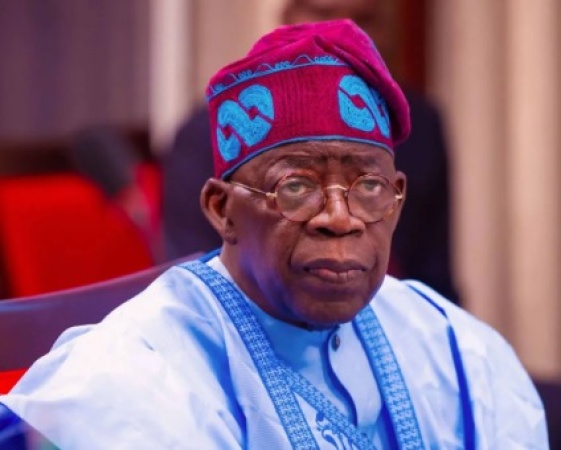
President Bola Tinubu
Economic experts have warned that the proposed N9 trillion increase to the 2026 budget from N58.4 trillion to N68.3 trillion by President Bola Tinubu could box Nigeria into a debt trap if a clear and sustainable debt repayment framework is not designed and diligently implemented.
Aside from deepening Nigeria’s debt crisis, the analysts also said new borrowing could trigger higher taxes and worsen inflationary pressures across the economy.
Their worries also extend to President Tinubu’s loan request to establish a structured total return swap external financing programme of $5, 000,000,000 with First Abu Dhabi Bank, to Support Federal Government Funding and Fiscal Liquidity Management and $1,000,945,693.55 UK Export Finance (UKEF) covered Loan Facility Arranged by Citibank for the rehabilitation of seaports.
President Tinubu wrote to the National Assembly yesterday seeking lawmakers’ nod to take in more loans.
However, economists who spoke on the development expressed concern that the move could further strain an already fragile economy.
A lecturer in the Department of Economics at the University of Lagos, Prof. Femi Saibu, warned that increasing the fiscal deficit amid rising inflation would compound existing economic pressures.
He noted that the rising cost of living, which he said has increased significantly in recent years, reflects the hardship already faced by households, stressing that injecting more money into the system without a corresponding increase in goods and services would fuel inflation.
Saibu added that the burden of financing the expanded budget would ultimately fall on citizens, either through direct taxation or reduced welfare. He advised the government to focus on reducing the cost of governance rather than expanding spending, warning that persistent reliance on deficit financing would worsen economic hardship.
He also linked the proposed increase to pre-election spending patterns, noting that such fiscal expansions are common in election cycles but often do not translate into meaningful improvements in citizens’ welfare. “When we are talking about inflationary challenges and the government still engaging in more deficits, it is going to have implications on the already existing pressure on the economy. We should not deceive ourselves with the recalibrated inflation rates.
“If we look at it very well, when you consider households now, there’s a report that says that within a few years, the cost of living has increased by 250 percent. So, this means there is pressure, and you are also pushing more money into the system without a corresponding increase in goods and services.
“So, number one, this is going to be inflationary. Number two is that it is increasing the indebtedness of Nigerians. That money will either come from another loan or through increased taxes, higher fuel prices, increased interest rates, or one way or the other, the government will raise that money by reducing the welfare of the people.
“So, rather than increasing the fiscal deficit, the government can contain the cost of governance such that it will spend less on what it is doing. I don’t think increasing the deficit now is the best way to go when the economy is already over-liquid.
“Also, we are moving towards an election year. Obviously, such should be expected from governments that have a taste for higher spending, and that is just what is happening. I am not seeing any significant change in the welfare of people because of this incremental change. To me, it is a way of filling shortfalls in expected expenditure, not necessarily in terms of providing additional services to the people.
“If you look at the reasons given for implementing the budget increase, I wonder what that is going to achieve. So, this is another way of the government spending money on problems that are not really issues of funding. The reason for the increment, to me, is not really economic.
“Therefore, we should not expect much from it. However, we should expect higher taxes or a reduction in some of the benefits people are currently enjoying in order to pay back, either today or tomorrow. People are going to pay for this, and those paying may not be the ones who benefit.
“My request to the government is that rather than increasing spending, it should focus on reducing the cost of governance. That will help reduce the fiscal deficit and dependency on borrowing. The idea of increasing deficits whenever there is a shortfall, just to raise more money, is going to worsen the pain of the people. I don’t see that as the best way.” On his part, however, an economist and development expert, Dr. Aliyu Ilias, endorsed the move, saying a larger budget is not entirely unexpected given current economic realities.
Ilias pointed to rising oil benchmark assumptions and global uncertainties, including tensions in the Middle East, as factors influencing the government’s decision.
He added that increased spending in an election year could drive visible projects and boost public confidence, noting that such expansions are often part of broader economic strategies.
The expert further dismissed concerns that the budget increase would necessarily worsen inflation or destabilise the macroeconomic environment.
“The budget may be small compared to what the government is actually expecting. You will also remember that the oil benchmark has increased because of the Iran-Israel war. There is also volatility in the economy now, so our debt servicing burden is high.
“If you look at it very well, they said capital projects were reduced significantly compared to previous years. So, looking at it, we are proponents of a bigger budget, even though we need to work on our revenue side. So, I think it is not bad.
“It is expected that they are going to increase it. You also recall that this is an election year, so the government needs to execute projects that people will appreciate. They also want to show people that they are delivering.
“We are yet to clearly see the areas where the budget is being increased, but I think it is expected, and it is not bad. It should be to the benefit of Nigerians.Budget increases do not necessarily have anything to do with inflation,” he stated.
Also speaking, Project Lead, Calabar and Gulf of Guinea Municipal and Trade Centre Limited by Guarantee, David Etim, explained that the increase in living costs due to the Middle East crisis has impacted the global economy.
“The cost of everything has increased significantly, at least by 100 percent worldwide. So, the government looking to increase the budget by this figure is not, to me, unexpected. However, a budget is only an estimate, it is a plan, a proposal for expenditure. If that budget is not funded, it amounts to nothing. The budget is purely a proposal, and the expenditure can only be realized when it has cash backing. “For me, the government’s or the president’s decision to request an additional N9 trillion in the 2026 budget is fine. My concerns are: What will the money be used for? How will this additional N9 trillion be funded? How realistic is the funding proposal?
“These are the key issues. Once we can see the funding mechanism to raise the N9 trillion, understand how it will be utilised, and monitor the implementation, then we can determine whether the increase makes sense or not,” he said.
In his views, Vice Chairman, Board of Directors, Highcap Securities, David Adonri, noted that expanding the budget could worsen Nigeria’s fiscal deficit.
“I will say that an increase in expenditure of this magnitude, without a commensurate rise in revenue, will inevitably lead to higher borrowing. That raises concerns about debt sustainability.
“It is not news that Nigeria’s fiscal space remains constrained with debt servicing already consuming a significant portion of government revenue. Also, there is always the risk of crowding out when government borrowing rises. Banks may prefer to lend to the government because of lower risk, which could limit credit to businesses,” he said.
The House of Representatives has passed a total budget of N68,303,309,818,667 appropriation for the 2026 fiscal year, ending on December 31, 2026. It also extended the implementation of the capital component of the 2025 budget from March 31 to June 30, 2026.
A breakdown of the budget indicated that N4,799,628,911,806 is for statutory transfers; N15,809,361,631,657 for debt servicing; N15,427,257,802,407 recurrent (non-debt expenditure) and N32,267,061,472,797 for capital expenditure.
President Tinubu had in December 2025 presented a budget proposal of N58.18 trillion titled “Budget of Consolidation, Renewed Resilience and Shared Prosperity,” for the 2026 fiscal year to a joint session of the National Assembly. According to the President, the budget proposal is designed to consolidate recent economic reforms and translate stabilising macroeconomic indicators into improved living standards for Nigerians.
For statutory transfers, the National Judicial Council(NJC) got N610,170,665,073; Niger Delta Development Commission (NDDC)N 618,127,393,490; South East Development Commission (SEDC) N 140,000,000,000; North West Development Commission (NWDC) N145,606,921,550; South West Development Commission(SWDC) N140,000,000,000; South South Development Commission (SSDC)N 140,000,000,000; North Central Development Commission (NCDC) N140,000,000,000 and North East Development Commission (NEDC) N244,066,466,734.
Similarly, the National Assembly got N577,852,880,669; Universal Basic Education Commission (UBEC) N490,283,091,346 and the Independent National Electoral Commission (INEC) N1,013,778,401,602.
For capital expenditure, the Presidency got N147,859,795,959; Ministry of Defence N466,304,756,899; Ministry of Police Affairs N 61,463,608,673; Ministry of Agriculture and food security, N 3,259,020,420,697, Ministry of Power N434,673,108,221 , Ministry of Works N 3,174,611,665,457; Ministry of Education N 655,823,091,110 and Ministry of Health and Social Welfare N1,225,103,984,786.
In a related development, the House considered and approved President Tinubu’s request to Establish a Structured Total Return Swap External Financing Programme of $5, 000,000,000 with First Abu Dhabi Bank, to Support Federal Government Funding and Fiscal Liquidity Management and $1,000,945,693.55 Uk Export Finance (UKEF) covered Loan Facility Arranged by Citibank, for the Rehabilitation of Ports Project. (The Sun)