ADAD
ADAD
Updating your news feed...
NEWS EXPRESS is Nigeria’s leading online newspaper. Published by Africa’s international award-winning journalist, Mr. Isaac Umunna, NEWS EXPRESS is Nigeria’s first truly professional online daily newspaper. It is published from Lagos, Nigeria’s economic and media hub, and has a provision for occasional special print editions. Thanks to our vast network of sources and dedicated team of professional journalists and contributors spread across Nigeria and overseas, NEWS EXPRESS has become synonymous with newsbreaks and exclusive stories from around the world.










Loading banners
Loading banners...

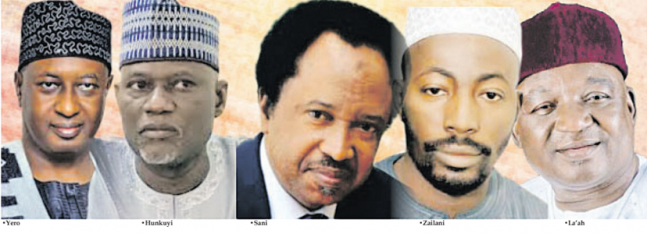
Although parties have yet to hold primaries, ongoing cross-party movements are making clear that current alignments—rather than last-minute surprises—will likely decide the contests. Early shifts are already resetting expectations and shifting the balance of power in the three districts.
Early signs indicate a move away from 2023, when voters mostly followed established party loyalties in traditional alignment zones.
In that election cycle, the ruling All Progressives Congress (APC) retained control of the governorship after former Governor Nasir El-Rufai’s eight-year tenure. However, the People’s Democratic Party (PDP) swept all three senatorial seats, significantly altering the state’s political balance.
The PDP’s clean sweep produced Senator Lawal Adamu Usman for Kaduna Central, Senator Khalid Soba for Kaduna North, and Senator Sunday Marshall Katung for Kaduna South, marking a rare moment of total opposition control of the state’s representation in the Senate.
Since the last elections, the political environment has changed significantly. Defections, recalculations, and strategic repositioning have fundamentally altered the major parties’ strength and structure ahead of the next electoral cycle.
Two of the three PDP senators, Sunday Marshall Katung and Lawal Adamu Usman, have since exited the party, leaving Senator Khalid Soba as the lone PDP senator from Kaduna State—a development that has significantly weakened the opposition’s foothold.
While Katung defected to the APC, citing the need to align with the ruling party for the benefit of his constituents, Usman moved to the African Democratic Congress (ADC). The ADC was gradually positioning itself as an alternative force.
Both lawmakers blamed the prolonged PDP crisis for their departures, arguing its instability hindered effective action.
Although the elections are still some distance away, a new phase has begun. Political observers are already projecting outcomes, and many suggest the APC is well-positioned to reclaim the senatorial seats across the state.
This projection is strengthened by the opposition’s lack of visible mobilisation or campaign energy to match the ruling party.
Currently, outside of Senator Khalid Soba and Lawal Adamu Usman, expected to represent the ADC in Kaduna Central, no other opposition aspirant has gained notable traction.
In contrast, the ruling APC has seen a surge in interest. At least 13 aspirants are present across the three senatorial districts, with 11 seeking the party’s ticket.
In Kaduna North, covering eight local governments, the contest has become a high-stakes battle between two influential political heavyweights.
Former Governor Mukhtar Ramalan Yero and former Senator Suleiman Uthman Hunkuyi have emerged as dominant contenders for the APC ticket. Each brings experience, grassroots appeal, and political resilience, making the race particularly intriguing.
Yero’s rise from finance commissioner to governor after Yakowa’s death, and his recent switch to the APC, have boosted his standing.
Yero has demonstrated loyalty to the APC under Governor Uba Sani. He is widely seen as a strong contender, and his experience and network could prove decisive in securing the party’s ticket.
Hunkuyi is recognised as a capable grassroots organiser with decades of experience, including terms as commissioner and senator. He is known for his political skill and resilience.
Despite leaving the APC after a fallout with Governor El-Rufai and a brief NNPP run in 2023, Hunkuyi’s return under reconciliation has restored him as a major contender.
Now a commissioner in the National Assembly Service Commission, Hunkuyi’s institutional experience and grassroots ties make the APC primary a defining contest.
Analysts say whoever wins the APC ticket will have an edge over PDP Senator Khalid Soba.
Related News
Soba faces stiff opposition, not just over his record but because the ongoing PDP crisis further weakens its election prospects.
In Kaduna Central Senatorial District, the contest now centres on ideology, personality, and structure. Several APC heavyweights are vying for what is expected to be the state’s most competitive primary, while the general election sets up a clash between established figures and emerging challengers.
Senator Shehu Sani, a former lawmaker, remains relevant for his public engagement, activism, and close relationship with Governor Uba Sani—a factor observers believe could shape the APC primary outcome.
Comrade Yerima Shettima, a northern youth leader, is a serious contender due to persistent grassroots work, strong visibility, and effective messaging.
Former Kaduna Assembly Speaker Yusuf Zailani offers legislative experience and influence in Igabi, a key voting bloc.
Abdulmumin Aminu Zaria initially entered the race with notable support, but withdrew after the governor called for neutrality and a level field, intensifying the remaining competition.
As the APC navigates a keenly contested primary, attention shifts to the general election. There, the candidate will face Senator Lawal Adamu Usman, who, after defecting from the PDP to the ADC, is expected to use his incumbency, name recognition, and new platform to mount a credible challenge.
The APC seems to have the advantage, but the outcome hinges on managing post-primary disputes, as party splits have often been costly.
Kaduna South Senatorial District’s political landscape is shifting: once a PDP stronghold, the zone is now seeing the APC steadily gaining ground amid shifting alignments.
This shift accelerated after incumbent Senator Sunday Marshall Katung defected to the APC. The move altered the zone’s political arithmetic and signalled a broader shift of loyalties among key stakeholders.
Katung justified his decision by arguing that aligning with the ruling party best serves his constituents’ interests. He described the tangible dividends of democracy provided by President Bola Ahmed Tinubu and Governor Uba Sani.
In Southern Kaduna, federal interventions such as Kachia University and the Kafanchan Medical Centre are often cited as evidence of government engagement.
Infrastructure projects, appointments, and interventions have gradually improved public perception, with more residents feeling included.
No major opposition figure has emerged in the zone, so the competition is mainly within the APC.
Among those interested are the incumbent Senator Katung, former Senator Danjuma La’ah, Amos Gwamna Magaji, Joseph Ciroma, and Michael Ayuba Auta. Each brings distinct strengths and networks.
Despite several contenders, Katung’s incumbency and record of federal projects give him a strategic edge.
His work in education, healthcare, infrastructure, and empowerment is increasing his reputation for effective representation, possibly deciding both the primary and general elections.
As the 2027 elections draw closer, Kaduna State is shaping up to be a major battleground where party strength, individual influence and strategic alignments will determine outcomes.
While the APC currently appears dominant, especially with the wave of defections and internal consolidation, the fluid nature of Nigerian politics means the opposition cannot be entirely written off. (The Nation)