Updating your news feed...
NEWS EXPRESS is Nigeria’s leading online newspaper. Published by Africa’s international award-winning journalist, Mr. Isaac Umunna, NEWS EXPRESS is Nigeria’s first truly professional online daily newspaper. It is published from Lagos, Nigeria’s economic and media hub, and has a provision for occasional special print editions. Thanks to our vast network of sources and dedicated team of professional journalists and contributors spread across Nigeria and overseas, NEWS EXPRESS has become synonymous with newsbreaks and exclusive stories from around the world.
























Loading banners
Loading banners...


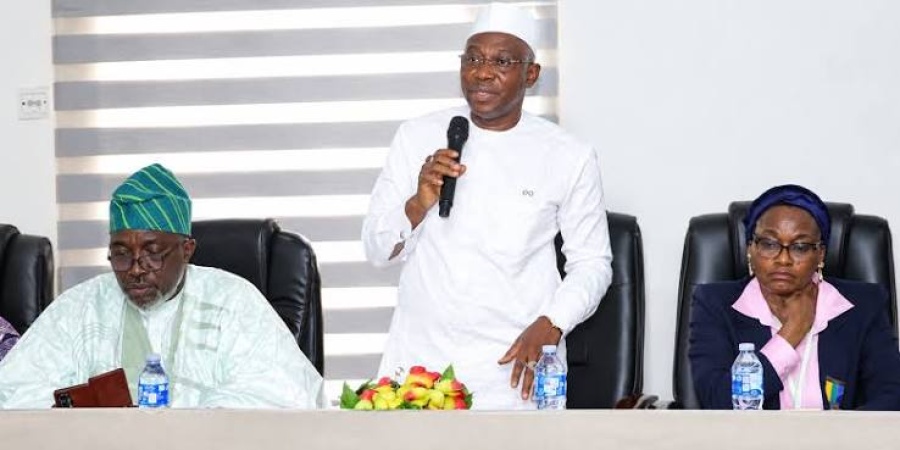
MAN D-G, Segun Ajayi-Kadir
By RUKAYAT MOISEMHE
The Manufacturers Association of Nigeria (MAN) has called for immediate Federal Government actions to insulate the country’s manufacturing sector from global economic shocks and avert widespread factory closures.
Director General, MAN, Mr Segun Ajayi-Kadir, made the call on Friday in Lagos via a statement.
Ajayi-Kadir stressed that proactive policy measures were critical to protect local industries from rising energy costs, foreign exchange volatility and supply chain disruptions driven by global geopolitical tensions.
To strengthen the sector’s resilience, he urged the government to fast-track and subsidise the Presidential Compressed Natural Gas (CNG) initiative for industrial hubs and heavy-duty logistics.
He said the move would reduce manufacturers’ dependence on imported diesel and cushion the impact of rising global energy prices.
The MAN DG also called on the Central Bank of Nigeria (CBN) to establish a dedicated foreign exchange (FX) window for manufacturers importing critical raw materials and machinery.
“Prioritised FX access would shield the sector from speculative pressures and ensure steady production,” he said.
Ajayi-Kadir further advocated policies to domesticate petroleum supply chains by compelling local refineries to prioritise the supply of refined fuels and petrochemicals to domestic manufacturers at concessionary rates.
He added that a six-month moratorium on logistics, haulage levies and multiple transit tolls would ease distribution costs and support market stability.
He stated that insulating the manufacturing sector had become imperative as global developments increasingly translate into higher local production costs.
He noted that manufacturers were grappling with escalating energy prices, expensive imports and weakening consumer demand, all of which threaten output and growth.
“The sector faces a dual challenge of rising production costs and declining sales, as consumers’ purchasing power continues to shrink.
“Without urgent intervention, these pressures could derail the sector’s projected 3.1 per cent growth in 2026,” he said.
Ajayi-Kadir identified key vulnerable segments, including the chemical and pharmaceutical sector, which relied heavily on imported petrochemical inputs.
He noted that the segment accounted for about 88 per cent of Nigeria’s manufactured exports to the United States in 2023, making it highly exposed to global oil market disruptions.
He also highlighted risks to the basic metal, iron and steel sector due to its high energy intensity, as well as the food, beverage and tobacco sector, which depends on imported grains and packaging materials.
The MAN DG cited lessons from the US-Iraq War, noting that Nigeria’s manufacturing sector recorded sharp declines during that period due to external shocks.
According to him, total manufacturing exports plummeted from $901.35 million in 2002 to a dismal $496.87 million in 2003.
He recalled that manufacturing GDP growth suffered a violent contraction, collapsing from a robust 17.74 per cent in 2002 to -10.8 per cent in 2003.
Ajayi-Kadir stressed that although Nigeria could not control global geopolitical events, it could strengthen domestic policies to protect its industrial base.
“The US-Israel-Iran conflict is a stark reminder of Nigeria’s vulnerability to external shocks so long as our manufacturing base remains heavily reliant on imported raw materials.
“Indeed, when the US and Middle East sneeze, the global economy catches a cold and the Nigerian economy is not an exception.
“The window for reactive measures is closed; the time for proactive manufacturing fortification is now,” he said. (NAN)