ADAD
ADAD
Updating your news feed...
NEWS EXPRESS is Nigeria’s leading online newspaper. Published by Africa’s international award-winning journalist, Mr. Isaac Umunna, NEWS EXPRESS is Nigeria’s first truly professional online daily newspaper. It is published from Lagos, Nigeria’s economic and media hub, and has a provision for occasional special print editions. Thanks to our vast network of sources and dedicated team of professional journalists and contributors spread across Nigeria and overseas, NEWS EXPRESS has become synonymous with newsbreaks and exclusive stories from around the world.

















Loading banners
Loading banners...

By IBIRONKE ARIYO
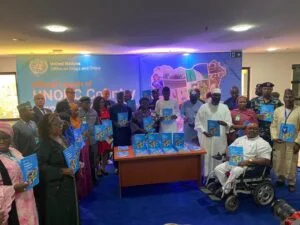
The United Nations Office on Drugs and Crime (UNODC) has inaugurated its Country Programme for Nigeria (2026–2030), calling for stronger domestic investment and political commitment to address gaps in justice, security and development.
Speaking during the inauguration on Friday in Abuja, the Country Representative, Mr Cheikh Toure, stressed that while the programme provided a comprehensive roadmap, its success depends largely on adequate funding and national ownership.
Toure warned that under-resourcing justice institutions could undermine efforts to deliver peace and accountability.
“Justice delayed is justice denied, but justice under-resourced is also justice denied,” he said.
Toure noted that the presence of stakeholders from government, the diplomatic community, civil society, academia, the private sector and the United Nations family reflected a shared commitment to advancing peace, justice and development in Nigeria.
He described Nigeria as being at a defining moment.
He noted that as Africa’s largest economy and most populous nation with a predominantly young population, it plays a critical role in shaping the future of West Africa, the continent and the global community.
He, however, highlighted persistent and interconnected challenges, including illicit drug trafficking and use, as well as transnational organised crime.
This, he listed were such as human trafficking and maritime insecurity, violent extremism, corruption and sustained pressure on institutions and communities.
“These challenges affect citizens directly and have far-reaching implications beyond Nigeria’s borders,”he said.
The UNODC official described the Country Programme as the organisation’s most comprehensive and integrated framework for Nigeria.
This, he said was developed through extensive consultations and grounded in respect for national sovereignty and institutions.
He said the programme adopted a holistic approach built on five key pillars, including strengthening the criminal justice system to ensure fairness, effectiveness and accessibility, particularly for women, children and vulnerable groups.
He added that it also focused on tackling corruption and illicit financial flows, supporting counter-terrorism efforts in line with the rule of law and human rights.
“It also addresses organised crime in all its forms, and promoting health through prevention and treatment of drug use disorders,” he added.
The UNODC boss noted that the framework mainstreams youth development, gender equality, inclusion of persons with disabilities and partnerships across federal, state and community levels.
This, he added were replacing fragmented interventions with a coordinated and results-driven approach.
The country representative acknowledged that implementation would be demanding due to security challenges, limited resources and evolving criminal trends such as cyber-enabled crimes, synthetic drugs and environmental offences.
He, however, expressed confidence in UNODC Nigeria’s capacity to deliver, citing its strong track record and established partnerships.
He disclosed that a Resource Mobilisation Strategy (2026–2030) had been developed alongside the programme to attract funding from diverse sources.
This, he said, included traditional donors, new partners, innovative financing mechanisms and the private sector.
He explained that Nigeria was positioned as a strategic co-investor, contributing through policy leadership, institutional reforms, data systems and progressively increased domestic funding rather than as a primary financial donor.
“Countries that demonstrate ownership through co-financing and strong leadership are more likely to attract sustained and predictable international support,” he said.
The UNODC official, therefore, called for high-level political commitment, support for enabling reforms and increased allocation of domestic resources to priority areas of the programme.
He said such commitment would strengthen institutions, enhance public trust and send a strong signal to development partners, unlocking additional financing.
The representative expressed appreciation to the Federal Government, particularly the Ministries of Foreign Affairs, Budget and Economic Planning, and Justice.
Also, Toure appreciated agencies including NDLEA, NAPTIP, the Nigeria Police Force, the Nigerian Navy, EFCC, ICPC and the Nigerian Correctional Service for their collaboration.
He also acknowledged the support of development partners, highlighting the European Union as the programme’s anchor partner, alongside Canada, the United States, Denmark, Switzerland, the Netherlands, the Global Fund and the Peacebuilding Fund.
He commended civil society, academia, the private sector and communities for their contributions to the programme, describing their engagement as critical to its relevance and sustainability.
The UNODC official lauded the dedication of staff in Nigeria, noting their professionalism and resilience in delivering results despite operational challenges.
He stressed that Nigeria’s challenges required collective action, adding that no single institution or country could address them alone.
He described the programme as a practical, evidence-based and nationally owned framework, backed by a clear plan to mobilise the resources required for implementation.
Toure reaffirmed UNODC’s commitment to working with the Nigerian government, development partners and citizens to strengthen institutions, promote justice and advance sustainable peace and development. (NAN)