Updating your news feed...
NEWS EXPRESS is Nigeria’s leading online newspaper. Published by Africa’s international award-winning journalist, Mr. Isaac Umunna, NEWS EXPRESS is Nigeria’s first truly professional online daily newspaper. It is published from Lagos, Nigeria’s economic and media hub, and has a provision for occasional special print editions. Thanks to our vast network of sources and dedicated team of professional journalists and contributors spread across Nigeria and overseas, NEWS EXPRESS has become synonymous with newsbreaks and exclusive stories from around the world.












Loading banners
Loading banners...

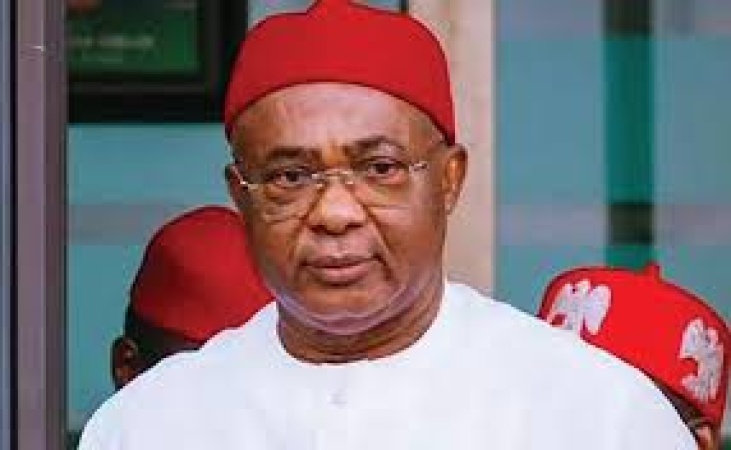
Gov Hope Uzodimma
By Dr NWAODU LAWRENCE
As Imo State approaches the 2027/2028 electoral cycle, a defining question emerges – one that is as historical as it is urgent: will the State once again produce leadership of the calibre of Sam Mbakwe or Michael Iheonukara Okpara – visionary statesmen whose legacies were not rhetorical, but structural, measurable, and enduring.
History provides a sobering benchmark. Over four decades ago, Sam Mbakwe demonstrated what purposeful subnational leadership could achieve within a constrained federal system. His administration delivered large-scale, productivity-oriented infrastructure: a five-star hotel that remains, to this day, the State’s flagship hospitality asset; a state university that institutionalised scholarship and human capital development; the first and only community funded functional airport in Nigeria, industrial estates and manufacturing ventures strategically distributed across local governments; and early investments in power generation and distribution – decades ahead of contemporary decentralisation debates in Nigeria’s electricity sector. His model was clear: development anchored on agriculture, education, and industrial production, with tangible improvements in employment, income levels, and social welfare.
Even earlier, over half a century ago, M.I. Okpara presided over what remains one of the most remarkable episodes in subnational economic governance globally. The Eastern Nigerian economy recorded growth rates estimated at approximately 9% per annum, driven by an integrated development strategy built on agricultural productivity, export-oriented value chains, industrialisation, and disciplined public investment. At a time when many of today’s “Asian Tigers” were still in formative stages, Eastern Nigeria had already begun articulating and executing a coherent development blueprint. The distinguishing factor was not merely policy intent, but clarity of vision, institutional discipline, and fidelity to implementation.
These precedents are not nostalgic references – they are analytical standards. They establish that transformative leadership is neither accidental nor cosmetic; it is the product of intellectual depth, strategic clarity, and executional discipline.
Today, the stakes are significantly higher. Imo State operates within a far more complex environment: a volatile national macroeconomy, evolving global economic realignments, technological disruption, and a demographic structure in which over 70% of the population is youthful – a reality that intensifies the urgency of job creation, enterprise development, healthcare delivery, and education reform. These are not challenges that yield to political improvisation or populist rhetoric. They require rigorous economic thinking, institutional competence, and globally informed leadership.
Accordingly, the quality of individuals who present themselves for leadership will decisively shape the State’s trajectory. The next governor cannot be defined by political agility alone. The moment demands a leader with demonstrable intellectual grounding, professional pedigree, and broad exposure to structured systems – whether in high-level corporate practice, advanced academia, or complex institutional management. This is essential not as a matter of elitism, but as a functional requirement for navigating the increasing sophistication of governance.
At its core, leadership in this context must be understood beyond titles or positional authority. The next leader of Imo State must be one who moves people and purpose forward – ethically, intentionally, and effectively. Such leadership is defined by three irreducible attributes:
Vision: the capacity to see beyond present constraints, articulate a credible future, and mobilise collective belief and participation toward it.
Integrity: the disciplined alignment between words, decisions, and actions, which builds trust – the most critical currency of governance.
Executional Competence: the ability to translate ideas into measurable outcomes through systems, institutions, and sustained policy implementation.
Ultimately, the question before Imo State is not merely electoral – it is existential. Whether the State reclaims a trajectory of productive growth, rising prosperity, and institutional credibility, or continues within cycles of underperformance, will depend largely on the character, capacity, and conviction of its next leadership.
Contemporary Nigeria, despite its structural constraints, has also produced subnational leaders whose tenures offer instructive parallels in disciplined governance, strategic clarity, and measurable development outcomes – further reinforcing the central thesis that vision, integrity, and executional competence remain the irreducible drivers of transformation.
In Lagos State, the reform trajectory initiated by Bola Ahmed Tinubu and institutionalised by Babatunde Raji Fashola stands as a canonical case of development anchored on a coherent long-term blueprint. The deliberate expansion of internally generated revenue – from under ?10 billion monthly in the late 1990s to multiples of that within a decade, and now to over 70 billion Naira per month – was not incidental, but the product of systemic tax reforms, administrative efficiency, and trust-building in public finance. This fiscal strengthening underwrote sustained investments in urban infrastructure, transport systems, environmental management, and judicial reforms. Crucially, Lagos exemplifies the power of policy continuity within a clearly articulated development masterplan, where successive administrations built incrementally on an agreed strategic direction.
Similarly, Peter Obi’s tenure in Anambra State demonstrated the potency of fiscal prudence, transparency, and results-based governance. His administration prioritised savings accumulation, debt reduction, and targeted investments in education, healthcare, and critical infrastructure. By the end of his tenure, Anambra had transitioned from fiscal fragility to one of Nigeria’s most solvent subnationals, with verifiable improvements in human development indicators. His approach underscores a critical lesson: resource constraints are not binding where governance discipline and prioritisation are present.
In the South-South, Godswill Akpabio’s administration in Akwa Ibom State redefined subnational ambition through large-scale infrastructure and urban modernisation – ranging from road networks and aviation infrastructure to hospitality and sports facilities that repositioned Uyo as a regional destination. While debates remain on sustainability, the administration nonetheless demonstrated the catalytic role of bold, visible investments in altering economic perception and attracting secondary capital flows.
More recently, Udom Emmanuel’s tenure deepened this trajectory by emphasising industrialisation – establishing manufacturing concerns in aviation, agriculture, and processing industries. This pivot reflects an important evolution: from infrastructure-led development to productive sector expansion and value-chain integration, a necessary progression for long-term economic resilience.
In Kaduna State, Nasir El-Rufai’s administration pursued governance through institutional restructuring – civil service reforms, education sector overhaul, and attempts at fiscal recalibration. While outcomes remain contested, the underlying framework highlights the importance of state capacity building and administrative efficiency as prerequisites for sustainable development.
In Ekiti State, Kayode Fayemi’s administrations (across two tenures) emphasised knowledge economy, social investments, and governance reforms, illustrating how smaller states can leverage human capital development and policy innovation as compensatory advantages in the absence of large industrial bases.
Across these varied examples, a unifying thread emerges: transformational outcomes are neither accidental nor personality-driven alone – they are the result of disciplined adherence to a clearly defined development architecture. The most successful administrations have operated within medium- to long-term economic and development masterplans, where annual budgets function not as isolated fiscal documents, but as programmatic instruments for sequentially executing a broader vision.
This is the critical institutional lesson. Development is cumulative and path-dependent. It requires:
A clearly articulated vision translated into a strategic roadmap,
Policy coherence across sectors and time,
Fiscal alignment of appropriations to long-term priorities, and A governance culture that privileges measurement, evaluation, and continuity over ad hoc interventions.
Where such frameworks exist, leadership transitions do not disrupt progress; they deepen it. Where they do not, governance becomes episodic, and development outcomes remain fragmented and reversible.
For Imo State, the implication is unequivocal: beyond personalities, the future will be determined by the ability to institutionalise a credible, data-driven, and executable development masterplan, and to entrust its implementation to leadership that possesses not only the intellectual depth to design it, but the discipline and integrity to translate it into measurable improvements in the lives of the people.
If history is to serve as a guide, then the path forward is clear: only leadership grounded in vision, discipline, and selfless commitment to public good can replicate – and indeed surpass – the enduring legacies of Mbakwe and Okpara – building upon the foundational gains and demonstrable stewardship established under the current administration of Senator Hope Uzodimma.
•Dr Nwaodu Lawrence, a Development Economist, writes from Owerri.