 ADAD
ADAD
Updating your news feed...
NEWS EXPRESS is Nigeria’s leading online newspaper. Published by Africa’s international award-winning journalist, Mr. Isaac Umunna, NEWS EXPRESS is Nigeria’s first truly professional online daily newspaper. It is published from Lagos, Nigeria’s economic and media hub, and has a provision for occasional special print editions. Thanks to our vast network of sources and dedicated team of professional journalists and contributors spread across Nigeria and overseas, NEWS EXPRESS has become synonymous with newsbreaks and exclusive stories from around the world.








Loading banners
Loading banners...

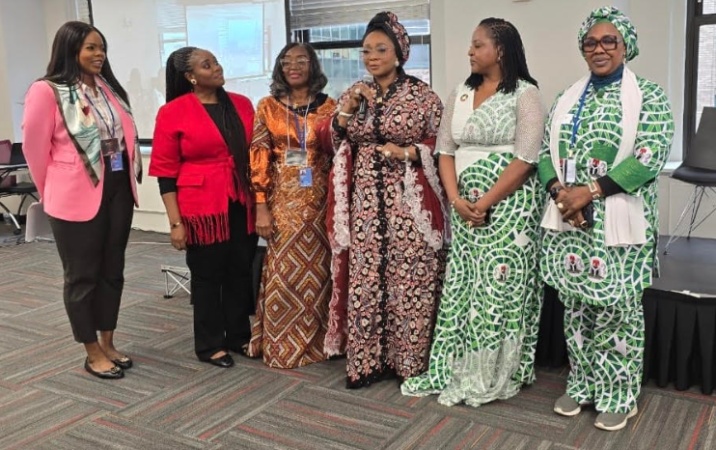
Nigerian women leaders on Thursday delivered a hard‑hitting message at the United Nations: without more money, constitutional reforms and genuine respect for women in institutions, peace and security will remain fragile.
Speaking at the Federal Ministry of Women Affairs’ Nigerian Women’s Day event on the margins of the 70th session of the UN Commission on the Status of Women (CSW70), four prominent women called for a fundamental reset in how Nigeria and the world treat women in leadership, policing, politics and community development.
Under the theme “Women’s Leadership, Peace and Security for Social Impact,” the panel, “Women Leading Across Institutions and Platforms,” was moderated by Seun Okediran, who opened with a stinging statistic: globally, only 24 per cent of leadership roles are held by women, and of 193 countries, just 27 are headed by women.
“We talk about peace and security, but women are not in the rooms where decisions are made,” she said. “Women are not seen for the work they do in building peace, security, and social infrastructure. The numbers are not encouraging. We need to do something about it.”
Gender Adviser to the Inspector‑General of Police, AIG Aisha Abubakar‑Baju, on her part highlighted that “Women in uniforms also have problems”.
She began by confessing she never planned to join the Nigerian Police Force. “I just happened to do my NYSC in police, and I fell in love with the job,” she said. “And I can tell you that if I’m coming back in my next world, I will still be a police officer.”
She joined the force in 1995 and has now served for nearly 31 years, a journey that has taken her through Nigeria’s patriarchal systems and into the role of Gender Adviser to the Inspector‑General of Police.
“In the police, I realised it is just like the Nigerian society—patriarchal, male‑dominated,” she said. “After about 30 years and in this position as the gender advisor, it gave me the opportunity to see whether we can have culture change in the Nigerian Police Force.”
She described how the force has become more intentional about creating equal‑opportunity spaces for women. “The Nigerian Police Force has been intentional about ensuring that the NPF is an equal‑opportunity institution, giving opportunity to more women, focusing particularly on mentorship,” she said.
“Growing up, I didn’t really find many women I could look to as mentors,” she added. “And if there was somebody that actually held my hand and took me through, I wouldn’t have suffered. So we are very intentional. We came up with a mentorship programme for young female officers to be able to hold the hands of the officers.”
The AIG highlighted the 70th anniversary celebration of women in policing last year, an event that was initially met with scepticism by some male colleagues. “At some point, when we announced we were going to celebrate 70 years of women in police, some of our colleagues were not even ready to key in,” she said. “By the time we were done, virtually every commissioner of police was showcasing how he celebrated women in police. It was really phenomenal for us.”
But she also pushed back on the invisibility of women in uniform. “Women in uniform also have the same challenges like every woman out there,” she said. “You think we don’t have problems? We have problems just like you do. And we are being forgotten when these opportunities come.”
She credited the current Minister of Women Affairs with becoming a strategic partner. “When the Honorable Minister was Minister of State for Police Affairs, it was a game‑changer for us,” she said. “Now we have somebody that we can tap into all these opportunities. We need to strengthen women in policing, not just talk about how much we are drained.”
Founder of the Women in Leadership Advancement Network (WILAN), Abosede George‑Ogan, on her part turned the conversation toward civil society, money and power, insisting: “Follow the money. Follow ownership.”
“We’ve come a long way,” she said, referencing the 70‑year milestone of women in policing. “But if you want to influence policy and legislation, there’s something fundamental we must change: we must learn how to work with government. It’s a skill set that we need to learn.”
She pointed to the example of visiting a European ministry with the Women in Leadership network. “We asked how we can fit into their agenda,” she said. “Because if you want to achieve scale and sustainability, then you’re going to have to do it with government.”
Then came the blunt punchline: “Women need more money. And I have a theory: follow the money. And what that means, follow ownership. Because you can only influence what you have proximity to.”
She warned that numbers alone do not equal power. “If numbers equated power, Nigerian women would be ruling,” she said. “We have the numbers, but it has not equated power because some things are missing. One of them is collaboration among women. We need to let it go. We need to focus on our focus. We need an agenda.”
Using the analogy of family disputes, she said: “Families quarrel, but come and fight with one of them and you will see that they are family. That is what we need—collaboration and alliance that is strong.”
She then targeted tokenism and empty leadership. “If we don’t empower young women and keep putting them in positions where they are not empowered, it’s just tokenism and you just want to tick the box, it’s not going to work,” she said. “These networks are only as strong as the weakest link.”
She urged women to monitor where money goes. “If you have money, pay attention to where the money goes,” she said. “Who is the beneficiary of that money? Who owns the business? Who owns the camera? If you start paying attention to this, it will be a game‑changer.”
Executive Director of Verbatim Virtual Solutions, Enene Ejembi, turned the spotlight on politics and constitutional reform. She began with a cold statistic: “Globally, we have 27.5% of women represented in parliament,” she said. “Nigeria is not a great case in point, because we are far below that.”
Her solution: constitutional affirmative action. “Countries like Rwanda and Senegal have used some kind of affirmative action,” she said. “There’s actually a bill to amend the Constitution to make sure that we have special seats for women, across state legislatures and the national assembly. If you can get constitutional amendments like this in place, that’s one really good way to reform the system so that women have more access.”
But she also warned that technical fixes alone are not enough. “As a development practitioner, we have all the methodologies and tools and pilot projects, but often what makes them succeed or fail is less the technical accuracy and more the behaviour—the soft things,” she said.
She urged women to own their ambition. “How many women here have political ambitions?” she asked the audience, noting that several hands went up. “A dream deferred doesn’t feel good, but you have to nurse it. There’s a lot of legwork before you ever stand for an election. Show up.”
She then targeted political parties as “boys’ clubs.” “No matter how much we vote or support women, if the parties themselves continue to be boys’ clubs, it’s a non‑starter for us,” she said. “Unless the parties themselves are no longer boys’ clubs, we have to show up there. Once we show up in the room, we begin to change the culture.”
On the issue of mentorship, she offered a sharp observation: “If you look deep into when a relationship broke down between an older woman and a younger woman, it’s a lack of respect.”
“We do things to other women that we would never do to men,” she said. “We need to give honour to whom honour is due, and that goes both ways.”
Finally, she addressed the childbearing years head‑on. “Do not leave the table,” she said. “Yes, you must focus on your family in your 20s and 30s, but keep a leg in the door. Don’t quit your job wholesale. Do something that keeps you economically viable and plugged into your network, so that when you come back, you can leverage your progress.”
Okediran said Ejembi’s comments had deeply inspired her as a young professional coming up in her career. “Women can do all,” she said, calling for applause for mothers and women balancing home, politics, academia and business.
At the state level, Hon. Maureen Aghukwa, Abia State Commissioner for Women Affairs, showed how policy and cash can transform women’s lives on the ground.
“In Abia State, the major thing that has empowered our women is the Nigeria for Women Project,” she said. “Women formed affinity groups and cooperatives, and that brought them together. They got grants, and you know what it means when you can get grants.”
She explained that the project not only injected capital but also built leadership. “The opportunities made them come together, and they were trained in leadership, because when you lead at the operating level, you learn how to lead other groups,” she said. “That has brought income into the hands of Abia women.”
Aghukwa highlighted a World Bank‑assisted project that supports women in agriculture, particularly in cassava and oil production, as well as a ₦10‑billion SME grant from the state government. “Women in fashion, entertainment, agriculture—all these sectors now have access to money,” she said. “Women need money. When you give women, you gain.”
Speaking on the International Women’s Day theme, “Give to gain”, she said: “Women know how to use money properly. They don’t go to nightclubs. They don’t go to pubs. They use it to train their children and do very good things.
She also spoke on health access, which her state governor, Alex Otti, sets as another priority. “Every local government now has a refurbished public health centre,” she said. “There’s health insurance for women. It has reduced maternal and infant mortality.” (The Sun)
•PHOTO: (L–R): Seun Okediran (Moderator), Abosede George-Ogan (Leadership Advocate and Founder, Women in Leadership Advancement Network), Abia State Commissioner for Women Affairs, Maureen Aghukwa, Minister of Women Affairs and Social Development, Imaan Sulaiman-Ibrahim, and Enene Ejembi (Executive Director, Verbatim Virtual Solutions), during the Nigerian Women’s Day event organized by the Federal Ministry of Women Affairs.



