
ADVERTISEMENT

ADVERTISEMENT

ADVERTISEMENT

ADVERTISEMENT



















Loading banners


NEWS EXPRESS is Nigeria’s leading online newspaper. Published by Africa’s international award-winning journalist, Mr. Isaac Umunna, NEWS EXPRESS is Nigeria’s first truly professional online daily newspaper. It is published from Lagos, Nigeria’s economic and media hub, and has a provision for occasional special print editions. Thanks to our vast network of sources and dedicated team of professional journalists and contributors spread across Nigeria and overseas, NEWS EXPRESS has become synonymous with newsbreaks and exclusive stories from around the world.
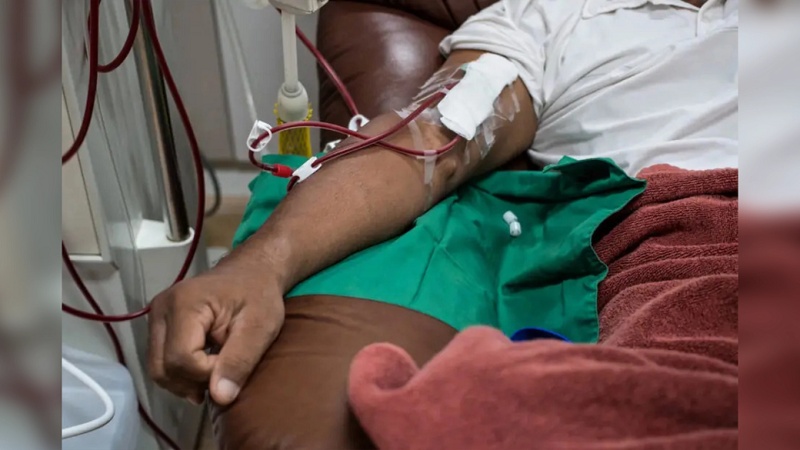
A kidney patient receiving treatment on a dialysis machine
As countries mark World Kidney Day, the high cost of care is taking centre stage in Nigerian hospitals, being a major determinant of survival rates.
Specifically, the cost of dialysis treatment now hovers between N50,000 and N80,000 per session, while a kidney transplant ranges between N25 million and N30 million, depending on the treatment location.
Apparently, in recognition of the disease burden, the Federal Government last year subsidised the cost of dialysis at 10 centres nationwide, bringing the cost down to N12,000 per session.
Caregivers, however, said more needed to be done to ease the burden on Nigerians in need of renal care, the majority of whom are between the active ages of 20 and 50 years.
According to the World Health Organisation, kidney diseases are a leading cause of death globally.
Data obtained from the International Society of Nephrology (ISN) showed that more than 850 million people worldwide have some form of kidney disease, which is roughly double the number of people who live with diabetes (422 million) and 20 times more than the prevalence of cancer worldwide (42 million) or people living with AIDS/HIV (36.7 million)
In Nigeria, Chronic kidney disease (CKD) is a growing public health crisis affecting an estimated 25 million people, with about 45,000 deaths yearly.
The financial implications remain severe for many. Dialysis, which is often required twice weekly for stages three to five renal disease, has shot up from N20,000 to as much as N80,000. While kidney transplantation previously cost between about N7 million and N10 million, today’s estimates indicate that the procedure now costs close to N30 million, placing life-saving treatment far beyond the reach of many Nigerians.
According to the Nephrology Association of Nigeria (NAN), Nigeria has over 200 dialysis centres and about 800 functional dialysis machines nationwide, far short of the 5000 required to effectively manage the growing caseload.
A Professor of Nephrology and the immediate past President of the Nephrology Association of Nigeria (NAN), Jacob Olugbenga Awobusuyi, affirmed that kidney care in Nigeria is expensive, especially for patients with stage five kidney disease.
“On average, dialysis costs between N50,000 and N60,000 per session and the patient is required to go for dialysis at least two or three times a week. So that’s on average, about N150,000 a week, and I don’t think many people can afford that in Nigeria.”
Awobusuyi disclosed that the cost of a transplant is between N25 million and N30 million for the procedure. In addition, the patient will need close to N600,000 to N700,00 every month for the initial drugs for preventing transplant rejection, commonly referred to as induction immunosuppressants.
Awobusuyi observed that chronic kidney disease has been on the rise in Nigeria, with a prevalence rate of between 11 and 12 per cent among the country’s adult population.
He explained that the prevalence could be as high as 20 per cent in some areas, such as among people with diabetes, but that it’s generally about 11-12 per cent.
Awobusuyi identified diabetes, hypertension, and glomerulonephritis as the major predisposing factors for chronic kidney disease.
However, there are other diseases, which include problems of enlarged prostate, HIV, hepatitis, sickle cell disease, especially in children, congenital abnormalities, environmental toxins and abuse of some drugs.
Awobusuyi said: “Nigeria needs about 5000 functional dialysis machines to effectively cater for the growing number of patients that need dialysis.”
He observed that most people are unaware of their kidney disease until it’s too late, adding that efforts are underway to integrate kidney care into primary and secondary health care systems to encourage early detection.
“We need to encourage people to develop a good health-seeking behaviour. That is, going for regular checkups not only for kidney disease, but for other chronic illnesses like hypertension, diabetes, and general ailments.”
Commenting on the federal government’s recently introduced dialysis subsidy, Awobusuyi said it’s a step in the right direction, but 10 to 12 government centres are inadequate. He called for an expanded scope that covers private hospitals nationwide.
Consultant nephrologist at the College of Medicine, University of Ibadan, Professor Babatunde Salako, who spoke with The Guardian, said that although the burden of chronic kidney disease may not appear to have changed significantly within the last decade, broader comparisons over the past 20 to 25 years suggest that the disease has gradually increased.
According to him, the trend is partly driven by lifestyle-related factors and the rising prevalence of underlying conditions that predispose individuals to kidney damage.
Salako explained that the annual global awareness campaign has also improved detection of the disease.
He noted that the yearly observance has created opportunities for people around the world to learn about kidney health, undergo screening and understand how the disease can be diagnosed early.
The nephrologist said that increased awareness has enabled not only nephrologists but also other healthcare professionals to recognise and diagnose chronic kidney disease more easily.
He added that this improved detection sometimes gives the impression that the disease burden is increasing rapidly, when in reality more cases are simply being identified as awareness and screening expand.
Salako, who is also the immediate past Director General of the Nigerian Institute of Medical Research (NIMR), pointed to emerging genetic causes of kidney disease, noting that pharmaceutical companies are currently exploring drugs that may target some of these genetic factors, with several undergoing clinical trials worldwide.
He explained that most materials used for dialysis and kidney transplantation are imported, making the sector highly vulnerable to fluctuations in the naira–dollar exchange rate.
According to him, more than a decade ago dialysis sessions cost between about N20,000 and N30,000, but today the average cost in private hospitals ranges from N50,000 to N80,000 per session.
Since patients often require three dialysis sessions each week, he said the financial burden can quickly become overwhelming for many families.
Salako noted that the cost of kidney transplantation has also increased sharply, rising from about N7 million to N10 million in the past to around N30 million or more now.
He said these escalating expenses have forced many patients to sell personal assets or depend on relatives to access treatment.
Salako reckoned that many kidney disease patients in Nigeria fall within the age bracket of 20 to 50 years. This group includes youths and adults who are often the breadwinners for their families.
He warned that the implications go beyond individual households, stressing that the disease also affects national productivity because those affected are part of the country’s active workforce.
The nephrologist clarified that kidney disease affecting younger people is not necessarily a new trend in Africa. He explained that historically the disease has tended to occur more frequently among younger populations on the continent, unlike in Europe and North America, where it is largely seen among the elderly.
The difference, he said, is largely linked to gaps in health systems. Limited access to hospitals, specialists, medications and financial resources often allows conditions such as diabetes and hypertension to progress to complications like kidney failure.
Salako also identified certain practices common in the region as contributing factors, including the use of herbal medicines whose contents are not clearly defined and the use of compounds that may contain harmful substances, such as mercury.
Beyond disease drivers, Salako highlighted the severe shortage of specialists needed to manage kidney disease in Nigeria. He said the migration of health professionals has significantly depleted the country’s nephrology workforce.
He disclosed that during a recent recruitment exercise at the College of Medicine, Ibadan, the institution could not find a single nephrologist to employ.
Although the Federal Government has directed universities to increase admissions to medicine and other health-related programmes, Salako said the impact of these measures may not be felt for the next five to six years.
He therefore called for coordinated efforts involving government, professional bodies and other stakeholders to address the manpower crisis and create conditions that would encourage skilled professionals to remain in the country.
Salako acknowledged the Federal Government’s efforts to subsidise dialysis in public hospitals.
However, he explained that other operational costs, such as electricity, water supply, and equipment maintenance, are not fully covered by the subsidy, making it difficult for hospitals to sustain the reduced price without additional support.
Salako suggested establishing a revolving fund or additional financial support mechanisms to help hospitals maintain subsidised costs and expand access to dialysis services.
Looking ahead, he stressed that stronger government policies and broader health insurance coverage would make the greatest difference in tackling kidney disease in Nigeria.
He explained that incorporating dialysis and post-transplant medications into health insurance schemes would help patients access treatment without facing catastrophic out-of-pocket expenses.
A Consultant Transplant Physician and Nephrologist at the Nephrology Unit, Department of Medicine, Lagos State University Teaching Hospital, Dr Theophilus Umeizudike, also expressed concern over the high cost of kidney care and treatment in the country, stressing that the cost of dialysis, depending on where you are accessing care, costs between N45,000 and as much as 70,000 per session.
“If somebody spends N50,000 per session and he does two sessions per week, in a month, you’re looking at about N400,000 to N500,000 for dialysis. In a year, if you multiply, that’s about N6 million. That’s aside from other treatments because dialysis is just one cost.
“There are injections, medications, and procedures that need to be done, so maybe another N3m or N4m. Maybe N10 million will be spent in a year. If the patient undergoes a transplant for maybe N25 million, that’s a huge cost that needs to be paid.
“But by the time the person is on what we call immunosuppression, that kind of reduces the cost because immunosuppression may be costing between N200,000 and N400,000 per month. But the good thing about a transplant is that after it’s done, the quality of life improves.”
Control measures
Umeizudike noted that the federal government has started subsidising dialysis, which is a very important step in helping people access care; however, he observed that the subsidy is available in only about 0.5 per cent of the hospitals offering dialysis.
Umeizudike stated that in the early stage of chronic kidney disease, stages 1 to 3, the person is completely asymptomatic, but some people may manifest symptoms like foamy urine, leg swelling, loss of appetite, vomiting, chest pain, and body itching, among others.
He urged Nigerians to observe the eight golden rules to prevent kidney disease. These include regular exercise, drinking enough water, eating a healthy diet, avoiding smoking and alcohol, doing regular checks, controlling blood glucose, checking for blood glucose elevation and also checking blood pressure to be sure the person doesn’t have hypertension.
A Professor of Medicine at Bayero University, Kano, and Consultant Nephrologist at Aminu Kano Teaching Hospital, Prof. Aliyu Abdu, warned that excessive consumption of processed foods and a high-salt diet could increase the risk of kidney disease.
Abdu explained that the kidneys play a critical role in regulating sodium levels in the body, but excessive intake places additional stress on the organs, which work harder to maintain the body’s fluid and electrolyte balance.
According to him, when the kidneys are unable to excrete excess sodium effectively, it becomes retained in the body, leading to poor blood pressure control and fluid accumulation that may cause swelling.
The nephrologist added that for individuals whose kidneys are already compromised, excessive sodium intake could lead to progressive damage that may eventually result in kidney failure.
According to him, such kidney failure is often accompanied by increased blood pressure, severe fluid retention and a heightened risk of cardiovascular diseases. (The Guardian)


