 ADAD
ADAD
Updating your news feed...
NEWS EXPRESS is Nigeria’s leading online newspaper. Published by Africa’s international award-winning journalist, Mr. Isaac Umunna, NEWS EXPRESS is Nigeria’s first truly professional online daily newspaper. It is published from Lagos, Nigeria’s economic and media hub, and has a provision for occasional special print editions. Thanks to our vast network of sources and dedicated team of professional journalists and contributors spread across Nigeria and overseas, NEWS EXPRESS has become synonymous with newsbreaks and exclusive stories from around the world.
















Loading banners
Loading banners...

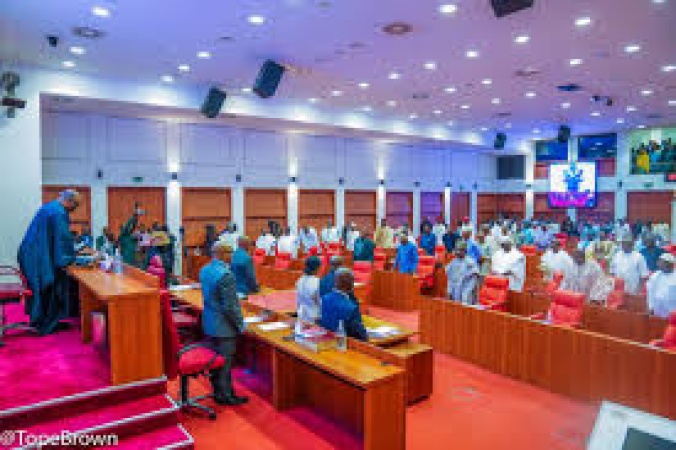
Senate session
The political parties are restructuring their plans for next year’s elections to meet the requirements stipulated by the Electoral Act 2026, particularly digital registration of members and nomination of candidates for the polls.
The African Democratic Congress (ADC) and the Action Democratic Party (ADP) have kicked against those parts of the act.
But it was gathered yesterday that some of the parties are leaving nothing to chance in meeting the requirements.
The Tanimu Turaki faction of the PDP is set to commence its digital membership drive nationwide tomorrow, according to National Publicity Secretary Ini Ememobong.
It will last three weeks.
Ememobong said in a statement that the exercise is in “compliance with the Electoral Act 2026, which requires all political parties to submit the digital register of their members to the Independent National Electoral Commission (INEC).”
He added: “Registration will hold every day (except on Sundays) at all Ward, Chapter and State offices of the Party (special cases will be handled at the National Secretariat), throughout the registration period.
“A committee headed by the National Organising Secretary, Hon. Theophilus Daka Shan, has been set up to oversee the exercise and handle any complaints that may emanate there from.”
The APC concluded Its own digital membership registration last month.
The other parties are expected to follow suit, failing which they will have no opportunity of presenting candidates for the elections.
Section 77 (2) of the Act says: “A party shall maintain a digital register of its members containing the name, sex, date of birth, address, state, local government, ward, polling unit, National Identification Number and photograph in both hard and soft copies.”
Besides, each party is required to make its register available to INEC 21 days before the date fixed for the party’s primaries, congresses and conventions.
Only members whose names are contained in the register will be eligible to vote and be voted for in party primaries, congresses and conventions.
Any party that fails to submit the membership register within the stipulated time will be ineligible to field a candidate for election.
National Chairman of ADP, Engr. Yabagi Sani, said the Act and the new election timetable released by the Commission raised serious red flags about fairness, inclusiveness, and equal political opportunity.
The Tanimu Turaki-led faction of the Peoples Democratic Party (PDP) said it was studying the timetable and would make its position known after a meeting tomorrow.
Sani said: “Let it be clear, democracy is not a race designed for only the well-positioned to win.
“Any electoral calendar that compresses the time available for party membership validation, primaries, and candidate emergence risks tilting the playing field against opposition parties and emerging political platforms.
“Nigerians must not forget credible elections are built long before election day. When the preparatory window is unreasonably tight, the integrity of the entire process comes into question.
“ADP is deeply concerned that the timetable places undue pressure on nationwide party structures to complete complex statutory processes within a narrow window; risks creating systemic disadvantages for smaller and reform minded parties, and may inadvertently fuel public distrust and political tension as the country approaches 2027.
“Nigeria has paid too high a price in its democratic journey to allow administrative decisions to create avoidable suspicion or instability.”
He called for an immediate review by stakeholders, expansion of critical timelines and a level playing field for all parties.
National Publicity Secretary of ADC, Bolaji Abdullahi, described Section 77(7) of the Electoral Act, which states that any party that fails to comply with the deadline for submission of the membership register shall not be eligible to field a candidate for election as a “deliberately constructed barrier” designed to shut opposition parties out of the electoral process.
INEC’s schedule fixes party primaries between April 23 and May 30, 2026. However, under Section 77(4) of the Electoral Act 2026, political parties are required to submit their digital membership registers not later than April 2, 2026.
In a statement by its National Publicity Secretary, Bolaji Abdullahi, on Friday, the party said the timeline effectively creates barriers for opposition participation.
“That is only 34 days away.
“Section 77(7) further provides that any party that fails to submit its membership register within the stipulated time ‘shall not be eligible to field a candidate for that election’.
“These are not house-keeping rules. They are deliberately constructed barriers to exclude opposition from partaking in the coming election,” it said.
The party pointed out that non-compliance would result in disqualification, while alleging that the ruling party had begun compiling its digital register well before the legal requirement came into force.
“What makes this requirement of digital membership particularly insidious is that the ruling party had commenced the process of this registration since February 2025, long before it became a requirement of the law.
“This is not a product of foresight, but insider knowledge. They knew what was coming.
“They therefore had one whole year to carry out an exercise that they expect other political parties to execute in one month.
“This is more or less a practical impossibility,” it said.
The ADC argued that democratic competition requires a level playing field, noting: “A system where one party takes advantage of incumbency to give itself a one-year head-start on a requirement that other parties only became aware of when it is almost too late is a rigged and corrupt system.”
The party said It had joined other opposition parties in rejecting the Electoral Act 2026 and the timetable issued pursuant to it.
However, INEC National Commissioner Mohammed Haruna faulted the opposition criticism.
He said that contrary to their claims, the parties have sufficient time to produce their digital membership register within the framework of the newly released election timetable.
Haruna said on Channels Television that he could not understand what the complaints were all about.
“I don’t see what the big problem or big issue with membership is. Right now, they are supposed to have had their membership sorted out,” he said.
“Every serious party should have no problem collating its membership,” he declared.
Haruna said completing the registration process within the stipulated timeline should not be a challenge.
“I don’t think that it is difficult to have that registration process done by April,” he noted.
The parties, according to him, “are entitled to their opinion.”
He added: “That is the law of the land. INEC doesn’t have the pleasure of rejecting any law. It is guided by what the law is.”
But he acknowledged that the schedule presents operational pressures for the commission.
“Of course, we are bothered by it. We need six months now for our money to be released, and a lot of the things we require are not off the shelf,” he said.
Haruna explained that INEC would need to procure additional Bimodal Voter Accreditation System (BVAS) machines to replace lost units, as well as print ballot papers and result sheets.
While the commission previously printed much of its materials internally, he said several raw materials were sourced externally.
“INEC is getting ready, but I can’t tell you that we are ready because we have yet to get the money for the sensitive materials,” he said
The commissioner also revealed plans to revalidate the voter register but expressed concern over public participation in the process.
“We intend to do a revalidation of the voter register, but the main problem is we have a period of publication for objections and so on, and people never get back to us; sometimes it is a kind of self-indictment,” he said.
On whether the forthcoming election would be glitch-free, Haruna was cautious.
“I cannot tell you it will be glitch-free,” he said.
Ex-INEC officials Igini, Okoye, Nwafor pick holes in Electoral Act
Three former senior officials of INEC are not comfortable with certain parts of the Electoral Act 2026.
Former National Commissioner Festus Okoye, former Resident Electoral Commissioner Mike Igini and former ICT Director Engr. Chidi Nwafor, warned that conflicting provisions on electronic transmission of results could undermine electoral integrity if not urgently addressed.
They spoke on Friday in Abuja at a roundtable discussion themed “Electronic Transmission and Electoral Integrity: Safeguarding the Vote Under the Electoral Act 2026,” organised by civil society organisation, Yiaga Africa.
Okoye, who was chairman, Information and Voter Education Committee of the commission, said while the Bimodal Voter Accreditation System (BVAS) remained a very good and innovative device, the 2026 Act contains inconsistencies that could create confusion in implementation.
He recalled that the Smart Card Reader was initially introduced through INEC guidelines but was not expressly recognised in the Electoral Act until the 2022 amendment.
Okoye cautioned lawmakers against embedding specific technological names in statutes, arguing that technology evolves rapidly.
He said: “Where BVAS appears in the principal section, Smart Card Reader is still retained in other parts of the Act. The National Assembly needs to clean up the drafting to avoid ambiguity.
“Don’t write a particular technology into the law. Allow the electoral body discretion to adopt appropriate technology at any given time. Each time technology changes, you cannot keep amending the Act.”
He explained that BVAS was designed as a multifunctional platform capable of voter registration, biometric accreditation, result upload and even future electronic voting if activated.
He, however, noted that while the device has the capacity for full electronic transmission of results, that function has not been fully operationalised.
A major highlight of the discussion was Section 60 of the 2026 Act, which mandates electronic transmission of polling unit results to the INEC Result Viewing Portal (IReV), but includes a proviso that Form EC8A, the manually completed result sheet remains the primary source of collation and declaration.
Okoye argued that a careful reading of Sections 60 and 65 reveals two separate transmissions; one to IReV for public viewing and another to the collation system.
He cited Section 155, which defines “transmit” as sending manually or electronically, suggesting that the law provides room for both methods.
Okoye maintained that where discrepancies arise, electronically transmitted results to the collation system should carry greater weight if interpreted creatively and strategically.
Former INEC ICT Director, Engr. Chidi Nwafor, lamented what he described as political resistance to reforms, arguing that stakeholders often support technology when in opposition but frustrate it once in power.
Nwafor explained that BVAS was designed to accommodate voter registration, authentication, electronic voting and transmission, stressing that even when network fails, data captured on the device remains intact and can be synchronised once connectivity is restored.
“BVAS was not just designed for accreditation. It was designed as a comprehensive electoral device — registration, authentication, result upload, and even future electronic voting. We were thinking ahead.”
He dismissed claims that network failures render electronic transmission ineffective.
“Even if there is no network at the polling unit, the result captured on BVAS does not disappear. It remains stored securely on the device and transmits automatically once it detects connectivity. That is how it was engineered.
“The greatest obstacle to electoral technology in Nigeria is not technical weakness. It is political resistance. Those who oppose these systems today often supported them when they were not in power,” he said.
He recalled the political battles that trailed the introduction of the Smart Card Reader, saying: “We were summoned to defend the Smart Card Reader before lawmakers. Yet the same technology later became the reason some leaders acknowledged that elections were more credible. The irony is not lost on us.”
On the controversy over manual versus electronic results, he questioned the logic of prioritising paper over digital records.
He added: “If a polling unit result uploaded electronically remains intact and traceable, and the manual copy is mutilated somewhere along the collation chain, common sense should tell us which one better preserves the will of the voters.”
Former Resident Electoral Commissioner, Mike Igini, said INEC has constitutional powers to regulate its own procedures and make binding guidelines.
He said the Supreme Court’s earlier characterisation of IReV as a mere viewing portal weakened public confidence in electronic transmission, adding that the new proviso that makes Form EC8A the primary source of collation could override the gains made through technology.
“The purport of a proviso is to create an exception. By subordinating electronic transmission to manual forms, we risk backsliding from the electoral thresholds we have crossed,” he said.
Igini insisted that electronic transmission should be central to Nigeria’s democratic architecture, arguing that real-time transmission enhances transparency, reduces human error and strengthens public trust.
Programs Director for Yiaga Africa, Cynthia Mbamalu, defended the role of BVAS and real-time upload of polling unit results, stressing that the polling unit remains the most transparent stage of the electoral process.
She explained that BVAS performs three key functions: biometric accreditation, capturing and uploading Form EC8A to IReV, and transmitting accredited voter data to the collation level.
Okechukwu warns opposition against ‘scaremongering’, defends Electoral Act
A former Director-General of the Voice of Nigeria (VON) and chieftain of APC, Mr. Osita Okechukwu, said whatever may be the shortcomings of the new Electoral Act, it is a vast improvement on the 2022 act.
He said that while the repealed law required presiding officers to transfer results “in a manner as prescribed by INEC,” it did not expressly mandate electronic transmission.
In contrast, he said, the 2026 Act mandates electronic transmission of polling unit results to the IReV portal after Form EC8A is signed, with a fallback provision making the hand-signed Form EC8A the primary legal source where transmission fails due to communication challenges.
Okechukwu maintained that under the 2022 act, Nigeria witnessed the defeat of nine sitting governors in their Senate bids — an unprecedented development in the Fourth Republic — which he cited as evidence that the electoral framework could produce competitive outcomes.
“My dear compatriots, we are not in Cameroon or Uganda please,” he told reporters in Enugu.
He blamed the crisis in PDP for the defection of governors elected on the party’s platform to the APC.
He dismissed allegations that the ruling party wants to entrench itself as the sole political force, insisting that the opposition’s internal implosion is largely responsible for its dwindling influence.
“The material conditions that give the impression of a looming one-party state stem from the PDP’s disintegration following its ignoble breach of the long-standing zoning and rotation convention during its 2022 presidential primary,” Okechukwu said.
“Rather than accuse the APC of anti-democratic tendencies, opposition leaders should reflect on their own role in weakening their party structures,” he said.
A review of the timeline of the amendment of the Electoral Act by our correspondent shows that its details were unveiled on Monday, October 13, 2025 during a joint public hearing by the Senate and House of Representatives Committees on Electoral Matters.
The Bill for an Act to Repeal the Electoral Act No. 13, 2022 and enact the Electoral Act, 2025 featured sweeping changes designed to improve transparency, litigation timelines, and voter participation.
During the session, the Senate Committee on Electoral Matters, Senator Simon Lalong, explained that both the Senate and House Committees on Electoral Matters had been engaging with critical stakeholders to ensure that the proposed amendments to the Electoral Act strengthen Nigeria’s electoral process and deepen democracy.
Senator Lalong acknowledged that the Electoral Act 2022 introduced significant reforms but also revealed certain weaknesses, such as delays in the release of election funds, disputes over voter registers, conflicting interpretations of result transmission, and weak enforcement of electoral offences.
Chairman, House Committee on Electoral Matters, Hon. Adebayo Balogun, noted that the amendment process had received robust scrutiny from lawmakers, civil society organisations, INEC, political parties, development partners, and other stakeholders.
Observers are wondering why the opposition failed to detect the inadequacies of the act that they are now complaining about when it was under consideration in the National Assembly. (The Nation)



