Updating your news feed...
NEWS EXPRESS is Nigeria’s leading online newspaper. Published by Africa’s international award-winning journalist, Mr. Isaac Umunna, NEWS EXPRESS is Nigeria’s first truly professional online daily newspaper. It is published from Lagos, Nigeria’s economic and media hub, and has a provision for occasional special print editions. Thanks to our vast network of sources and dedicated team of professional journalists and contributors spread across Nigeria and overseas, NEWS EXPRESS has become synonymous with newsbreaks and exclusive stories from around the world.





















Loading banners
Loading banners...

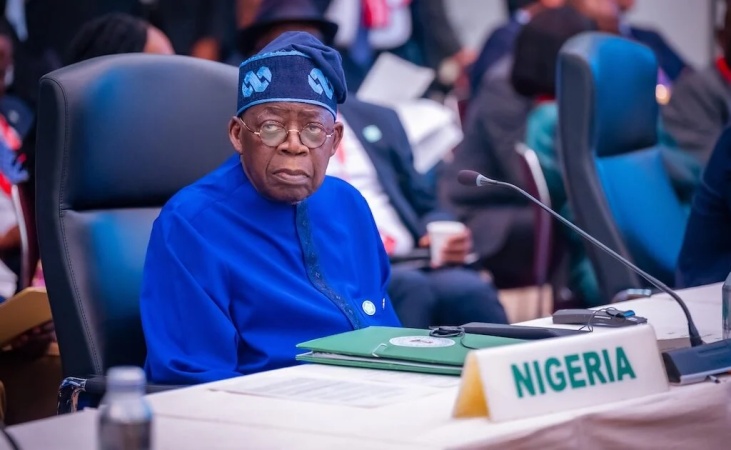
President Tinubu
President Bola Tinubu’s Executive Order 9 issued last week to end the Nigerian National Petroleum Company Limited (NNPC Limited’s) retention of 30 per cent of oil revenues has continued to generate reactions in the polity with energy, legal experts as well as the labour unions querying the rationale for the order which they said flies in the face of the Petroleum Industry Act (PIA) 2021.
Besides, there were concerns that stripping the NNPC Ltd of key revenue streams may undermine capital-intensive frontier exploration efforts, notably in the Lake Chad Basin and Kolmani River projects in northern Nigeria.
President Tinubu had on February 13, 2026, signed a sweeping Executive Order mandating the direct remittance of all oil and gas revenues into Nigeria’s Federation Account, effectively eliminating longstanding revenue retention mechanisms previously enshrined within the Petroleum Industry Act (PIA) 2021.
In a statement, Special Adviser to the President (Information and Strategy), Bayo Onanuga, said the order will also affect the company’s 20 percent profits to cover working capital and future investments.
The statement noted that given the existing 20% retention, the additional 30% management fee is considered unjustified by the Federal Government, as the retained earnings are already sufficient to support the functions NNPCL performs under these contracts.
It also identified the Midstream and Downstream Gas Infrastructure Fund (MDGIF) under Section 52(7)(d) of PIA, funded by the collection of gas flaring penalties provided under Section 104.
It however said the fund is to be used for supporting environmental remediation and relief for host communities impacted by gas flaring but section 103 of the PIA has already established a dedicated Environmental Remediation Fund, administered by NUPRC, specifically designed to fund the rehabilitation of communities negatively impacted by upstream petroleum operations, including gas flaring. Furthermore, Section 103 already imposes a fee on lessees to contribute to this fund for precisely this purpose.
It added that all these deductions far exceed global norms and effectively divert more than two-thirds of potential remittances to the Federation Account.
It also blamed the deductions on decline in net oil revenue inflows that has fragmented oversight under the current PIA architecture.
“The Executive Order aims to resolve, among others, the duplicative 30 per cent deduction for Profit Sharing arrangements by addressing overlapping and redundant provisions across all relevant laws and regulatory instruments under the PIA framework and NNPC Limited’s governing structure. The objective is to eliminate unjustified multiple layers of deductions that erode revenues that ought to accrue to the Federation Account, enabling the three tiers of government to pursue critical national priorities.”
Observers believed that though aimed to increase revenue for the government, the order would constitute a drawback for exploration in the Northern Basins such as Chad, Sokoto, Benue, and Anambra.
Dedicated, long-term capital for exploring high-risk, unproven basins will no longer be available through NNPCL’s internal mechanisms on account of the removal of the 30% FEF, which the government said would ensure fiscal discipline, essentially removing the guaranteed, automatic funding source.
Coming at a period Petroleum Explorationists drummed campaign search for increased exploration for more oil in the country’s productive basins, observers said the order constitutes an albatross, adding that active exploration and geological programs in the north are at risk of slowing down or stalling.
According to observers, the policy will cause technical teams to do away with their equipment, thus making it more expensive to restart projects in the future.
They expressed worry that the policy has brought about uncertainty, forcing international partners to re-evaluate their involvement in Northern Nigeria’s oil exploration.
The observers bemoaned that Northern states that had started planning for local economic development relating to oil exploration face a potential freeze on these prospects.
Frontier Exploration in Lake Chad, Kolmani, others under threat?
The Lake Chad Basin has been identified for decades as a frontier petroleum province with significant hydrocarbon potential.
Geological surveys and exploratory expenditures by the Nigerian National Petroleum Company (predecessor to NNPC Ltd) revealed promising indications of oil and gas deposits in this inland basin.
Historical records indicate federal government spending in the region; for example, N27 billion had been expended on exploration in the Lake Chad Basin prior to 2013, with additional funding earmarked, though detailed disclosures were limited.
Former President Muhammadu Buhari had in 2023 flagged off the resumption of drilling in the Wadi-B Well in the Lake Chad Basin area of Borno State which is expected to produce 943 million barrels of oil.
Buhari said although the exploration started in 1976, it was suspended in 1995 but after the success of Kolmani oil well last year, NNPC re-entered the Lake Chad Basin oil and gas exploration.
Also, the former commission chief executive of the Nigerian Upstream Petroleum Regulatory Commission, NUPRC, Engr. Gbenga Komolafe, said the well with Oil Prospecting Licence (OPL) 732 will add to the reserve.
Komolafe said, “We are optimistic that through this appraisal drilling, the huge hydrocarbon resource estimated at 943 million barrels of initial oil in place will be matured and migrated into the proven oil reserves.”
Kolmani prospect
The Kolmani River field, located on the border between Bauchi and Gombe states within the Gongola Basin, represents perhaps the most strategically significant inland hydrocarbon prospect outside the Niger Delta.
Initial exploratory drilling confirmed substantial hydrocarbon presence, with NNPC Ltd reporting the discovery of over one billion barrels of crude and approximately 500 billion standard cubic feet of gas.
On Tuesday, November 22, 2022, Buhari inaugurated the Kolmani oil drilling project, marking the first-ever crude oil exploration in northern Nigeria.
While the project was stalled shortly after it was flagged off, the new Group Managing Director of NNPC Limited, Bayo Ojulari assured that drilling activities would resume soon.
As of last year, an official of the NUPRC said, “We have some work going on in Kolmani, and we currently have two rigs involved in appraisal drilling. If the data meets the minimum requirements, that work will be reclassified as development drilling, allowing us to add production from that axis.”
In addition to the Kolmani, the Sokoto basin oil exploration has also been stalled over the years with NNPC promising to resume explorations.
Martin Onovo, a petroleum engineer, told Daily Trust that the Federal Government was mischievous and deceptive over the removal of the 30% Frontier Exploration Fund (FEF).
According to him, Tinubu’s executive order directing the immediate remittance of oil revenues to the Federation Account and removes the 30% Frontier Exploration Fund (FEF) retention by the Nigerian National Petroleum Company Limited (NNPCL) show the gross incompetence of the current administration to make the country prosper through quality governance.
He said apart from starving the northern exploration basins, the order constitutes avenue for job cuts and a reduction in the country’s general exploration efforts.
For instance, the landmark Kolmani discovery which demonstrated the transformative value of combining emerging non-seismic technologies with legacy geological and geophysical datasets to enhance prospect identification and maturation in Nigeria’s under explored basins could be affected by the new policy.
According to him, it was misnomer for the President to override the Petroleum Industry Act with the executive order to remove the 30% Frontier Exploration Fund (FEF).
He added: “It’s wrong for President Bola Tinubu to override the provision of the Petroleum Industry Act with his recent executive bill which upstage some of the provisions contained in the Act. It shows the gross incompetence on his part and failure to make the oil and gas industry work for the benefits of Nigerians.”
Kunle Odesola, an energy expert, told Daily Trust that President Tinubu’s Executive Order 9, represents a game-changer for Northern Nigeria’s long-term destiny.
He said by sweeping away the old 30% Frontier Exploration Fund that used to sit idle or speculative under NNPC, EO9 routes every kobo of government entitlements straight into the Federation Account.
He added: “Right now, on February 24, 2026, the Lake Chad Basin remains one of Africa’s toughest theatres. ISWAP (Islamic State West Africa Province) has been the deadliest IS “province” globally, claiming 445 attacks and 1,552 casualties between mid-2024 and mid-2025, while overall militant Islamist fatalities across the region rose 7% to 3,982 last year and civilian deaths jumped 32% to 880 — the highest since 2016.
“Borno State alone accounts for 74% of those losses. JAS (the original Boko Haram faction) has roared back with night assaults using drones, night-vision gear, RPGs and IEDs, clashing violently with ISWAP over Lake Chad islands and smuggling routes as recently as November 2025.
“Just six days ago, on February 18, ISWAP overran a base in Cross Kauwa, killing eight soldiers. Yet the federal government is refusing to blink: the January 2026 licensing round deliberately put four frontier Lake Chad blocks on the table, signalling that energy development is now national security policy.
“Geopolitically, EO9 sharpens this nexus beautifully. Short-term, the shift to budgetary funding may feel slower than the old automatic carve-out, but it forces discipline — no more “idle cash” while insurgents exploit poverty.
“Longer-term, the extra trillions now flowing cleanly into FAAC give the centre real muscle: expanded MNJTF operations (even as its mandate expires this month and Niger has stepped back), community infrastructure that starves recruitment, and a genuine peace dividend. Imagine oil jobs, roads, schools and clean water in Borno and Yobe — the very things that undercut the economic despair feeding insurgency.
“It strengthens Nigeria’s hand in the Lake Chad Basin Commission, checks foreign influence from neighbours, and turns the basin from a hideout into a growth pole. If the Implementation Committee and National Assembly treat Chad Basin as the strategic priority it is in the 2027 budget, EO9 will have delivered exactly what the North needs: wealth that builds peace, not just funds more conflict.”
… Executive Order threatening oil industry stability – PENGASSAN
The leadership of the Petroleum and Natural Gas Senior Staff Association of Nigeria (PENGASSAN), on Tuesday, described the recent order by the President, Bola Tinubu on oil remittance as an attack on Petroleum Industry Act.
It specifically warned that 30% profit oil remittance to the Federation Account (FAAC) may affect workers’ salaries, forex earnings, saying such an order is currently threatening stability in the oil industry.
Speaking on the sideline of the emergency National Executive Council meeting of the union, PENGASSAN President, Festus Osifo, said provisions of the order particularly the directive endanger workers’ welfare.
He said, “From our own assessment, the provisions of this order are a direct attack on the PIA. If government wants to amend laws, send those laws to the National Assembly.
“Let stakeholders debate it. The way this executive order has been done has the ability to impact the stability we currently enjoy in the oil and gas industry.”
Osifo expressed concern that moving the 30 per cent profit oil allocation to the Federation Account Allocation Committee without clearly defining how the statutory management fee would be refunded to NNPC Ltd. could affect the salaries of hundreds of PENGASSAN members.
“That 30 per cent of profit oil amounts to between 1.5 and 2.5 per cent of total revenue. It is the management fee used to pay salaries of those administering the PSCs.
“There are comrades interfacing daily with Shell, TotalEnergies, ExxonMobil and other operators, ensuring that Nigeria is not cheated. How will their salaries be paid?” the labour leader queried.
Prof. Dayo Ayoade, Energy Law expert at the University of Lagos, explained that one of the features of the Petroleum Industry Act 2021 is that it created different funds to achieve different purposes and one of those purposes is the Frontier Basin Fund.
“Now, is this a good or a bad thing? The Frontier Basin Fund is basically looking to look for crude oil in areas where it is hard to get the oil despite its potential as such, the government is providing money to explore for oil and gas in frontier basins where the risk is much higher than in the Niger Delta.”
He said these basins are where commercial companies would normally not go to so the government wants to spend its own money to look for oil and gas there.
“From the very beginning, I thought that was not a good idea because it’s easily a black hole where you can sink billions of dollars and not find anything. The fund has now been redirected by the executive order directly into the federation account. If NNPC is going to be applying to the federation account to get that money, then I guess it will be a lot more accountable for the funds. But the truth of the matter is that finding oil and gas is a bit of a lottery.”
He added that the exploration is not guaranteed so billions of dollars can be spent and nothing might be found or not sufficient to make commercial decisions.
“As to whether those funds are important in de-risking the basins, curiously, yes, they do de-risk the basin because the government is doing the work. But I’ve always had problems with it and I’ve always argued that we should create a different financial and tax model for frontier basins that is so attractive that companies will be willing to gamble their money there.”
Also, an Emeritus Professor of Petroleum Economics, Prof. Omowumi Iledare, said the PIA created the Frontier Exploration Fund as a dedicated, ring-fenced allocation from NNPC Ltd profit oil and gas to support structured de-risking of frontier basins through the NUPRC.
He said the logic was funding certainty for long-term petroleum reserves growth but if the Executive Order effectively removes that automatic deduction and channels the funds into the Federation pool, frontier exploration may lose predictability.
“In that case, access to funding would likely depend on budgetary appropriation and fiscal prioritization, which introduces negotiation dynamics and political competition for resources. From a petroleum economics perspective, the government’s optimal role in frontier basins is to fund data generation (seismic, basin studies, petroleum systems analysis) to reduce information asymmetry and crowd in private capital—not to assume open-ended drilling risk.”
He added that the core issue is the trade-off between short-term revenue optimization and long-term reserve and production sustainability.
“Any policy shift should be assessed against funding certainty, institutional clarity, and capital efficiency in reserve replacement.” (Daily Trust)