Updating your news feed...
NEWS EXPRESS is Nigeria’s leading online newspaper. Published by Africa’s international award-winning journalist, Mr. Isaac Umunna, NEWS EXPRESS is Nigeria’s first truly professional online daily newspaper. It is published from Lagos, Nigeria’s economic and media hub, and has a provision for occasional special print editions. Thanks to our vast network of sources and dedicated team of professional journalists and contributors spread across Nigeria and overseas, NEWS EXPRESS has become synonymous with newsbreaks and exclusive stories from around the world.























Loading banners
Loading banners...

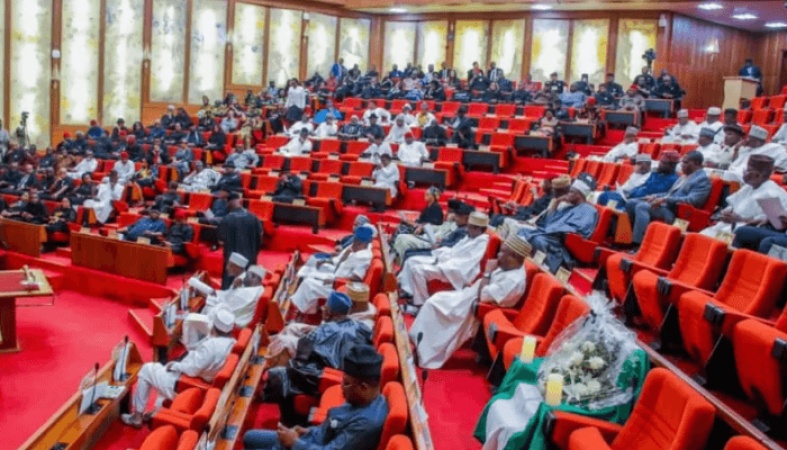
The Senate in session
Reactions have continued to trail the Senate’s rejection of electronic transmission of election results, with some insinuating that it is a strategy for the ruling All Progressives Congress (APC) to rig the 2027 general elections.
The Senate had on Wednesday, rejected an amendment to make it mandatory for election results to be transmitted electronically in real time from the polling units to the IREV portal in the ongoing amendment of the Electoral Act 2022, amongst others.
The upper legislative chamber, had instead, retained the provision in the 2022 Act, which does not specifically provide that the results should be sent to the collation Centre.
This development has not gone down well with some Nigerians, including political parties, support groups and civil society organisations, among others.
It’s a plot to rig future elections in Nigeria – ADC
The African Democratic Congress (ADC) has described the development as a plot by the APC to allegedly rig future elections in the country.
The party, in a statement by its National Publicity Secretary, Bolaji Abdullahi, accused the APC of exploiting its majority in the Senate to allegedly prepare ground for electoral malpractice.
The party also campaigned against the reduction of the time for the issuance of election notice and timeline for the publication of a list of candidates for elections.
The ADC accused the Senate of rejecting critical proposals that would have enhanced the credibility and transparency of elections in the country.
“The ADC condemns the decision of the 10th APC-led Senate to reject critical provisions that would have strengthened the credibility, transparency and integrity of Nigeria’s electoral process.
“Foremost among these is the rejection of electronic transmission of election results, a move that clearly signals yet another attempt by the APC to undermine the will of the Nigerian people and manipulate future elections.
“The Senate also voted against key reforms that would have allowed for the electronic download of voter cards from the INEC website, reduced the notice period for elections and shortened the timeline for the publication of candidates from 150 days to 60 days.
“Proposed provisions were intended to provide the necessary safeguards against electoral abuse and to restore voter confidence in the electoral process. But what the Senate has done amounts to tampering with the laws to expand opportunities for rigging and foist logistical nightmares on INEC that will make future elections even less efficient,” the opposition party stated.
It’s a threat to Nigeria’s democratic progress – TCM
A prominent socio-political organisation, The Collective Movement (TCM), has described the senate’s action as a charade that threatens Nigeria’s democratic progress.
It warned that the decision undermines electoral transparency and risks eroding public confidence in future elections.
TCM’s National Leader, Mr. Oti Paul Obinna, called on Nigerians to demand a technology-driven electoral system capable of curbing election-related violence, thuggery, and manipulation.
“We must rise to demand a modern electoral process in Nigeria,” Obinna said. “How can we claim to be the ‘Giant of Africa’ while spending more on elections than countries like South Africa, which deploy advanced electoral technologies, yet cling to archaic methods designed to serve the hidden interests of those in power?”
It emphasised that real-time electronic transmission of results through IReV was vital to the credibility of elections, noting its key benefits to include enhanced transparency, reduced disputes, improved accuracy and public confidence.
While INEC has consistently promoted IReV as a transparency tool, TCM expressed concern that the Senate’s refusal to make its use mandatory signals a dangerous regression in electoral integrity.
TCM, therefore, called on all well-meaning Nigerians to reject the move and demand an electoral system that genuinely reflects the will of the people.
“The Godswill Akpabio-led Senate appears determined to stall democratic progress. Nigerians must remain vigilant to ensure that our votes are not only cast, but properly counted and transparently transmitted,” he said.
Deliberate attempt to undermine democracy ahead of 2027 – Obi
However, former presidential candidate of the Labour Party (LP), Peter Obi, has also condemned the Senate’s action, describing the decision as a deliberate attempt to undermine democracy ahead of the 2027 general elections.
Obi on his verified ‘X’ handle yesterday said: “The Senate’s action represents a blatant assault on Nigeria’s electoral integrity and a calculated move to entrench manipulation and disorder in the country’s democratic process.”
The former Anambra State governor, who spoke against the backdrop of the tragic loss of over 150 lives in Kwara State, said the incident reinforced the urgent need for responsible leadership and credible institutions in Nigeria.
Obi argued that the controversies and disputes that characterised previous elections, particularly the 2023 general elections, were largely due to the failure to fully implement electronic transmission of results.
According to him, Nigerians were misled with claims of technical glitches that never existed, while other African countries continued to adopt technology to strengthen transparency and credibility in their electoral systems.
“By rejecting mandatory electronic transmission; a critical safeguard for electoral integrity, we are entrenching disorder aimed at perpetuating confusion according to the whims of a small clique,” Obi said.
He accused the political elite of resisting meaningful reforms and dragging the country backward, despite hosting conferences and producing policy papers on national development.
He recalled past comments by international leaders who described Nigeria as “fantastically corrupt” and a “now disgraced nation,” noting that current actions by those in power continue to validate such labels.
To him, Nigerians would no longer tolerate electoral malpractice in 2027, calling on citizens to prepare to legitimately resist any attempt to subvert democracy.
“The criminality witnessed in 2023 will not be tolerated in 2027. Nigerians must rise up and decisively reclaim their country,” he stated.
He urged the international community to pay attention to what he described as “groundwork for continued electoral manipulation,” warning that it poses serious risks to Nigeria’s democracy and development.
Mandatory electronic transmission of election results critical to safeguarding Nigeria’s democracy – CNPP
Reacting to the development, the Conference of Nigeria Political Parties (CNPP) has called on the National Assembly Conference Committee to adopt the House of Representatives’ version of the Electoral Act (Amendment) Bill 2026, insisting that mandatory electronic transmission of election results was critical to safeguarding Nigeria’s democracy.
In a statement on Wednesday, the umbrella body of registered political parties and political associations urged lawmakers to prioritise national interest by ensuring that election results are uploaded directly from polling units to the Independent National Electoral Commission (INEC) Result Viewing Portal (IReV) in real time.
The CNPP specifically rejected the Senate’s decision to retain provisions in the 2022 Electoral Act that give INEC the discretionary powers to determine how results and accreditation data are transmitted.
It described the Senate’s position as anti-democratic and unacceptable, warning that it could undermine public confidence in future elections.
According to the group, the House of Representatives has demonstrated responsiveness to the aspirations of Nigerians by proposing amendments that make electronic transmission compulsory rather than optional.
The CNPP highlighted key provisions in the House version of the bill, including the removal of INEC’s discretionary authority on result transmission and the obligation of Presiding Officers to upload polling unit results immediately after collation.
“These provisions represent the minimum democratic safeguards required to guarantee credible, transparent and verifiable elections in Nigeria,” the statement declared.
The CNPP warned that retaining discretionary transmission provisions would preserve systemic weaknesses that have historically enabled electoral malpractice.
It recalled that controversies surrounding the 2023 general elections were largely fuelled by the failure to enforce real-time electronic transmission of results, leading to public distrust and numerous post-election litigations.
“The Senate’s retention of ambiguous language prioritises administrative convenience over electoral integrity,” the CNPP stated.
From the civil society organisation, Yiaga Africa, the Senate’s action is a major setback for Nigeria’s electoral process. The Executive Director, Samuel Itodo, said this during an interview on Arise TV, where he accused the Senate of misrepresenting the recommendations of the technical committee that drafted amendments to the 2022 Electoral Act.
“I was part of the technical committee that was part of this entire process. What the House of Representatives passed was that electronic transmission will be part of this process. In fact, the report also mentioned the IReV. So, I think that the Senate president is lying to Nigerians because that’s not what was provided in the report,” he said.
Itodo also warned that the Senate’s amendments introduced what he described as “draconian provisions” that could undermine preparations for the 2027 elections. The changes, he said, reduces the window for party primaries to 90 days before elections and requires the INEC to publish candidates’ lists just 60 days before voting. The amendments also removed a provision requiring presiding officers to compare electronically transmitted results with manually collected ones, a safeguard Itodo said was essential for electoral integrity.
He questioned whether the Senate acted independently or under external influence, noting that some provisions in the final bill were not included in the original committee report. “What they have only done is to prioritise their own primordial, and perhaps, personal interest over and above public interest,” he said.
We didn’t reject real-time electronic transmission of results – Senators
However, a group of senators have said the senate did not delete the real-time electronic transmission of election results in the Electoral Act amendment Bill passed by the Senate on Wednesday.
The clarification followed the controversy over the retention of Section 60(3) of the 2022 Act which makes it discretionary for the Independent National Electoral Commission (INEC) to electronically transmit polling unit results in real time.
Section 60(3) of the bill as recommended by the Senator Simon Lalong Committee on Electoral Matters provides that, “The Presiding Officer shall electronically transmit the results from each polling unit to IREV portal in real time and such transmission shall be done after the prescribed Form EC8A has been signed and stamped by the Presiding Officer and/or countersigned by the candidates or polling agents available at the polling unit.”
However, during clause-by-clause consideration of the bill on Wednesday, Senate President Godswill Akpabio had announced that Clause 60 was adopted “as amended and not as recommended.”
However, 24 hours later, 13 serving senators from across party lines, led by Enyinnaya Abaribe (PDP, Abia South), addressed journalists covering the National Assembly to dispel what they described as a wrong impression of the Senate’s position.
Abaribe said the lawmakers decided to brief the media to correct reports suggesting that the Senate had removed electronic transmission of results from the bill.
He stressed that the Senate did not reject electronic transmission and assured Nigerians that senators would closely monitor the provision until the final version of the bill is transmitted to the President for assent.
“To put the record straight, yesterday (Wednesday), the Senate did not, I repeat, did not pass the transfer of results which was in the 2022 Act,” Abaribe said.
“What we passed and which the Senate President himself said, when he was doing a clarification, sitting on his chair, is electronic transmission of results,” he added.
According to him, the briefing was organised to reassure Nigerians that the provision on electronic transmission of results remains firmly in the bill and would be protected through the legislative process.
“I can assure you on my own and on all of us who are standing here, that both the Electoral Committee of the Senate and the Ad Hoc Committee of the Senate, and also in the Executive Session, that we all agreed on Section 60(3), which is electronic transmission of votes or electronic transmission of results,” Abaribe stated.
Also speaking, Senator Abdul Ningi (PDP, Bauchi Central) described reports that the Senate had rejected electronic transmission of results as very painful.
“Our coming here today is to assure Nigerians that the Senate at no time since September last year, when the whole process for a new Electoral Act for the 2027 general election started, jettisoned the need for legal provision for electronic transmission of election results by INEC,” Ningi said.
He cautioned against what he termed a negative narrative against the Senate and the National Assembly, insisting that lawmakers remain committed to strengthening the credibility of elections.
“This negative trajectory against the Senate, and by extension, the National Assembly should stop. We shall ensure that Section 60(3) of the 2026 Electoral Bill follows what will be transmitted to the President for assent,” he added.
Other senators present at the briefing were Austin Akobundu (PDP, Abia Central), Peter Jiya (PDP, Niger South), Ireti Kingibe (ADC, FCT), Victor Umeh (LP, Anambra Central), Binos Yaroe (PDP, Adamawa South), Kabeeb Mustapha (PDP, Jigawa South West), Khalid Mustapha (PDP, Kaduna North), Mohammed Ogoshi Onawo (APC, Nasarawa South), Aminu Waziri Tambuwal (PDP, Sokoto South), Tony Nwoye (LP, Anambra North), and Natasha Akpoti-Uduaghan (PDP, Kogi Central). (The Sun)