ADVERTISEMENT

ADVERTISEMENT





.webp&w=256&q=75)

















Loading banners


NEWS EXPRESS is Nigeria’s leading online newspaper. Published by Africa’s international award-winning journalist, Mr. Isaac Umunna, NEWS EXPRESS is Nigeria’s first truly professional online daily newspaper. It is published from Lagos, Nigeria’s economic and media hub, and has a provision for occasional special print editions. Thanks to our vast network of sources and dedicated team of professional journalists and contributors spread across Nigeria and overseas, NEWS EXPRESS has become synonymous with newsbreaks and exclusive stories from around the world.
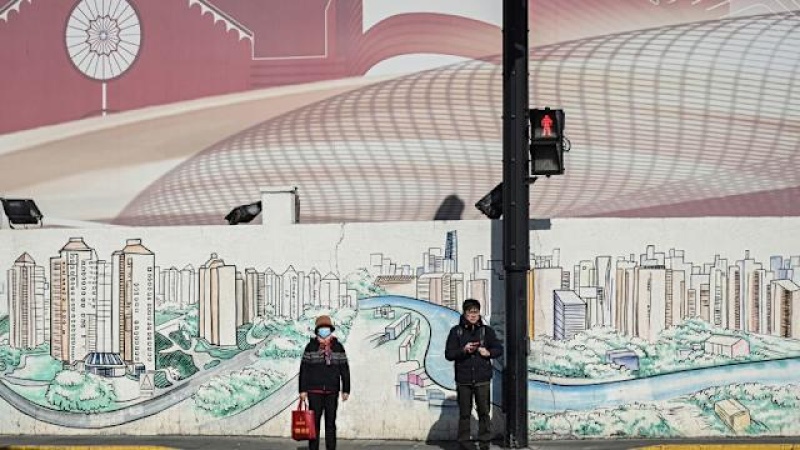
China has introduced policies to boost its birthrate that so far haven't delivered a populat
China clocked its lowest birth rate on record in 2025 as its population shrank for the fourth year in a row, deepening a demographic challenge that could drag on the world’s second-largest economy for decades to come.
The rate fell to 5.63 births per 1,000 people in 2025, beneath 2023’s low of 6.39 per 1,000, China’s National Bureau of Statistics reported on Monday. The drop suggests that a slight uptick in births in 2024 was an outlier rather than a reversal of an otherwise steady decline since 2016.
China’s economy grew 5% in 2025, officials also reported, in line with the government’s annual goal of “around 5%.”
The annual expansion was buoyed by a surge in Chinese exports that offset trade tensions with the US and weak consumption at home. China racked up a record $1.2 trillion-dollar trade surplus last year, despite US President Donald Trump’s on-again, off-again trade war with the world’s second largest economy.
But the data also showed an economic slowdown in the fourth quarter, with the country recording only 4.5% growth from a year earlier – the slowest quarterly increase since the end of 2022.
Officials hailed the “remarkable stability” of the economy, with statistics bureau chief Kang Yi saying this was achieved despite a “complex and severe situation marked by rapid changes in the external environment and mounting domestic challenges.”
“In 2025, China’s economy withstood pressure and maintained steady progress, achieving new results in high-quality development,” Kang said in a press conference.
Despite the on-target annual economic growth, the birth figures deal a blow to Beijing’s efforts to reverse the impact of decades of stringent, state-enforced birth control under the now-abandoned “one-child” policy, and persuade more young people to have children.
With the 7.92 million babies born in China last year outpaced by 11.31 million deaths, the overall population dropped by 3.39 million, the data shows. The country’s headcount – still the world’s second-largest, behind India’s – stands at 1.4 billion for 2025.
China’s changing demographics are seen as a stark challenge by officials, as the country’s labor force shrinks and its population of pension-drawing retired adults grows.
Years of stringent population control under the “one-child” policy, which was scrapped in 2016, have accelerated trends seen in other countries like Japan and South Korea, where falling birth rates have been seen as a result of rising education levels, changing views on marriage, rapid urbanization, and the higher cost of raising kids.
aging of China’s society deepened in 2025, with the population of those aged over 60 standing at 323 million and making up 23% of the population, up one percentage point from 2024, the data shows.
A staggering half of the country’s population could be over 60 by 2100, according to United Nations projections – a reality with potentially far-reaching implications, for not only China’s economy but also its ambitions to rival the United States as a military power.
China’s central government last year began offering annual cash bonuses to families with children under the age of three, amended rules to streamline marriage registration, and kicked off a scheme for free public preschool.
Those add to a raft of incentives local governments have tried in recent years to boost birth rates – from tax breaks and financial assistance for buying and renting homes, to cash handouts and extended maternity leave.
Declining births last year relative to 2024 may also have been linked to the Chinese zodiac, with 2025’s “Year of the Snake” considered less desirable for offspring than the previous “Year of the Dragon.”
Analysts expect more policies or incentives to support births and marriage in the year ahead. But many believe it will be impossible to stem the decline, especially as young people struggle to find jobs and eye the high costs of raising children, while women say the uneven burden of childrearing discourages them from starting or expanding families.
“Children are ‘super consumers.’ With births at such low levels, China’s domestic demand is likely to remain weak, leaving the economy increasingly dependent on exports,” Yi Fuxian, a demographic expert and senior scientist at the University of Wisconsin-Madison in the US.
China’s on-target GDP of 5% shows the resilience of its economy during a year when tariffs on Chinese imports into the US briefly reached triple-digit figures.
But the growth masks deeper challenges for the domestic economy that policymakers are under pressure to address in the year ahead, analysts say.
Expansion slowed to 4.5% in the fourth quarter, the lowest rate on record since economic reopening after the Covid-19 pandemic. The figure was slightly above the 4.4% figure forecast by analysts polled by Reuters, enabling the data to nail the 5% growth target in a year where economic growth started strong and lost momentum.
But while Beijing sought to project an image of resilience, economists remain concerned about weak household spending amid deflationary pressure and an overreliance on exports to drive growth – particularly at a time when governments globally have grown more alarmed by widening trade imbalances.
Chinese manufacturers and exporters made an agile pivot in 2025 to drive their goods deeper into markets across the world, including in Southeast Asia, Africa and Latin America as their entry in the US market came under pressure from Trump’s levies. Those tariffs now stand at 20% imposed on top of pre-existing duties after a trade truce reached late last year.
Despite strong export-led momentum in the first half of 2025, the economy slowed in latter months, weighed down by tepid consumption growth, falling investment and plunging industrial profits.
In December, retail sales grew only 0.9%, compared with the 1.3% growth in November, highlighting the weakness in consumer spending.
Over the year, investment in housing, manufacturing and infrastructure slowed to a historic low, contracting 3.8%, according to the data released Monday – the first annual decline on record. Within that, real estate development declined by 17.2% amid a persistent property sector slum.
One bright spot for the economy was “strong AI & tech investments and robust financial market activities,” the Economist Intelligence Unit analysts said in a note Monday.
“Authorities did not rush a stimulus toward year-end because the 5% target was within reach, helped by strong exports,” they wrote.
Beijing is expected to set its growth target in March, when China’s rubber-stamp legislature convenes. The government will also unveil its next five-year economic blueprint, which will guide the country’s development strategy and policy priorities for the next half-decade.
In a note last month, the OECD forecast that China’s economic growth would weaken to 4.4% in 2026 and 4.3% in 2027, while the IMF projected 4.5% growth for the year ahead.
The economy has been slowing for years following a boom period of double-digit growth that tapered off more than a decade ago. Authorities acknowledge that growth will moderate even as they aim to double the country’s per capita GDP by 2035.
There are also questions about the accuracy of China’s GDP figures, which some analysts argue are inflated to cover up much lower growth. In a report released last month, analysts at the Rhodium Group argued that China’s GDP actually grew between 2.5% and 3% in 2025.
Observers will be watching closely how high China aims as it sets a new GDP target later this year – and how forcibly the government in the year ahead will look to spark consumer spending to rev up that engine of the economy. (CNN)