Updating your news feed...
NEWS EXPRESS is Nigeria’s leading online newspaper. Published by Africa’s international award-winning journalist, Mr. Isaac Umunna, NEWS EXPRESS is Nigeria’s first truly professional online daily newspaper. It is published from Lagos, Nigeria’s economic and media hub, and has a provision for occasional special print editions. Thanks to our vast network of sources and dedicated team of professional journalists and contributors spread across Nigeria and overseas, NEWS EXPRESS has become synonymous with newsbreaks and exclusive stories from around the world.






Loading banners
Loading banners...

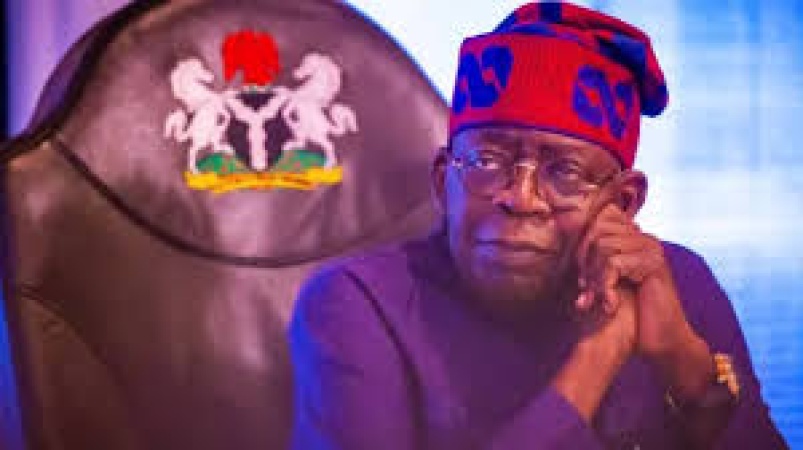
President Tinubu
By VITUS OZOKE, PhD
If politics were only local, Bola Ahmed Tinubu’s path to 2027 would be determined almost entirely by domestic maneuvering, party discipline, and the blunt advantage of incumbency. But politics is no longer merely local – if it ever was. In today’s world, power is exercised as much through perception and narrative as through ballots and institutions. And it is in this terrain that Bola Tinubu faces his most serious vulnerability. Bola Ahmed Tinubu has governed Nigeria as if global power dynamics stopped evolving sometime in the early 2000s. That illusion will soon cost him not only legitimacy but also his political future.
So, let me go straight to it: Washington will not allow Bola Tinubu to run for president again in the 2027 Nigerian election. Let me translate that into Nigerian pidgin: Baba, abi na Uncle Donald Trump, and the United States, no go tolerate Baba Tinubu pass 2027. Not quietly. Not politely. And certainly not out of respect for Nigeria’s electoral process. So, if Tinubu is truly as shrewd and politically discerning as his admirers insist, he should already see the storm gathering on the horizon – and understand that it is not one he can outmaneuver with the usual tricks of incumbency. The geopolitical weather has changed.
The International framing of Nigeria’s insecurity is shifting in ways that should alarm even the most confident strategist in Aso Rock. Recent U.S. military actions and policy rhetoric increasingly situate violence in parts of Africa within a simplified schema: Islamist extremism versus Christian victimhood. While analytically crude, this framing is politically potent, especially within American evangelical and conservative ecosystems that exert outsized influence on Republican foreign policy.
So, the moment American airstrikes entered the African theater and Nigeria’s insecurity was deliberately reframed as Islamic terror against Christian populations, Tinubu’s fate was sealed. That framing is not accidental; it is ideological ammunition. It is certainly not favorable to Bola Tinubu, whose political identity is inseparable from a Muslim-Muslim ticket. It is a narrative that plays perfectly into the ideological instincts of a Trump White House and feeds directly into the bloodstream of Trumpism, where evangelical politics is indistinguishable from national security doctrine.
Donald Trump’s America does not hide its messianic pretense. Evangelical politics is not a sideshow; it is a governing force. This is not foreign policy. This is crusade politics. Donald Trump does not view the world through diplomatic nuance. The man’s foreign policy record shows little patience for nuance. Context is irrelevant. His worldview collapses complex internal conflicts into moral binaries that align neatly with domestic political constituencies. Trump sees enemies, symbols, and narratives. Foreign policy, especially toward Africa, is filtered through a worldview that divides the globe into persecuted Christians and suspect Muslims. In such a framework, Nigeria is being recast not as a multi-religious state struggling with governance failures but as a symbolic battleground in a broader civilizational story. In that worldview, a Muslim-Muslim ticket presiding over a country portrayed as a graveyard of Christians is not a governing arrangement – it is an indictment.
Nigeria’s current leadership configuration – a Muslim-Muslim presidential ticket – was defended domestically as pragmatic and constitutional. Internationally, however, symbolism often outweighs explanation. Once Nigeria is viewed through the lens of religious conflict, that ticket ceases to look like political arithmetic and begins to resemble ideological imbalance. Whether this perception is fair is irrelevant; what matters is that it travels easily in Washington’s policy bloodstream. And Washington, particularly under Trump, governs by perception. Allow me to explain. The APC sold Nigerians an experiment in convoluted political pragmatism: religious homogeneity at the top in exchange for “competence.” What they failed to calculate was how radioactive that choice would become once Nigeria was dragged into America’s culture war. To the American evangelical establishment, a Muslim-Muslim ticket is not inclusivity; it is confirmation. It is not balanced; it is biased. And it is certainly not optically attractive.
American evangelicals – who watch too much TV – do not negotiate with optics. They consume them. And the optics are catastrophically brutal for Bola Tinubu. They view Tinubu as a man whose electoral victory was already contested at home and who now presides over a country increasingly portrayed abroad as a killing field where Christian communities are under siege. In Washington’s evangelical echo chamber, this is not about land disputes, state failure, or criminal banditry. It is about religion. Once that frame hardens, no amount of diplomatic finesse can soften it. Tinubu’s defenders can shout “sovereignty” until their cows come home. It won’t matter. Sovereignty does not survive when global power decides you are a liability.
This is where analysis gives way to an uncomfortable reality. In global power politics, leaders are assessed not only by policy outcomes but also by perceived risk. With Bola Tinubu, some vulnerabilities have refused to go quietly into the night. His controversial age is no longer whispered about; it is out in the open. His health is no longer private; it is a geopolitical risk. Together, age and health raise quiet but persistent questions about stamina and longevity. His long financial and political history, recycled endlessly by critics and adversaries, continues to generate uncomfortable conversations in international policy circles. Allegations, past investigations, court and drug records in Chicago, whether fairly or unfairly interpreted, are the kinds of issues that intelligence briefings do not ignore. They sit there, unblinking, on the table.
These are not gossip items in foreign capitals. They are variables in risk-assessment matrices. They inform judgments about reliability, longevity, and strategic usefulness. For a Trump White House that treats alliances as transactional and leaders as disposable, such variables are not marginal. They are decisive. In a Trump White House that weaponizes personal history as policy leverage, these are not footnotes; they are pressure points. In a White House that governs by intimidation and loyalty tests, Tinubu checks every wrong box.
Let me be clear, and let us dispense with fantasy. It is a mistake to imagine that the United States must overtly oppose a leader to shape outcomes. Modern influence is quieter and more effective. Washington does not need tanks to remove an inconvenient African leader; it does not even need to oppose Tinubu openly. It does not need to issue condemnations or impose sanctions. It uses markets, intelligence briefings, aid conditionality, visa regimes, and diplomatic cold shoulders. All it needs is to cool diplomatic enthusiasm, recalibrate security cooperation, and signal to international financial and security institutions that Nigeria’s leadership is “problematic.” These signals cascade. Investors will retreat. Allies will hedge. Security cooperation will slow. And domestic opposition will find oxygen. No incumbent survives that kind of external chill unscathed. That is how modern regime suffocation works.
APC loyalists who believe incumbency will shield Tinubu in 2027 are either naïve or dishonest. To take that stance is to misread the moment. Nigeria is no longer operating in a permissive global environment. It is drifting into an era where ideology, religion, and spectacle increasingly drive policy in major capitals. In that environment, Nigeria’s internal complexities are flattened, and Bola Tinubu is judged not on intent but on optics. And the optics are deteriorating. Global power has already moved on from Mr. Tinubu. He is not being groomed as a partner; he is being profiled as a problem. And Donald Trump does not keep problems in office.
If Tinubu is truly the political tactician his mythology claims, he should already be preparing his exit – or grooming a successor. The coming years will not be kind, nor will they be neutral. The idea that Donald Trump would look at Nigeria in 2027 – through the prism of evangelical politics, anti-Islam sentiment, and strongman optics – and decide that Bola Tinubu is the man to keep in office defies political reality. Trump does not reward leaders who complicate his narrative. He discards them.
Look, this is not about democracy or Nigeria’s sovereignty. It is about power aligning with perception. Nigeria has wandered into America’s religious culture war. And Bola Tinubu is standing on the wrong side of history, power, and perception. If the ruling APC believes that incumbency alone will carry Tinubu into 2027, it is indulging in dangerous self-deception. The international winds that once tolerated ambiguity are now hostile to it. Nigeria is no longer just a regional power struggling with insecurity; it has become a symbolic battlefield in America’s culture wars. In culture wars, casualties are chosen early. Bola Tinubu will be an early casualty because global power does not reward leaders who complicate dominant narratives. It sidelines them – slowly, methodically, and often invisibly.
If the APC is serious about political continuity beyond 2027, it must confront this reality without sentimentality. Succession planning is not betrayal; it is survival. Strategic recalibration is not weakness; it is intelligence. So, not that I care for or about them, but the smart move for Tinubu and the APC would be to read the signs honestly and begin succession planning. Lower the temperature and prepare for a post-Tinubu reality. The idea that a Trump White House will quietly stand by while a Muslim-Muslim ticket continues to preside over a country framed as a theater of Christian persecution, and against which American military assets have been deployed, is a fantasy. Politics is ruthless. Global politics, even more so. To Bola Tinubu and the APC, ignore this warning at your peril.
To summarize, Nigeria has not merely wandered into a difficult geopolitical moment – it is being drawn into a culture war not of its making. Unless Nigeria’s ruling political class understands how power now operates, it will discover too late that sovereignty is not only defended at home but also negotiated daily in the imaginations of those who shape the world. History is rarely kind to leaders who mistake control for consent or incumbency for inevitability. Global politics is never neutral. It takes sides. Donald Trump has taken a side, and Bola Tinubu is not on that side. Translation: Washington will not allow Bola Ahmed Tinubu to run Abuja beyond 2027. That is being charitable. If he does not continue to take and execute instructions, he could be gone sooner.
•Dr. Vitus Ozoke is a lawyer, human rights activist, and public affairs analyst based in the United States. He writes on politics, governance, and the moral costs of leadership failure in Africa.