ADAD
ADAD
Updating your news feed...
NEWS EXPRESS is Nigeria’s leading online newspaper. Published by Africa’s international award-winning journalist, Mr. Isaac Umunna, NEWS EXPRESS is Nigeria’s first truly professional online daily newspaper. It is published from Lagos, Nigeria’s economic and media hub, and has a provision for occasional special print editions. Thanks to our vast network of sources and dedicated team of professional journalists and contributors spread across Nigeria and overseas, NEWS EXPRESS has become synonymous with newsbreaks and exclusive stories from around the world.























Loading banners
Loading banners...

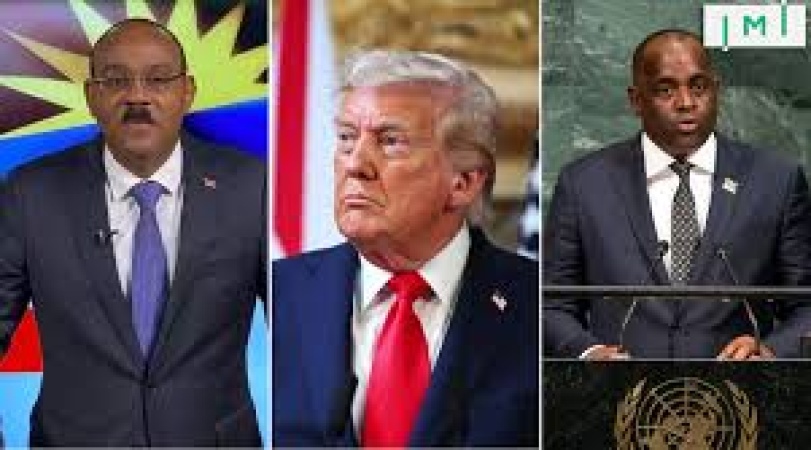
President Donald Trump expanded restrictions on foreign nationals entering the United States on December 16, targeting two Caribbean nations that offer citizenship by investment while exempting three others with similar programs.
Antigua and Barbuda and Dominica will encounter partial entry restrictions beginning January 1, 2026. The proclamation blocks nationals from both countries from obtaining:
The White House proclamation explicitly cited citizenship by investment (CBI) programs as the rationale for restricting the two islands.
Trump warns that “a foreign national from a country that is subject to travel restrictions could purchase CBI from a second country that is not subject to travel restrictions, obtain a passport in the citizenship of that second country, and subsequently apply for a United States visa for travel to the United States, thus evading the travel restrictions on his or her first country.”
US law enforcement and the State Department have determined that “historically, CBI programs have been susceptible to several risks.” The President says these risks include allowing individuals “to conceal his or her identity and assets to circumvent travel restrictions or financial or banking restrictions.”
Grenada, Saint Kitts and Nevis, and Saint Lucia operate similar CBI programs, but did not appear in the proclamation.
Prime Minister Gaston Browne expressed disappointment at his country’s inclusion and rejected the administration’s characterization of the CBI program. Browne declared the government “deeply disappointed that Antigua and Barbuda has been included in this proclamation on the stated ground that our Citizenship by Investment Programme has historically operated without a residency requirement.”
That assertion “does not reflect the present reality of our laws,” according to Browne’s statement. Parliament recently enacted legislation introducing a mandatory 30-day physical residency requirement as a strict condition for citizenship qualification.
Antigua’s Ambassador to the United States, Sir Ronald Sanders, contacted the State Department immediately following the proclamation’s release. Officials told Sanders they found the proclamation surprising and had received no prior notice of its issuance, Browne disclosed.
Browne emphasized that Antigua and Barbuda “engaged in good faith” with several US departments over the past year to strengthen CBI safeguards.
He says the government accepted practical suggestions and took concrete steps to ensure the program “presents no risk whatsoever to the security of the United States,” according to his statement.
The United States serves as Antigua and Barbuda’s most significant trading partner and continues to enjoy a substantial and consistent trade surplus with the country, Browne noted.
He stressed that the relationship predates the independence of both nations and rests on “long-standing ties of friendship, shared democratic values, and close people-to-people connections.”
The prime minister announced he is writing directly to Trump and Secretary of State Marco Rubio, “offering the full engagement and cooperation of the Government of Antigua and Barbuda to address any concerns” and restore normal visa access.
Dominica’s government issued a brief statement acknowledging the restrictions and promising urgent engagement with US authorities.
Officials are actively consulting the US Embassy in Bridgetown, Barbados, to obtain clarification on the scope, basis, and specific implications for Dominican travelers, students, and families.
The government pledged to work closely with US authorities to address identified issues and protect Dominican citizens’ interests.
Officials are committed to treating the matter “with the utmost seriousness and urgency” and promised further updates once they confirm additional details.
The proclamation adds five countries to the full entry ban: Burkina Faso, Mali, Niger, South Sudan, and Syria. The administration also blocks Palestinian Authority passport holders from entering the United States.
Laos and Sierra Leone, previously under partial restrictions, now encounter full bans. Fifteen countries join Antigua and Dominica under partial restrictions: Angola, Benin, Burundi, Côte d’Ivoire, Gabon, The Gambia, Malawi, Mauritania, Nigeria, Senegal, Tanzania, Togo, Tonga, Zambia, and Zimbabwe.
Sierra Leone does not have an outright CBI program, but an expedited pathway to citizenship via its GO-FOR-GOLD program.
Tonga’s new Prime Minister, Lord Fatafehi Fakafanu, has advocated for a CBI program as part of his election strategy.
Burundi, Cuba, Togo, and Venezuela continue facing partial restrictions from earlier proclamations. The administration removed Turkmenistan from the restricted list.
Nineteen countries endure full entry bans: Afghanistan, Burma, Chad, the Republic of the Congo, Equatorial Guinea, Eritrea, Haiti, Iran, Libya, Somalia, Sudan, and Yemen from previous orders, joined by the five newly added nations.
The December 16 proclamation represents the culmination of a nine-month policy development. State Department spokesperson Tammy Bruce categorically denied reports of a draft travel ban list in March, insisting “there’s no list.”
A June memo reviewed by the Washington Post showed 36 countries facing potential restrictions, explicitly citing “citizenship by monetary investment without a requirement of residency” as grounds for action.
That memo gave countries 60 days to address deficiencies in document security, data sharing, and visa overstays.
The restrictions do not apply to nationals who already hold valid visas before January 1, 2026, or who are outside the United States on the effective date.
Other exceptions include:
The proclamation directs consular officers to reduce the validity of other nonimmigrant visas issued to Antiguans and Dominican nationals “to the extent permitted by law.”
A 180-day review cycle will assess whether restrictions should continue, with recommendations on modifications or lifting while engaging affected countries on improving screening, vetting, and information-sharing practices.
The restrictions take effect at 12:01 a.m. EST on January 1, 2026. (IMI Daily)