
Updating your news feed...
NEWS EXPRESS is Nigeria’s leading online newspaper. Published by Africa’s international award-winning journalist, Mr. Isaac Umunna, NEWS EXPRESS is Nigeria’s first truly professional online daily newspaper. It is published from Lagos, Nigeria’s economic and media hub, and has a provision for occasional special print editions. Thanks to our vast network of sources and dedicated team of professional journalists and contributors spread across Nigeria and overseas, NEWS EXPRESS has become synonymous with newsbreaks and exclusive stories from around the world.












Loading banners
Loading banners...

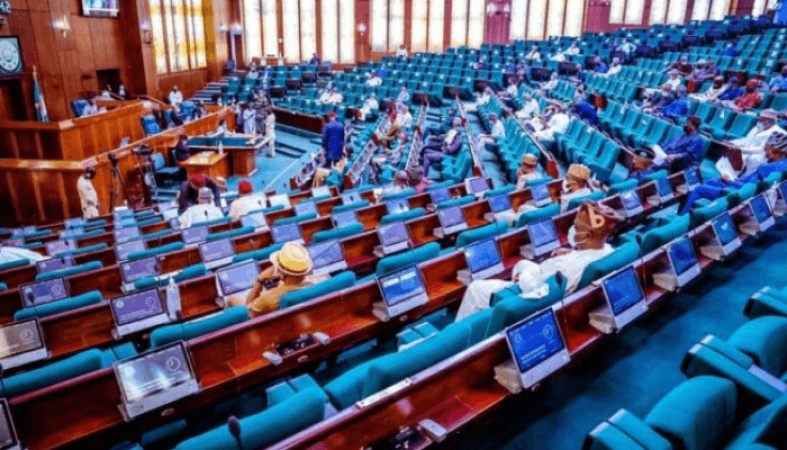
The House of Representatives has suspended consideration of the 2026–2028 Medium-Term Expenditure Framework and Fiscal Strategy Paper after lawmakers clashed over proposed changes to crude oil price assumptions that underpin the federal government’s revenue projections and spending plans.
Consideration of the framework presented during plenary on Wednesday by James Faleke, chairman of the joint committees on finance and on national planning and economic development stalled as Lawmakers raised concerns over inconsistencies in the figures and the wider implications of altering key macroeconomic parameters.
At the centre of the dispute was the committee’s proposal to revise crude oil benchmark prices used in the framework. While the executive had projected benchmark prices of $64.85, $64.30 and $65.50 per barrel for 2026, 2027 and 2028 respectively, the committee recommended lowering the 2026 benchmark to $60 per barrel, while setting prices at $65 for 2027 and $70 for 2028.
The committee said the recommendation reflected heightened geopolitical tensions in Europe and the Middle East and continued volatility in global oil markets.
Tajudeen Abbas, speaker of the House criticised the changes ans warned that adjusting the oil benchmark would have cascading effects on revenue forecasts, borrowing needs and the overall size of the budget.
He questioned whether the committee had fully modelled the impact of lower oil prices — and possible adjustments to production levels, on total government revenue.
Abbas noted that the proposed ₦54.46tn spending framework was predicated on specific oil price assumptions, and argued that cutting the benchmark to $60 per barrel implied a shortfall of about $5 per barrel. That gap, he said, would weaken oil and gas revenue and potentially force a reassessment of the budget envelope.
“How do you intend to accommodate the revenue shock that will arise from lowering the benchmark price and possibly adjusting production volumes?” he queried, urging the committee to clarify whether any shortfall would be covered through higher domestic revenue mobilisation or increased domestic and external borrowing.
Faleke, however defended the proposal, stressing that the MTEF and FSP were built on assumptions that still required legislative approval before the executive could prepare the annual budget. He said the estimates submitted by the government did not necessarily determine the final parameters used in the budget and urged lawmakers to approve the framework to avoid delaying the budget cycle.
Benjamin Kalu, Deputy Speaker, agreed with the Speaker saying that while a more conservative oil benchmark was fiscally prudent, it would inevitably create a revenue gap.
After a prolonged and inconclusive debate, Faleke moved a motion for the reports to be stepped down to allow for further work. The House adopted the motion, with Abbas directing the joint committees to review the figures and return with a revised report the following day. (Business Day)




