Updating your news feed...
NEWS EXPRESS is Nigeria’s leading online newspaper. Published by Africa’s international award-winning journalist, Mr. Isaac Umunna, NEWS EXPRESS is Nigeria’s first truly professional online daily newspaper. It is published from Lagos, Nigeria’s economic and media hub, and has a provision for occasional special print editions. Thanks to our vast network of sources and dedicated team of professional journalists and contributors spread across Nigeria and overseas, NEWS EXPRESS has become synonymous with newsbreaks and exclusive stories from around the world.














Loading banners
Loading banners...

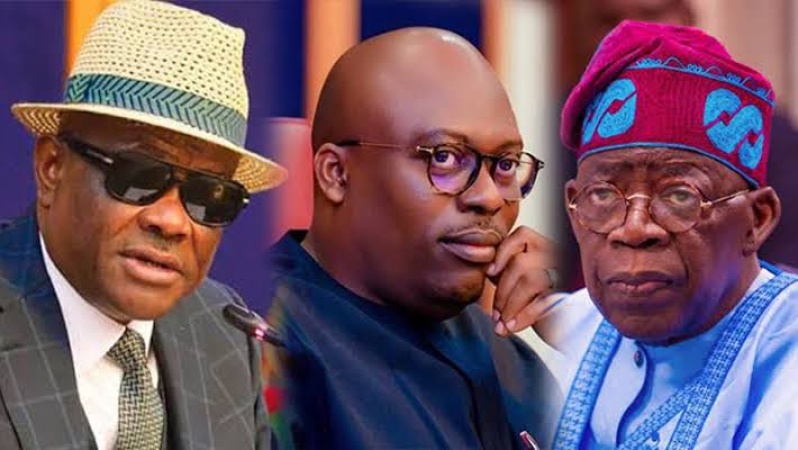
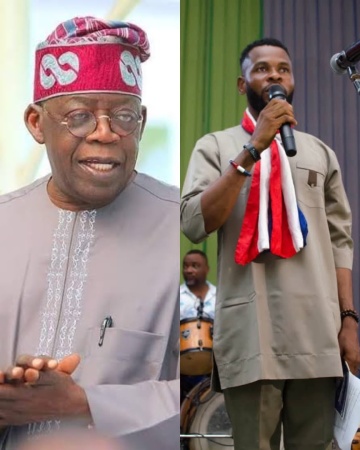
Photo combo of President Tinubu, Nyesom Wike and Gov Fubara
The political landscape in Rivers State has entered a new and more complex phase following the defection of Governor Siminalayi Fubara to the All Progressives Congress (APC) from the Peoples Democratic Party (PDP).
Long regarded as one of Nigeria’s most politically sophisticated and combustible states, Rivers has once again become a theatre where ambition, loyalty, incumbency and power intersect.
Analysts are of the view that Fubara’s move has not only altered party calculations ahead of 2027, but has also deepened the long-running feud between him and his predecessor, Nyesom Wike, now Minister of the Federal Capital Territory (FCT).
Sixteen members of the Rivers State House of Assembly, widely believed to be loyal to Wike, had earlier defected to the APC.
Wike himself, however, remains formally in the PDP despite controversies surrounding his status following his recent “expulsion” by the party’s national convention in Oyo State.
This has fueled speculations about whether his continuous stay in the PDP is tactical or merely a holding position amid a broader realignment.
Fubara
For many observers, the central question is who truly controls Rivers politics today? Is it the sitting governor armed with incumbency, state resources and constitutional authority, or the former governor whose political structure has dominated the state for nearly a decade and who now enjoys proximity to the centre of power in Abuja?
Those who argue that Fubara currently has the upper hand point first to the power of incumbency. Observers say, as governor, he controls the machinery of state, including security apparatuses and financial resources, which traditionally give sitting governors leverage over both party structures and electoral outcomes.
His defection to the APC, analysts say, positions him strategically within the ruling party and could smoothen his path to securing the party’s ticket for a second term.
They say Fubara appears to be determined to assert his independence and shed the image of a loyal protégé.
There is also the argument that President Bola Ahmed Tinubu, as leader of the APC, may ultimately prioritise political expediency over old loyalties.
Some believe Tinubu could, at the eleventh hour, throw his weight behind Fubara if it serves his broader electoral interests, reinforcing the idea that in Nigerian politics, permanent interests matter more than permanent friendships.
Wike
Yet, another school of thought insists that Wike remains the dominant political force in Rivers regardless of party labels. His supporters argue that political power in the state is not merely about occupying office, but about controlling structures, party organs, grassroots networks and elected representatives.
Pundits have argued that the defection of the 16 state lawmakers to the APC was less a victory for Fubara and more evidence that Wike had successfully transplanted his structure into the ruling party.
Wike, as a former governor, is widely believed to still wield influence over appointments, policies and succession plans.
A chieftain of the PDP, Timothy Osadolor, however, said Fubara’s overtures to President Tinubu might yield short-term gains but could prove costly if the political winds shifted.
Analysts say reports of a previous peace pact, allegedly brokered with President Tinubu’s involvement, underscore the fragility of the situation. According to reports, Fubara was expected not to seek re-election and to make significant concessions, including changes to key positions such as the Chief of Staff.
Whether such an agreement truly existed or was honoured remains contested, but its mere circulation highlights the high-stake negotiations that have characterised Rivers politics in recent months.
Analysts weigh in
A public affairs analyst and development consultant, Jide Ojo, told Daily Trust in a telephone interview that the unfolding developments had created what he described as an “untidy situation” in Rivers State politics marked by deepening distrust and competing power blocs involving Governor Fubara, Wike and the members of the House of Assembly.
Ojo maintained that the broader implication of this imbalance was that Wike remained indispensable to the ruling party’s electoral calculations in Rivers, making it unlikely that he would be sidelined for the benefit of the sitting governor.
According to him, Fubara appears to be placing excessive emphasis on courting presidential goodwill in Abuja at the expense of consolidating his political base at home, a strategy he warned could prove counterproductive.
Ojo stressed that electoral strength was built locally and not imposed from the centre, noting that presidential support alone could not substitute for grassroots mobilisation and party cohesion within the state.
“My worry for Fubara is, ‘You are now seeking presidential attention. But the president is not the one that will go and mobilise votes for you in Rivers. You are the one that should even mobilise votes for the president and the president already knows that it’s Wike that can do that job’,” he said.
“If you are telling the president, this is what you are doing, this is what you are doing. Why are your members of the House of Assembly not carried along? that portends a danger because it then means that you have ceded the political structure of Rivers to Wike,” he added.
A political scientist at Al-Hikmah University, Associate Professor Sikiru Nurudeen, said despite assumptions that Wike was expelled at the party’s convention, the minister had deliberately chosen to remain in the PDP in order to assert his continued relevance.
He said Governor Fubara’s defection to the APC, though long anticipated, had introduced a new dynamic into Rivers politics.
“However, since Governor Fubara crossed to the APC, which had long been expected, there has been a new rumbling in Rivers State,” he said.
According to him, while Fubara claims to be abiding by the terms of an earlier peace accord, his defection has given him a sense of comfort and protection within the ruling party.
“Fubara no doubt is still claiming to respect the terms of the peace accord, but he seems more comfortable now being in the APC because the president will see him as one of their own.
“He will also be attending meetings with APC governors, which will give him some leverage, and his colleagues will have more reasons to protect him so that he will not suffer under Wike,” Nurudeen explained.
He, however, cautioned against assuming that party defection automatically confered leadership control in Rivers State, drawing parallels with the APC experience in Lagos.
“But we should not make the mistake of misunderstanding who the leader of a group is in Rivers State. Even while former governors Babatunde Raji Fashola, Ambode, and even with the incumbent Governor Sanwo Olu, Tinubu remained the leader of the party even before becoming President of Nigeria,” he said.
Nurudeen said the current confusion might ease with time, noting that Wike would not immediately contest leadership within the APC since he remained in the PDP with a mission to accomplish.
“Another issue is whether it will be possible for Fubara to get a second term if Wike is not comfortable with him. Given their experience during his first term, Wike might not be ready to support him for a second ticket,” he said, adding that Fubara’s fate might depend on how effectively he aligned with President Tinubu.
Also, a lecturer in politics and governance at the Kwara State University, Seyid Hassan Cisse, said the crisis could be understood through one of the principles of The 48 Laws of Power, which advised political actors never to outshine their masters.
“Political bigwigs and godfathers will remain so, no matter the political party,” Cisse said.
He argued that political allegiance in Nigeria often transcended formal party membership.
“Political scholars believe that someone can be physically in one political party and mentally in another, and that is exactly the case in Nigeria. This is the best way to describe Wike,” he stated.
Cisse noted that Wike’s appointment as FCT minister underscored his political weight.
“Wike was appointed as the Minister of the FCT, one of the juiciest portfolios in Nigeria. Wike is only in the PDP in name, and we all know the obvious,” he said, while attributing Fubara’s defection to fear of political isolation.
He added that Wike’s strength remained intact and hinted that his eventual move to the APC would not be surprising.
“What is happening is a deceitful power play, and if it is real at all, there may be underlying issues that we are not yet aware of that still need to be settled,” he said.
In his remarks, Dr. Kamar Hamza, a political scientist at the Ibrahim Badamasi Babangida University, Lapai, Niger State, said the crisis reflected the entrenched challenge of godfatherism in Nigerian politics.
“Although Governor Fubara may be seen as the one with political power, Wike is still the one who calls the shots and is fully in charge, including controlling resources. We can see how Wike is even disorganising the PDP,” Hamza said.
“The implication is that there may be another cycle of electoral violence, because Fubara will be interested in winning a second term while Wike may want to scuttle that ambition,” he said.
According to Hamza, Fubara’s defection to the APC is a strategic move aimed at countering Wike’s dominance.
“Fubara is not fully succumbing to Wike, and his defection to the APC is meant to give him the opportunity to prevail over his former godfather.
“But for now, President Tinubu appears more aligned with Wike than with Fubara within the APC. The president may call them again, but this time on a different level,” he said. (Daily Trust)