Updating your news feed...
NEWS EXPRESS is Nigeria’s leading online newspaper. Published by Africa’s international award-winning journalist, Mr. Isaac Umunna, NEWS EXPRESS is Nigeria’s first truly professional online daily newspaper. It is published from Lagos, Nigeria’s economic and media hub, and has a provision for occasional special print editions. Thanks to our vast network of sources and dedicated team of professional journalists and contributors spread across Nigeria and overseas, NEWS EXPRESS has become synonymous with newsbreaks and exclusive stories from around the world.

























Loading banners
Loading banners...

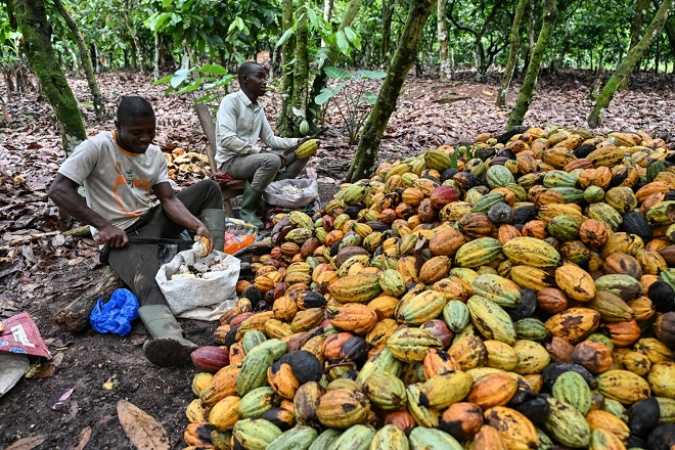
A cocoa planatation
The fall in cocoa prices has accelerated, with a 45% drop since the beginning of the year. This decline in prices began in January.
“After two years of tension, the current correction is bringing cocoa prices back to more rational levels. But it would be illusory to talk about normalization: the sector remains fragile due to structural constraints and a very high geographical concentration of bean production,” said Simon Lacoume, sector economist.
A market in the midst of correction
After reaching nearly $12,000/ton at the end of 2024, cocoa is now trading at around $5,000/ton, a drop of more than 50% in one year. This sharp decline can be explained by two factors: optimistic harvest forecasts in Côte d’Ivoire and the end of speculation that had fuelled the price surge in 2024. Despite this decline, prices remain twice as high as their 2012-2022 average ($2,525/ton).
A potential reprieve for businesses and consumers
The sharp decline in global cocoa prices offers South African and African chocolate manufacturers and retailers a potential reprieve from last year’s record-high costs, with the possibility of affordable products for consumers during the festive season. However, the sector remains exposed to ongoing supply chain risks, elevated costs compared to historical averages, and the need for greater sustainability and diversification, as most cocoa is sourced from a highly concentrated and vulnerable region in West Africa, impacting both local businesses and economies across the continent.
Persistent structural tensions
Although the effects of El Niño and the swollen shoot virus have subsided, the supply deficit remains, and the problems of 2024 persist. Plantations are ageing, investment remains too limited, and production is highly concentrated geographically. Côte d’Ivoire and Ghana together account for nearly 60% of global production, rising to 70% if we include the rest of West Africa. The cocoa sector is therefore extremely vulnerable to any disruption in supply from this region.
Robust global demand
Chocolate consumption continues to grow, driven by Asia and the premium segments. Ethical, organic and low-sugar chocolates are gaining ground, as is certified cocoa (Fairtrade, Rainforest Alliance). At the same time, producing countries such as Côte d’Ivoire and Ghana are seeking to increase the share of domestic grinding to capture more value.
Europe dominates grinding and retail market
The cocoa processing industry is dominated by Europe, particularly Germany and the Netherlands. Four companies control two-thirds of the world's grinding capacity, and the same is true of the retail confectionery market. This concentration makes it difficult for new players to enter the market and reinforces the North-South divide in the value chain.
Sustainability and diversification
West Africa remains dominant, but Latin America, particularly Ecuador, aims to overtake Ghana by 2027, targeting 650,000 tons of cocoa produced per year. Traceability initiatives imposed by the EU and the Reference Price for a Decent Income (PRRD) mechanism put in place by the Ghanaian and Ivorian governments – setting a minimum producer price (farm gate price) of $3,408/ton in Ghana and $2,650/ton in Côte d’Ivoire – are simultaneously increasing pressure for a sustainable and transparent supply chain.
Long-term environmental impact
The life cycle of a cocoa plantation is 25 to 30 years. In detail, crops reach their peak productivity after 5 years, then start to decline after 15 years, falling below the break-even point in the last 10 to 15 years.
At this point, farmers have several choices:
• continue with a much lower income
• renew the plants (and therefore go without a harvest for the next 5 years)
• cultivate new land and/or convert these crops to palm or rubber trees.
The relocation of cocoa cultivation de facto leads to the clearing (and hence deforestation) of virgin areas in order to benefit from the "forest rent" to finance the industry. Despite increasingly strict forest protection rules, the increase in production needs is likely to lead to an expansion of cultivated land and therefore an increase in deforestation, a process exacerbated by the difficulty of tracing cocoa products beyond the grinding stage.