ADAD
ADAD
Updating your news feed...
NEWS EXPRESS is Nigeria’s leading online newspaper. Published by Africa’s international award-winning journalist, Mr. Isaac Umunna, NEWS EXPRESS is Nigeria’s first truly professional online daily newspaper. It is published from Lagos, Nigeria’s economic and media hub, and has a provision for occasional special print editions. Thanks to our vast network of sources and dedicated team of professional journalists and contributors spread across Nigeria and overseas, NEWS EXPRESS has become synonymous with newsbreaks and exclusive stories from around the world.












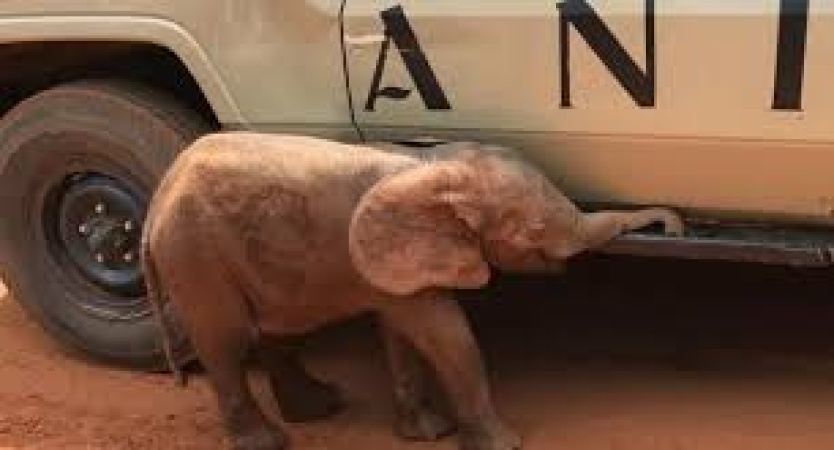
The baby elephant
Hours after dawn on Nov. 30, workers on a routine patrol at Okomu Oil Palm Company in Edo noticed a figure wandering alone among the trees in Extension 1 of the plantation.
At first, they thought it was a stray calf from a local livestock herd.
But as they drew closer, reality struck – a frail, dehydrated elephant calf, barely two months old, struggling to stand, its ears drooping from exhaustion.
The discovery sent shockwaves through Edo’s conservation circle.
No one in Nigeria – parks, researchers, or wildlife responders – had ever rescued a forest elephant calf and lived.
Now, suddenly, Okomu had an orphan on its hands again.
Mr. Osaze Lawrence, Conservator of Park at Okomu National Park provided some clarifications.
“We were told a very young elephant was found walking alone.’’
Lawrence explained that the company kept it, gave it water, and called on the authorities immediately.
“When we arrived with African Nature Investors (ANI), we picked it up and took the first step – attempting to reunite it with its herd,” he said.
ANI foundation has been in partnership with the National Park Service since, engineering a community-led model that has resuscitated the integrity of Okomu National Park.
After retrieving the calf, the conservator of the park said rangers entered deep into the elephant home range, guided only by faint noises they believed came from a nearby herd.
They placed the baby gently on the forest floor; hoping instinct would lead it back.
“At first, it walked some metres into the wild; we stepped back to see if the family would find him.
“But after two hours, there was no sign.
“Later, a bike rider called to say the small elephant had wandered onto the main road again.”
Only then did the team realise the heartbreaking truth: the calf’s mother was gone, and the reunion attempt had failed.
Returning it to the wild would mean certain death – predation, hunger, dehydration, or poaching.
“So, we agreed the only humane thing was to rescue it, rehabilitate it, stabilise it, and prepare it for a future return to the wild,” he said.
The calf was moved to ANI’s R1 Base Camp, an operational facility near the park headquarters.
A makeshift rehabilitation space was prepared – quiet, isolated, and close enough to the forest to reduce stress from human presence.
But within 48 hours, the calf’s condition deteriorated.
Dr. Faith Amune, a veterinarian with Okomu Oil Palm Company, provided insights.
“He had a very thin line between life and death.
“We were not prepared for it, but duty is duty; we administered emergency medication, and honestly, on that first Tuesday (Dec. 2), it looked like we were losing him,” she said.
The crisis triggered an unprecedented collaboration.
ANI quickly created an SOS WhatsApp group that linked wildlife experts within and outside Nigeria.
Messages flew across time zones – symptoms, photos, hydration levels, recommended milk formulas. Responders realised they needed hands-on expertise.
When wildlife rescue technical consultant Liz O’Brien, a UK-born elephant rehabilitation specialist based in Zambia, received the alert, she acted immediately.
R-L: Liz O’Brien, Wildlife Rescue Specialist and Peter Abanyam, ANI’s Project Manager at Okomu while educating rangers on the rehabilitation measures
She has spent 15 years working across Africa – Botswana, Kenya, Tanzania, Malawi, Burkina Faso – specialising in orphaned elephants.
She knew the significance of the call; she booked the next flight.
“It is an elephant and when a baby elephant needs help, I go.
“I did not just come to save this calf; I came to train the people here; Africa cannot rely on outsiders flying in.
“The real solution is to build capacity locally.
“If they learn how to handle this one, they will manage the next,’’ she said.
On arrival, O’Brien assessed the calf and immediately began working side by side with local vets, rangers, keepers, and park managers.
She redesigned the milk formula, corrected hydration patterns, and began teaching techniques that normally take years to learn through field exposure.
Dr Adedolapo Oke, another Okomu veterinarian, acknowledged O’Brien’s impact.
“She has decades of experience; you could see immediately that she knows exactly what to do.
“For vets like us, who rarely encounter elephants, it was priceless,” Oke said.
By records, Nigeria’s elephant population has declined drastically over the past century.
From tens of thousands, forest elephants have disappeared from most states due to logging, poaching, and habitat fragmentation.
Today, the Okomu–Omo–Osse landscape hosts the last viable population of critically endangered African forest elephants in southern Nigeria.
Peter Abanyam, Project Manager for ANI at Okomu, said for years, elephants avoided the eastern corridor of the park because of human pressure.
“But recently they have started crossing again. It shows that protection efforts are working,” he said.
Abanyam believes the calf rescue symbolises a larger conservation shift: local communities are no longer passive observers – they are now participants.
Interestingly, one of the most striking developments since the rescue is how communities now perceive the park.
Abanyam recalls how the project integrated him into the community.
“They don’t even call me by my name; they call me ‘ANI’ – because they see the organisation as part of them; that sense of ownership didn’t exist five years ago.
“The awareness is strong now; people know the elephants are theirs to protect,” said ANI’s project manager.
For Lawrence, the Conservator of Park, this is the biggest sign of transformation.
To reinforce boundaries and prevent future human-elephant conflicts, stakeholders are now planning a full demarcation of the park’s southern boundary – a move involving communities, the Edo State Forestry Commission, the Edo Geographic Information System (GIS), and local governments.
“It has become urgent. As elephant numbers stabilise, they need land. If we don’t act now, conflicts will rise,” Abanyam warned.
Behind the scenes, veterinarians worked in shifts around the clock.
“The adrenaline was high; but what matters is consistency – days, weeks, months of follow-up; that is the real challenge,” Oke said.
To wildlife veterinarians, elephant calf care is one of the hardest tasks in the world.
“In global records, nearly 45 per cent of rescued calves die.
“They are sensitive; the digestive system is complicated; the psychological trauma is severe,” O’Brien said.
The calf will need specialised milk for two to three years, constant monitoring, hydration therapy, environmental enrichment, and minimal human contact to avoid imprinting.
“It will take four to five years before he can be fully independent; but if you want wild animals, you keep them in the wild – not zoos.
“My hope is to reintroduce him when he’s ready,” the wildlife rescue specialist said.
For Nigeria, the experience is historic.
Dr Abdulrahman Adam, a wildlife vet who flew in from Bauchi to learn on the field, said it was his first elephant calf case.
“In Nigeria, this has never happened before. What I learned here, you cannot get in any classroom,” Adam said.
Beyond the touching story of rescue lies a deeper narrative – Okomu National Park is emerging as a model for conservation in Nigeria.
“When I came in 2022, illegal logging was everywhere.
“But with ANI’s support, we trained 40 rangers, engaged communities, and pushed logging to the barest minimum,” the conservator of the park said.
Now, the Federal Ministry of Environment, led by Balarabe Lawal, and the National Park Service under Dr Ibrahim Goni, are backing the park’s renewed momentum.
The rescue has also strengthened calls to expand protection areas. Nigeria has grown from seven national parks to seventeen, reflecting rising awareness about biodiversity conservation.
“Any community with a valuable forest can approach the National Park Service to upgrade it.
“Tourism, research, environmental benefits—it is all worth it,” Lawrence said.
Standing in the quiet rehabilitation shelter, O’Brien watched the calf sway gently on its feet – more stable, more alert, and more alive.
“We are not there yet; but we are one step on the path,” O’Brien said.
For Lawrence, Abanyam, the veterinarians, and the communities, the calf has become more than an animal; it is a symbol of what collective action can achieve.
“This is a first for Nigeria, and it shows that when the community, NGOs, government and experts come together, wildlife can survive,” Lawrence said.
Summing up the whole effort, O’Brien said, “It takes a village to raise a child; and it takes a village to raise an elephant." (NAN)