
Updating your news feed...
NEWS EXPRESS is Nigeria’s leading online newspaper. Published by Africa’s international award-winning journalist, Mr. Isaac Umunna, NEWS EXPRESS is Nigeria’s first truly professional online daily newspaper. It is published from Lagos, Nigeria’s economic and media hub, and has a provision for occasional special print editions. Thanks to our vast network of sources and dedicated team of professional journalists and contributors spread across Nigeria and overseas, NEWS EXPRESS has become synonymous with newsbreaks and exclusive stories from around the world.










Loading banners
Loading banners...

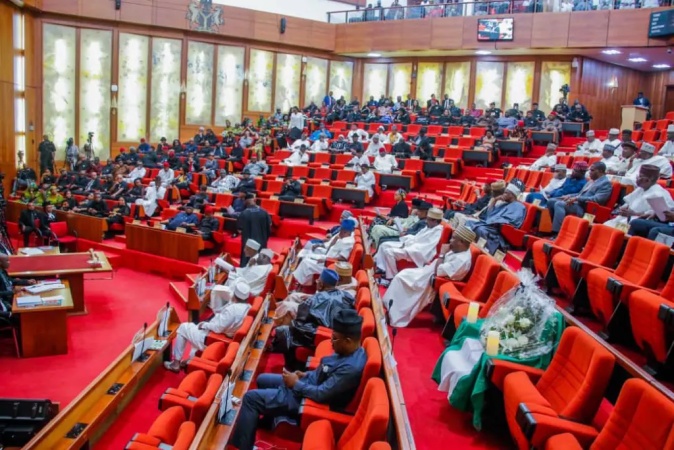
The Senate of the Federal Republic of Nigeria
The Senate, on Thursday, raised a national alarm over what it called a “widespread and scientifically-verified lead-poisoning disaster” devastating Ogijo, a densely populated community straddling the Ikorodu area of Lagos and the Ogun East Senatorial District.
Lawmakers said the tragedy, caused by emissions from multiple used lead-acid battery recycling factories operating in the area, has matured into what one senator described as “a full-scale public health emergency that is silently destroying an entire generation.”
Tokunbo Abiru, who sponsored the motion alongside Senator Gbenga Daniel, warned that the scale of contamination in Ogijo was “an environmental catastrophe of global significance,” adding that laboratory findings revealed pollution levels “as high as 186 times the globally acceptable safety threshold.” According to him, the testimonies from residents were heartbreaking.
“People have complained of constant headaches, abdominal pains, seizures, memory loss and a frightening drop in cognitive function,” he said.
“These are not random conditions; they match, almost word for word, the medical markers of long-term lead exposure.”
Abiru cited investigations by The Examination and The New York Times, saying the reports left him “deeply disturbed,” because independent blood-lead testing and toxic soil sampling “confirmed beyond doubt that Ogijo residents have been inhaling and ingesting poison for years.”
Even more troubling, he added, was evidence showing that processed lead from the community had entered global industrial chains.
“Imagine this irony,” Abiru told the chamber.
“Contaminated Nigerian lead is feeding the supply lines of major automobile manufacturers abroad, while the local communities that produced this lead are choking, coughing and dying slowly under toxic smoke and dust.”
He said the human stories behind the statistics were even more devastating.
“Children are dying slowly,” the senator declared.
“Families have lived for years under poisonous smoke and dust. A mother in the report said her child wakes up screaming at night because of constant headaches.
“Another talked about sudden convulsions. How many more symptoms do we need before we act?”
Although the Federal Government has recently intervened, shutting down seven recycling factories and suspending the export of lead ingots, Abiru insisted that the measure was “only the first step.”
According to him, “Many of these operators deny wrongdoing; enforcement is weak, and the level of exposure in the community remains extreme and unacceptable.”
He argued that beyond environmental laws, “the Constitution itself imposes a duty on government to protect citizens’ health,” adding: “This is not just an environmental issue; it is a constitutional duty.
The lives and futures of children in Ogijo must not be traded for toxic profits.”
Senator Gbenga Daniel, co-sponsor of the motion, echoed these concerns, warning that Nigeria was gradually creating what he called “sacrifice zones,” where companies “operate with impunity because they assume nobody is watching.” Senator Saliu Mustapha of Kwara Central, who seconded the motion, said the situation demonstrated “how regulatory failure can quickly translate into human tragedy.”
He added, “If the government does not act fast, Ogijo will only be one of many such cases.”
Shuaib Salisu, Ogun Central senator, commended the Ogun State Government for conducting medical tests and offering treatment to victims, but stressed that “border communities like Ogijo require far more attention than they currently receive.”
According to him, “People in these areas are often the first to suffer and the last to be noticed.”
Babangida Hussaini of Jigawa North-West urged the federal government to widen its scope of oversight. “Ogijo cannot be the only community facing this,” he said.
“If we do not extend monitoring and intervention, we are simply waiting for the next disaster.”
Reacting to the debate, Senate President Godswill Akpabio recounted a similar tragedy in his own community in Akwa Ibom.
“We had a battery industry in my place in the 1980s,” he said.
“Then suddenly, we recorded a lot of deaths in the community. The toxins were seeping into the river.
“People were drinking from that same river, cooking with it, bathing in it, living with it daily.
“Eventually, life expectancy in that community was not even up to 40 years. And in rural communities, people did not even know they were dying from lead poisoning.”
Akpabio said he was “deeply moved” by the motion, adding, “This touches on the lives of Nigerians.
“By bringing this motion, you are not only exposing the dangers of these operations but reminding us of the sacred duty we owe our citizens.
“Lead poisoning does not announce itself; it kills silently, slowly, and painfully.”
After listening to the contributions, the Senate President put the motion to a vote, and it passed overwhelmingly.
He then directed the Committee on Legislative Compliance to ensure “strict monitoring and timely execution” of all Senate directives and to report back within two months.
Senators agreed that the Ogijo disaster must mark a turning point in Nigeria’s handling of industrial pollution.
“The tragedy of Ogijo must be a turning point,” the chamber resolved.
“The nation cannot allow this slow, silent poisoning to continue.”
They ordered federal agencies to begin emergency medical response, environmental cleanup, enforcement of recycling standards, relief support for severely affected families, and high-level ministerial briefings.
The Senate also directed the creation of a National Lead Poisoning Response and Remediation Office to coordinate clean-up, treatment, monitoring and global traceability of exported lead.
As the session drew to a close, the mood in the chamber reflected both urgency and regret. “Ogijo,” Abiru said quietly, “is a warning.
“And if we ignore it, we will be signing death warrants in communities we may never even visit.” (BusinessDay)




