Updating your news feed...
NEWS EXPRESS is Nigeria’s leading online newspaper. Published by Africa’s international award-winning journalist, Mr. Isaac Umunna, NEWS EXPRESS is Nigeria’s first truly professional online daily newspaper. It is published from Lagos, Nigeria’s economic and media hub, and has a provision for occasional special print editions. Thanks to our vast network of sources and dedicated team of professional journalists and contributors spread across Nigeria and overseas, NEWS EXPRESS has become synonymous with newsbreaks and exclusive stories from around the world.













Loading banners
Loading banners...

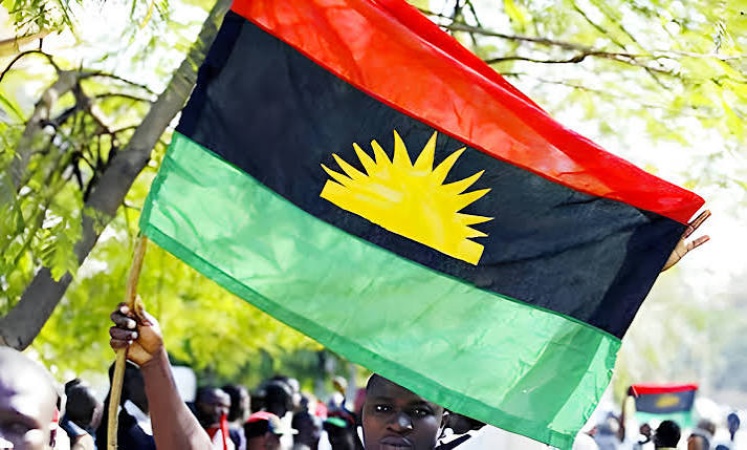
IPOB LOGO
By ODIMEGWU ONWUMERE
The Indigenous People of Biafra (IPOB) is a Nigerian organization believed to be a separatist organization seeking to restore the Republic of Biafra, which existed briefly from 1967 to 1970 and was subsequently reintegrated into Nigeria after the Nigerian Civil War.
This group regarded as being peaceful was founded in 2012 by Nnamdi Kanu, who became a prominent figure in the Biafran independence movement. IPOB was founded in response to the perceived injustices the Igbo people believe they face, including political marginalization, unequal distribution of resources, and human rights violations.
Since its inception, IPOB has been involved in what those familiar with the matter call a ?low-level guerrilla conflict? with the Nigerian government. The group criticizes the federal government?s heavy military presence in southeastern Nigeria and alleged extrajudicial executions. On September 20, 2017, the Nigerian government banned the group as a terrorist organization under the Nigerian Terrorism Act. However, this classification was overturned by a High Court in Enugu in 2023.
Despite this change in the law, tensions between IPOB and the Nigerian government remain high. As of early 2025, IPOB is believed to still be active in Nigeria and is committed to self-determination for the people of the former Eastern Nigeria.
The group has received significant media attention due to the Nigerian government?s crackdown and has established various communication channels to disseminate information among its members. Some reports have exaggerated IPOB?s military strength, claiming it has up to 50,000 militants, while others claim that its militant force is much smaller and mainly made up of local vigilantes and supporters.
There are differing views internationally on how to classify IPOB. Some argue that the group should be classified as a terrorist organization because of its supposed conflicts with security forces, while others argue that such a classification would overlook the legitimate grievances of many Biafrans. Despite this, the United States has refrained from designating IPOB as a Foreign Terrorist Organization (FTO), maintaining that the group poses no threat to U.S. national security.
The United Nations (UN) has, however, been involved in discussions on global self-defence and determination movements, including the efforts of IPOB. But the relationship between the UN and IPOB is complex and marked by several key issues. It is clear that the UN recognizes the principle of self-determination as the fundamental right of peoples to determine their own political status and promote their economic, social, and cultural development.
This principle is enshrined in various international treaties and declarations, such as the International Covenant on Civil and Political Rights (ICCPR). In the case of IPOB, its demand for independence is consistent with this principle. Yet, it faces significant challenges due to Nigeria?s sovereignty and territorial integrity. Despite IPOB calling for a UN-supervised referendum to determine its fate, the organization has done surprisingly little with regard to this demand.
The UN has generally remained indifferent to the IPOB situation, reflecting a general tendency for international organizations to often prioritize national sovereignty over claims to self-determination. This indifference can be attributed to Nigeria?s membership status and insistence on maintaining national unity. Although, the UN has expressed concern about human rights violations associated with Nigeria?s response to IPOB activities.
For example, several UN special rapporteurs have criticized the Nigerian government?s ban on IPOB as a violation of the right to association and political expression. These concerns highlight the inconsistency between Nigeria?s military actions against IPOB members and international human rights standards. Kanu has been in custody since June 2021 under circumstances that many have called controversial and that have attracted international attention.
In July 2022, the United Nations Human Rights Council (UNHRC) issued a statement calling for Kanu?s release. It said his detention was not legally justified and called on Nigeria to comply with international law in its treatment. Experts have complained that the situation surrounding IPOB is not only a national issue but also poses a risk to stability in the West African region.
They argue that any potential escalation into violence and insurgency could create a humanitarian crisis reminiscent of past conflicts in the region. If proactive steps are taken, the role of the United Nations in mediating these tensions could be crucial. While the UN says it supports the principle of self-determination as it pertains to groups like IPOB, its actions, or lack thereof, reflect a cautious approach that prioritizes state sovereignty over individual claims of independence.
?Onwumere writes from Rivers State.