ADAD
ADADUpdating your news feed...

NEWS EXPRESS is Nigeria’s leading online newspaper. Published by Africa’s international award-winning journalist, Mr. Isaac Umunna, NEWS EXPRESS is Nigeria’s first truly professional online daily newspaper. It is published from Lagos, Nigeria’s economic and media hub, and has a provision for occasional special print editions. Thanks to our vast network of sources and dedicated team of professional journalists and contributors spread across Nigeria and overseas, NEWS EXPRESS has become synonymous with newsbreaks and exclusive stories from around the world.












Loading banners
Loading banners...


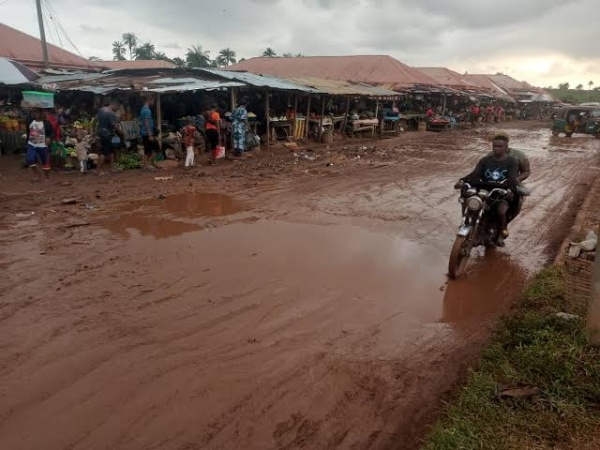
A soggy main street in Yeliboya Mara Kardas-NelsonAl Jazeera
Yelibuya, a small town in northwest Sierra Leone, is precariously perched on a sandy, waterlogged stretch of land that juts out where one of the country's largest rivers, the Great Scarcies - also called the Kolente, yawns into the Atlantic Ocean.
Little more than a few straggly mangroves grows here.
Fresh food and water are imported, and everything from the town's singular motorcycle to children's clothes are covered in sticky sand.
But Yelibuya is bustling.
About 5,000 people live in the town and surrounding area.
It sits between the coastal cities of Freetown, Sierra Leone's capital, and Conakry, the capital of Guinea, making it an important last stop on a long and historic trade route.
A majority of the country's fish and rice is harvested along the river.
With poor road networks, traders brave choppy waters on small canoes to buy Yelibuya's fish in exchange for cassava leaf, groundnut, clothes, and building materials.
But life in the town is increasingly impossible; the island is going underwater.
Mangrove deforestation, coastal degradation and rising sea levels have led to dozens of homes being flooded each year. Residents make new ones, often on stilts, to lift them above the slush.
While there's no official government data on how much the water is rising, elders in the community estimate that the ocean has encroached inland at least 300 metres over the last 30 years.
According to some estimates, Yelibuya will be completely submerged within two decades.
"As you can see, there is no method for protection," says Abdulai Bangura, one of the town's elders. "And it gets worse every year. We only seek God's protection."
Mohammed Salie Sesay has lived in Yelibuya for 20 years. He's lost his home twice, most recently in July. Each time a home is demolished, he builds a new one on drier land with money he makes from daily fishing.
"I would leave, but my business is here, my wife is here, my kids are here. We're fully dependent on the island," he says.
Yelibuya's residents are trying to adapt.
Two of the town's most important structures, the clinic and the chief's house, used to sit on the ocean's edge. They've been moved further inland, towards the small mangrove forest.
Despite being built on heavy cinderblocks however, the clinic is regularly flooded and the chief's house looks out onto a sandy bank that is perpetually filled with water with the encroaching tide.
The mangrove patch offers the only barrier between the town and the rising water.
But because of wood harvesting, the patch is getting smaller.
In a place with no electricity, no alternative natural fuel, and a constant need for rebuilding, mangrove wood is being used for current problems, rather than protecting against future challenges.
Yet life goes on, with some recognising the economic opportunity of life on the island.
A bag of rice sells for 110,000 leone ($14) in Sierra Leone, and 325,000 leone ($40) in Conakry, so Sierra Leonean traders are choosing to live where they can trade upwards rather than settling in a less precarious, but less lucrative, location in the country's relatively dry interior. (Aljazeera)