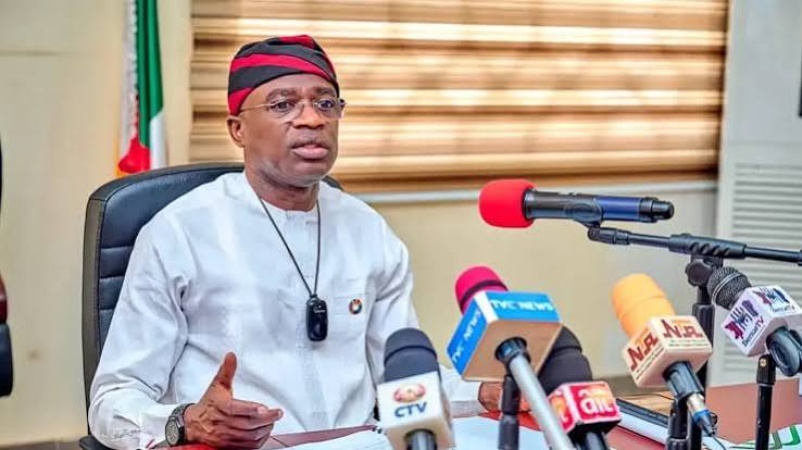
Speaking with journalists on the finances which got to the state from the federation account, the governor in his breakdown disclosed that the state received N1.16 billion as statutory allocation, 13% derivation amounted to N3.2 billion, Value Added Tax, N699 million and Petroleum Profit Tax, N2.4 billion.
Others are budget supports to state, N1.111 billion, foreign exchange differential, N1.2 billion and refunds on over payment, N57.5 million.
Dickson disclosed out of this amount, N2.3 billion was deducted at source by FAAC which include bond obligation, foreign loans, commercial agriculture credit scheme 1 and 11 and salary bailout to state.
He added that the government is servicing the loan obtained for the construction of the multi billion naira cargo airport, which according to him would be of immense benefit to the economic growth of the state.
The governor said the efforts of the government at addressing the issue of over bloated wage bill has begun to yield some dividends, as it has recorded a reduction of over N1 billion.
Also, the government has ordered full payment of January salary with effect from Thursday.
Commenting on the prevailing economic situation in the country, the governor said, although the price of crude oil experienced a leap in the months of November and December 2016, it was sad to note that it did not reflect in the funds from the Federation Account within the period.
Meanwhile, the State Government and relevant stakeholders in civil service administration on Wednesday in Yenagoa endorsed a number of reforms aimed at restructuring the public service for effective delivery.
The meeting was also aimed at checking the syndrome of ghost workers and other unwholesome practices.
While the stakeholders of his commitment to reposition the state public service, Governor Dickson called for the support of stakeholders in the implementation of the various reforms.
He described as unacceptable, the age long sharp practices in the state civil service, adding that the said payment of over N4 billion monthly wage bill could no longer be sustained.
Dickson said that it has impacted negatively on the developmental agenda of the restoration government.
According to him, the meeting was convened to intimate the stakeholders of the financial position of the state and chart a way forward in view of the prevailing economic situation.
Some of the reforms as highlighted by the governor and endorsed by the stakeholders in attendance include; approval of N200 million monthly subvention to the state owned Niger Delta University.
He stressed that only subventions would be given to tertiary institutions as against the old practice of monthly payment of salary.
Also the state government gave approval of N10 billion for the purpose of upgrading facilities in all its tertiary institutions across the state and also instituted a special Education Safety Corps to ensure the safety of its schools.
The governor urged all tertiary institutions to key into government’s vision of adopting a single accounting system to check fraud, stressing that education levy would be introduced for all workers in the state to fund activities in the sector.
According to Governor Dickson, as part of the reforms, the state civil service commission will be reconstituted just as government did to that of the local government service commission.
He stressed that further steps would be taken to re-organise the state’s Ministries, Departments and Agencies pointing out that staff with requisite qualifications and skills would be redeployed to relevant ministries and institutions.
Also, the state government has created a N10 billion Entrepreneur Development Fund to empower people that may voluntarily opt out of the civil service arising from the re-organisation of the service.
The governor announced that henceforth, the State Environmental Sanitation Authority would be taken out of the mainstream of the civil service, stating that only a few and relevant staff would be deployed on secondment to the authority.
To tackle the problems of absenteeism, and ghost workers syndrome, attendance registers have been introduced in all the MDAs which would be properly monitored by special teams.
The meeting had in attendance traditional rulers, captains of industry, members of the State House of Assembly, top government functionaries, local government chairmen, among others.
 AD
AD