ADAD
Updating your news feed...

NEWS EXPRESS is Nigeria’s leading online newspaper. Published by Africa’s international award-winning journalist, Mr. Isaac Umunna, NEWS EXPRESS is Nigeria’s first truly professional online daily newspaper. It is published from Lagos, Nigeria’s economic and media hub, and has a provision for occasional special print editions. Thanks to our vast network of sources and dedicated team of professional journalists and contributors spread across Nigeria and overseas, NEWS EXPRESS has become synonymous with newsbreaks and exclusive stories from around the world.
















Loading banners
Loading banners...

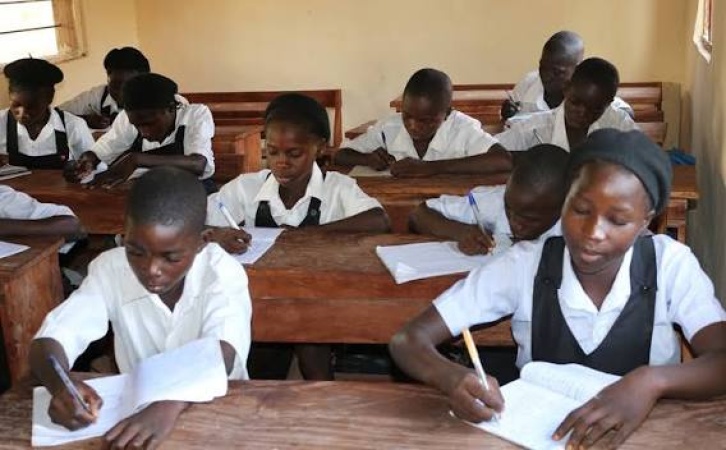
File photo of students in a classroom
By LINDA OGBONNA
Some parents and education stakeholders have called for the enforcement of reusable textbook policies in Lagos State private schools to reduce education costs and ease families’ financial burden.
They made the call in separate interviews with the News Agency of Nigeria (NAN) at various private schools in the Oworonshoki area of Lagos before the midterm break on Friday.
This followed concerns that younger children often cannot reuse textbooks previously purchased for their older siblings.
The parents said that repeated textbook purchases had increased their financial burden, with some spending thousands of Naira each academic session on books containing similar learning materials.
NAN reports that the Federal Government in January announced a reusable textbook policy to lower education costs for parents, improve learning quality, and promote sustainability.
The policy stipulates that standardised textbooks should last between four and six years.
A parent and nurse, Mrs Edith Akpobaro, told NAN that she spent N54, 000 on textbooks for her child in Primary Two and N57, 000 for another in Primary Four.
Akpobaro added that textbooks for her child in Junior Secondary Two cost more than N70, 000.
She said the situation was frustrating because textbooks previously passed from older children to younger siblings were now difficult to reuse.
“In our own days, when I used a textbook, I could pass it on to my younger siblings. But these days, the situation is not the same. You buy the same textbook every year, over and over again,” she said.
Another parent, Mrs Maria Otolorin, said the practice had increased the financial burden on families, particularly those with several children in school.
She, however, acknowledged that textbooks with exercises and spaces for pupils to write answers had educational benefits, as they reduced the need to copy questions into separate exercise books.
Otolorin said publishers and schools should explore ways to retain these benefits while allowing younger siblings to reuse textbooks.
Similarly, Mrs Ayo Oluwatoyin, a teacher and parent, said she spent almost N100, 000 on textbooks for one of her children, sometimes exceeding the cost of school fees.
She said several textbooks purchased for her older children were now abandoned at home because younger siblings could not use them after they had been written in and marked.
“The economy is not smiling at anybody. Some parents are even selecting books because they cannot afford all the textbooks required by the schools,” she said.
Oluwatoyin urged the Lagos State Ministry of Education to engage publishers and other stakeholders to ensure continuity in textbook use and reduce unnecessary expenses for parents.
Another parent, Mr Chikeze Njoku, a bakery consultant, described the situation as unfair, recalling that younger children were previously allowed to use textbooks bought for their older siblings.
He urged the government to intervene, particularly in private schools, to encourage textbook reuse and reduce financial pressure on families.
A parent and teacher, Mr Amoye Segun, attributed part of the problem to publishers producing textbooks alongside workbooks, which require pupils to write answers directly into them.
He said such arrangements often made it difficult for younger siblings to use the same materials, forcing parents to buy another complete set.
Segun supported the federal government’s reusable textbook policy, saying books should be produced to last between three and four years to allow other children to use them.
Another parent, Mrs Franca Nwogu, suggested that private schools introduce textbook rental arrangements, allowing pupils to use books for a specified period before returning them for other learners.
Reacting to the concerns on Monday, Dr Simeon Fowowe, National President of the Association of Early Childhood and Basic Education Instructors in Nigeria, said repeated textbook purchases posed a challenge to Nigerian families.
Fowowe told NAN that textbooks should be treated as long-term educational investments rather than compulsory annual expenses, particularly where curriculum content had not changed substantially.
He said the federal government announced a reusable textbook policy on Jan. 9, 2026, providing for durable textbooks expected to last between four and six years and allowing siblings to share learning materials.
According to him, the major challenge was effective implementation, particularly in private schools, through clear monitoring and enforcement arrangements.
Fowowe said government should also regulate textbook revisions to prevent schools from compelling parents to buy new editions annually when changes involved only page numbering, colours, illustrations or covers.
He recommended community-based textbook lending schemes involving schools, Parent-Teacher Associations (PTAs), non-governmental organisations and philanthropists to improve access to learning materials.
On publishers’ role, Fowowe urged them to produce textbooks with quality paper, strong covers and durable binding to withstand repeated use by different children.
He also recommended separating exercise books and materials requiring pupils to write directly into them from core textbooks.
Fowowe urged publishers to introduce affordable pricing, family discounts and textbook take-back programmes.
He said publishers could also provide supplementary digital learning materials, including audio resources, interactive exercises and teachers’ guides, without making new textbook purchases compulsory.
He explained that the ultimate purpose of education should be learning rather than repeated purchases of learning materials.
He added that no child should be disadvantaged because parents could not afford new textbooks every academic session. (NAN)