ADAD
Updating your news feed...

NEWS EXPRESS is Nigeria’s leading online newspaper. Published by Africa’s international award-winning journalist, Mr. Isaac Umunna, NEWS EXPRESS is Nigeria’s first truly professional online daily newspaper. It is published from Lagos, Nigeria’s economic and media hub, and has a provision for occasional special print editions. Thanks to our vast network of sources and dedicated team of professional journalists and contributors spread across Nigeria and overseas, NEWS EXPRESS has become synonymous with newsbreaks and exclusive stories from around the world.


























Loading banners
Loading banners...

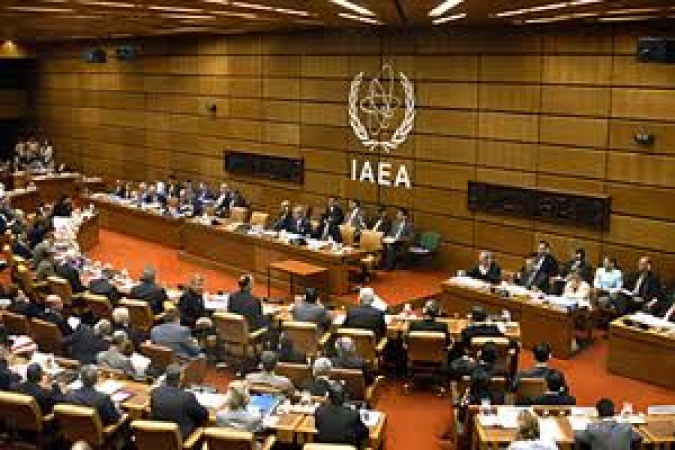
On the 70th anniversary of the approval of the IAEA statute, Iran’s permanent mission to the UN in Vienna issued a statement calling for an end to the selective and politically motivated implementation of the Agency’s obligations.
The statement criticized the IAEA for applying double standards and discriminatory approaches, emphasizing that the Statute is a binding legal document and must not be used as a political instrument to serve the interests of certain powerful states.
Iran also condemned the unacceptable silence of the Agency’s governing bodies regarding the military attacks by the US and the Israeli regime on its peaceful nuclear facilities in 2025 and 2026. Furthermore, it highlighted the IAEA’s failure to address the lack of comprehensive safeguards on the Israeli regime’s nuclear activities.
The Islamic Republic also called for the full, balanced, and non-discriminatory implementation of the IAEA Statute for all member states, particularly regarding technical cooperation and access to peaceful nuclear energy.
The full text of statement by the Iranian permanent mission in Vienna is as follows:
“Permanent Mission of the Islamic Republic of Iran to the United Nations and other International Organizations in Vienna
On the Anniversary of the Approval of the IAEA Statute
23 October 2026
Seventy years after the adoption of the Statute of the International Atomic Energy Agency (IAEA) on 23 October 1956, a fundamental assessment is required as to the level and extent of the adherence to the principles and objectives of the Agency’s founding document.
This anniversary must therefore be more than an occasion for commemoration; it must serve as a moment of critical reflection, institutional accountability and a renewed commitment to the full, impartial and non-discriminatory implementation of the Statute.
The Statute: A Binding Mandate, Not a Political Instrument
The continued relevance of the IAEA Statute lies in the objective it establishes and the principles it enshrines. It implementation over the past seven decades has produced achievements in important areas. However, the failure to implement it fully, consistently, effectively and without discrimination, under all circumstances and with respect to all Member States, has caused the Agency to drift away from its core objective and priorities, undermine the principles governing its conduct, compromise its professionalism, and tarnish its authority and credibility.
The undeniable fact is that the Statute is the Agency’s constitution, not a document to be invoked selectively or interpreted according to the interests of powerful States or a group of States.
Beyond Safeguards: Upholding the IAEA’s Full Statutory Mandate
Article II establishes the Agency’s fundamental objective: to accelerate and enlarge the contribution of atomic energy to peace, health and prosperity throughout the world. Article III.A.1 requires the Agency to encourage and assist research, development and the practical application of atomic energy for peaceful purposes.
Article III.B.3 further requires the Agency to allocate its resources efficiently to achieve the greatest possible general benefit, with due regard to the special needs of developing countries. While safeguards are part of the IAEA’s mandate, the Agency is not merely a “watchdog” organization, as some Member States, in contravention of the Statute, seek to portray it.
Such a narrow and politically motivated characterization distorts the Agency’s mandate and shifts its priorities away from its broader statutory objective that is the promotion of peaceful nuclear applications and international scientific and technical cooperation. Verification must not eclipse peaceful nuclear cooperation, development and the legitimate rights of Member States.
An Agency that concentrates on scrutiny while failing to advance its key statutory responsibilities cannot claim to be fulfilling its mandate in a balanced manner.
Sovereign Equality Cannot Coexist with Double Standards
Article IV.C expressly establishes that the Agency is based on the sovereign equality of all its members and requires them to fulfil their statutory obligations in good faith. Article III.C prohibits the Agency from making assistance subject to any political, economic, military or other conditions incompatible with the Statute. Article III.B.1 requires the Agency to conduct its activities in accordance with the purposes and principles of the United Nations, while Article III.D requires due observance of the sovereign rights of States.
These provisions are neither optional nor subordinate to geopolitical calculations. Sovereign equality requires that every State be treated fairly and without discrimination under the legal instruments applicable to it, free from double standards, selective interpretation and politically motivated action.
A clear example is the continuing disparity between the scrutiny applied to Iran and the absence of comprehensive safeguards covering all nuclear activities of the Israeli regime, which remains outside the Treaty on the Non-Proliferation of Nuclear Weapons. This disparity raises fundamental questions about the credibility and consistency of the international nuclear non-proliferation norms.
A credible, comprehensive and non-discriminatory approach to nuclear verification throughout the Middle East is a legitimate demand and a longstanding objective of regional countries that are parties to the NPT. Regional security cannot be built on selective scrutiny and unequal expectations.
Peaceful Nuclear Cooperation: A Right, Not a Political Privilege
Peaceful nuclear cooperation must not be subject to political pressure. Article III.C of the Statute is clear: assistance must not be subjected to conditions incompatible with the Agency’s legal mandate. Political pressure and geopolitical rivalries must not obstruct legitimate scientific cooperation or turn access to peaceful nuclear technology into a privilege reserved for selected countries.
The Agency is expected to defend the integrity of its technical cooperation mandate and ensure that its programs serve the development needs of all Member States fairly and without discrimination.
Attacks on Nuclear Facilities and Unacceptable Institutional Silence
Attacks on safeguarded nuclear facilities demand strong and unequivocal condemnation. The military attacks by the U.S. and the Israeli regime against Iranian nuclear facilities in 2025 and 2026 constituted serious and material breaches of peremptory norm of international law on the prohibition of aggression.
They presented a grave challenge to nuclear safety, nuclear security, peaceful uses of nuclear energy, the credibility of the IAEA and its safeguards system. The Agency’s General Conference and Board of governors has repeatedly adopted resolutions expressly stating that armed attacks on, or threats against, nuclear facilities devoted to peaceful purposes violate the principles of the UN Charter, international law and the Agency’s Statute.
Nevertheless, the Agency’s governing bodies and Secretariat failed to issue even a simple statement to condemn clear acts of aggression against Iran’s nuclear facilities – unprecedented in the Agency’s history. This failure represents a serious institutional shortcoming and raises troubling questions about the consistent application of the principles the Agency is mandated to uphold.
The Agency cannot credibly defend the integrity of safeguards while treating attacks against facilities subject to those safeguards as a secondary concern. The Agency must therefore unequivocally reaffirm that attacks against peaceful nuclear installations are unlawful and unacceptable and must not be tolerated under any pretext.
Safeguarding the IAEA’s Independence, Integrity and Confidentiality Principle
Independence, confidentiality and professional integrity must be protected. Article VII.F of the Statute prohibits the Director General and Agency staff from seeking or receiving instructions from external sources. It also requires the protection of confidential information acquired in the course of their official duties and obliges Member States to respect the international character of their responsibilities and refrain from seeking to influence them improperly.
These are concrete institutional safeguards, not ceremonial principles. Reports, assessments and decisions must be based on verifiable evidence, sound technical analysis and applicable legal obligations—not political demands, unsupported allegations or selective approaches. Any breach of confidentiality or attempt to instrumentalise safeguards information undermines cooperation, erodes trust and may compromise the safety and security of nuclear activities.
The Agency mustaddress credible concerns, protect sensitive information and ensure accountability.
Restoring the IAEA’s Credibility: From Selective Implementation to Full Compliance cooperation must be matched by institutional responsibility. Iran recognises the importance of credible safeguards and professional verification and remains committed to engagement within the framework of its applicable legal obligations and its inherent and sovereign rights and interests. However, cooperation requires good faith, mutual respect, professional integrity and the consistent implementation of agreed legal commitments.
On this anniversary, Iran calls upon Agency, particularly the Board of Governors and the Director General to end double standards, resist politicisation, protect confidential information, condemn attacks against peaceful nuclear facilities, and restore the full and balanced implementation of the Agency’s statutory mandate. Iran also calls for an effective and non-discriminatory technical cooperation policy that enables all Member States, particularly developing countries, to benefit from nuclear science and technology.
The Agency’s credibility cannot rest solely on its authority to inspect. It depends equally on its adherence to the law, its impartiality, its independence and its willingness to uphold the legitimate rights of all its members. The Statute must be implemented as a whole, equally and in good faith—not selectively, not conditionally and not according to political convenience.
The Agency owes this obligation to every Member State. On the seventieth anniversary of the Statute’s adoption, the Agency is expected to honour letter, spirit, object and purpose of the Statute through concrete action, not merely words, and to uphold its principles without political selectivity, discrimination or exception.
Seventy years after the adoption of its Statute, the IAEA’s credibility rests on upholding its Statute in full, serving all Member States equally, and demonstrating that international law and statutory principles cannot be sacrificed to political convenience.” (WANA)