Updating your news feed...

NEWS EXPRESS is Nigeria’s leading online newspaper. Published by Africa’s international award-winning journalist, Mr. Isaac Umunna, NEWS EXPRESS is Nigeria’s first truly professional online daily newspaper. It is published from Lagos, Nigeria’s economic and media hub, and has a provision for occasional special print editions. Thanks to our vast network of sources and dedicated team of professional journalists and contributors spread across Nigeria and overseas, NEWS EXPRESS has become synonymous with newsbreaks and exclusive stories from around the world.









Loading banners
Loading banners...

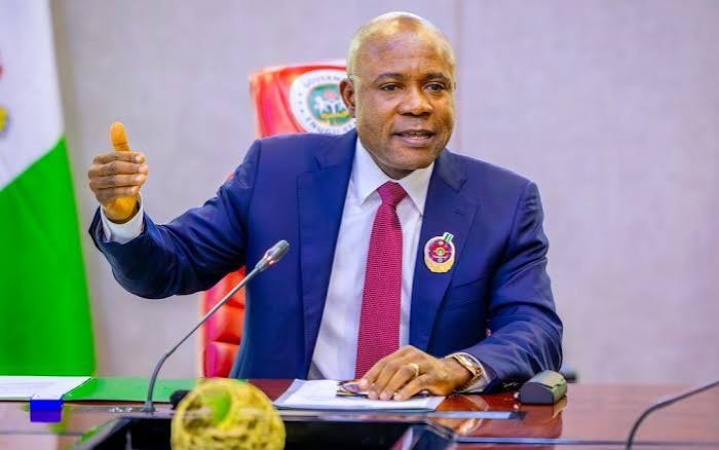
Governor Mbah
By VITUS OZOKE, PhD
I thought 101 was a lot. Apparently, Governor Peter Mbah thought it was just an appetizer.
On September 21, 2026, the Enugu State Government announced the appointment of 101 new Special Advisers, Senior Special Assistants, and Special Assistants: seven Special Advisers, six Senior Special Assistants, and eighty-eight Special Assistants. I wrote then that some announcements require analysis and others require calculators. Ndi Enugu, please bring back the calculator. Governor Mbah has done it again.
This time, the Enugu State Government has announced appointments to the state’s 68 Development Centers. But “68 Development Centers” disguises the real number. Each Development Center receives ten appointees: an Administrator, a Secretary, and eight members. Sixty-eight centers. Ten appointees per center. 68 × 10 = 680. Add the 101 advisers and assistants announced barely two weeks earlier: 781.
But even that does not tell the full recent picture. On August 19, Governor Mbah appointed another 23 Special Advisers and Senior Special Assistants. So: 23 + 101 + 680 = 804. Eight hundred and four appointments in approximately seven weeks. At this rate, perhaps the next Enugu State Government Public Service Announcement should come with a calculator. And all this is happening as Governor Peter Mbah prepares to contest the 2027 governorship election as the APC candidate. That timing makes questions unavoidable.
What exactly is going on?
Let me begin with a correction that matters because this argument should be based on facts. Peter Mbah did not create the Development Centers. They predate his administration. They were established under Governor Chimaroke Nnamani in 2003 to bring administration and development closer to rural communities. Governor Ifeanyi Ugwuanyi later expanded the structure from 56 to 68 Development Centers. In 2021, Ugwuanyi appointed 68 administrators, whose nominations were reportedly sent to the Enugu State House of Assembly for confirmation under the law creating the centers. Fine.
Then the questions become even more interesting. What have these 68 Development Centers done during Peter Mbah’s governorship? Who has been running them? How much have they cost us? Why do they now require 680 appointments? What specific law established them? What are their statutory functions? What services do they provide that the constitutionally recognized Local Government Councils do not? What have their allocations and expenditures been since 2023? Who are their permanent employees? Where are their headquarters? What projects have they completed? What measurable public service have they delivered? And perhaps most importantly, why 680 appointees now?
Enugu State has 17 constitutionally recognized Local Government Areas. Something extraordinary happened just days before this announcement. On September 30, Governor Mbah swore in the newly elected chairmen of all 17 Local Government Areas. The Enugu State Government reported that APC candidates won all 17 chairmanship seats and all 260 councillorship seats in the September local-government election.
Think about the sequence. September 30: 17 Local Government Chairmen and 260 councilors. Six days later: 680 Development Center appointees. So, what exactly is everybody doing? Local Government Chairmen govern. Councilors represent wards. Supervisory councilors have designated portfolios. Local Government bureaucracies administer programs. Town unions represent communities. Traditional institutions operate at the community level. State ministries, departments, and agencies have their own administrative structures. Now, 680 additional Development Center appointees are arriving to strengthen “grassroots participation,” enhance “community engagement,” improve “coordination,” promote “responsiveness,” and deepen government’s reach. Those are attractive words. But government cannot be organized by thesaurus.
At some point, someone must tell taxpayers exactly which institution does what. What will a Development Center Administrator do that the Local Government Chairman does not? What will the Secretary do? What will the eight members do? What authority do they have? What budgets do they control? To whom do they report? How do their responsibilities differ from those of councilors? And if these centers are necessary for grassroots representation, what exactly are Enugu State’s 260 elected councilors representing? Ndi Enugu deserve more than administrative poetry. We deserve an organizational chart.
There is another reason the government should provide these answers. A November 2023 investigative report on Enugu’s Development Centers painted an extraordinary picture. It described many of the 68 centers as essentially comatose, even though salary-earning workers and administrators were reportedly attached to them. The report said the centers were supposed to have administrators, heads of departments, treasurers, heads of personnel management, and employees. The report appeared months after Peter Mbah became governor.
Here is the accountability test. If the Development Centers have been active throughout Mbah’s administration, show us their activities, budgets, payrolls, projects, addresses, staffing records, and allocations. If they have largely been dormant, a different question arises: Why is the solution to moribund institutions to suddenly appoint 680 people to them months before an election? Why not first audit them? Restructure them? Determine whether they duplicate Local Government Councils? Ask whether Enugu State still needs all 68? Instead, apparently, we discovered 680 chairs and immediately found 680 people to sit on them.
I am particularly fascinated by the government’s word choice. According to the announcement, Governor Mbah approved appointments to fill “existing vacancies” in the Development Centers. Existing vacancies? Wonderful. Then Ndi Enugu should be told when these vacancies arose. Who previously held those positions? When did their tenures end? Were all 680 positions previously occupied? If so, who held them, what were they paid, and what work did they perform?
If the positions have been vacant for much of Mbah’s administration, how did the state manage without these 680 officials? What administrative emergency suddenly required filling all those vacancies in October 2026? Government records should make these questions easy to answer.
And then there is the election. This is where the matter becomes impossible to separate from politics. Peter Mbah is not merely the Governor of Enugu State. He is also the APC candidate seeking reelection in 2027. His political journey makes the timing even more significant. He was elected governor in 2023 on the PDP platform. On October 14, 2025, he formally defected to the APC, saying the move would better serve Enugu and align the state with broader national opportunities. That is his political right.
But enormous numbers of government appointments near an election raise a legitimate accountability question: Where does government end and the campaign begin? That question becomes especially important when the appointments penetrate directly into communities, wards, and grassroots political structures. Sixty-eight Development Centers. Ten appointees each. Six hundred and eighty people distributed throughout the 17 LGAs. Administrators. Secretaries. Members. Community by community. Ward by ward. Village by village. And all arriving as the governor enters election season. Perhaps every one of these appointments is entirely administrative. If so, demonstrate it. Transparency settles arguments. Who are they working for?
Here is the simplest test. If these 680 people are working for Enugu State, tell Ndi Enugu exactly what they will do. Publish their job descriptions, salaries, allowances, tenure, offices, reporting structures, and performance indicators. Will they receive vehicles? Transportation or sitting allowances? Housing? Drivers? Personal assistants? Fuel? Telephone or travel allowances? What is the fully loaded annual cost of maintaining 680 appointments? Not just salaries. Everything.
Then add the 101 aides appointed in September and the 23 advisers and senior assistants appointed in August. What is the total annual cost to Ndi Enugu for these 804 recent appointments? That figure should be public.
To be clear, nothing is objectionable about a political party preparing for an election. If the APC wants 680 organizers across Enugu State, let it appoint them. If it wants 6,800, let it appoint them. If it wants one million vote canvassers, let it recruit them. Campaigns need organizers, ward coordinators, polling agents, canvassers, and voter-outreach teams. Nothing unusual about that. But one small detail matters: The party should pay them. That is why the distinction between Peter Mbah, the Governor, and Peter Mbah, the APC candidate, matters.
If these 680 people are serving Governor Peter Mbah and performing identifiable governmental functions for Ndi Enugu, the public purse may legitimately bear their lawful costs. If they are substantially serving Candidate Peter Mbah – organizing communities, mobilizing voters, strengthening APC structures, and preparing the political ground for 2027 – the question becomes very different: Why should Ndi Enugu pay APC’s campaign personnel?
I am not asserting that the 680 appointees are campaign workers. The appointment announcement alone does not prove that. I am saying that their number, grassroots distribution, and electoral timing make the question unavoidable. The government can answer it. But if it walks like a duck and quacks like a duck, Ndi Enugu are entitled to ask at least whether we are looking at a duck.
But seriously, what is Peter Mbah afraid of?
And this is perhaps the strangest part of the story. Peter Mbah has a record to run on. His government points to roads, smart schools, infrastructure, and numerous development projects across the state. So why does a governor who believes strongly in his record appear to need such an extraordinary expansion of appointments just before seeking reelection? Why not simply say: Here is what I promised. Here is what I delivered. Judge me. Why the apparent administrative arms race? Twenty-three. Then 101. Then 680. What changed?
Is this primarily about governance? Political consolidation following Mbah’s move from PDP to APC? An effort to build grassroots structures for his new party? Preparation for the governorship campaign? Or are all these appointments genuinely necessary for public administration? I do not know. That is precisely why the government should tell us. “Grassroots participation” cannot be a magic phrase that ends public scrutiny.
There is an embarrassing irony here. A governor who believes he has transformed Enugu should need less political multiplication, not more. Roads can campaign. Smart schools can campaign. Hospitals can campaign. The International Conference Center can campaign. Water can campaign. Jobs can campaign. Smart security can campaign. Economic growth can campaign. Performance is perhaps the most persuasive political advertisement ever invented. Let Mbah’s achievements campaign for him.
If Peter Mbah believes his administration has delivered on his promises, and I believe he has substantially done so, he should trust Ndi Enugu to see it. That is why this avalanche of appointments creates an appearance of political anxiety. Not proof of anxiety. Not proof of wrongdoing. But certainly enough to ask: Governor, why so many people, and why now?
I propose a simple transparency exercise. Call it the 804 Test. For the 23 August appointments, publish their salaries, allowances, and job descriptions. For the 101 September appointments, do the same. For the 680 October Development Center appointments, also include their tenure, statutory responsibilities, and reporting structures. Then publish the total annual cost. One figure. Let Ndi Enugu see it.
For the 68 Development Centers, publish their budgets and expenditures since 2023, physical addresses, permanent staff, payroll histories, projects, and legal mandates. Most importantly, explain how their functions differ from those of the 17 Local Government Councils and 260 councilors. That is not opposition politics. That is public accounting.
Peter Mbah’s government may have perfectly reasonable explanations. Perhaps the Development Centers are being revived as genuine institutions of grassroots administration. Perhaps they perform important functions that Local Government Councils cannot perform efficiently. Perhaps the 680 appointees will produce measurable benefits worth every naira they cost. Good. Then transparency should be the government’s friend. But 680 appointments announced at once, following 101 appointments two weeks earlier and 23 only weeks before that, is not a minor administrative adjustment. The public has every right to examine their purpose, cost, and timing.
And Peter Mbah should understand something else. The strongest case for his reelection should not be the number of people who owe their appointments to him. It should be the number of citizens who independently conclude that his performance merits another term. Those are two very different constituencies. One is built on appointments. The other is built on trust.
So, I return to the question I asked after the 101 appointments. How large does the Government of Enugu State need to be? The state already has commissioners, ministries, departments, agencies, civil servants, 17 Local Government Councils, 17 chairmen, supervisory councilors, 260 elected councilors, and established local-government bureaucracies. Now add 680 Development Center appointees. How many layers of government does it take to govern one state?
And when 680 people are inserted into grassroots structures immediately before an election, Ndi Enugu are entitled to ask the question that matters most: Are these people being appointed because the government suddenly needs them – or because an election suddenly does?
There is an easy way to answer. Show us the law. Show us the offices. Show us the work. Show us the payroll. Show us the budgets. Show us the results. Show us the cost. And show us why these positions had to be filled now. Until then, the timing will continue to invite a political interpretation. Peter Mbah has spent years telling Ndi Enugu that Tomorrow Is Here.
But with 804 appointments in roughly seven weeks, Ndi Enugu may reasonably ask whether tomorrow is still about development – or whether tomorrow has suddenly become Election Day. Eight hundred and four appointments. Seven weeks. One candidate. One election approaching. One public purse.
Governor Mbah, the question is no longer merely how many people it takes to govern Enugu State. The question is: How many people does it take to campaign for reelection, and who should pay them?
•Dr. Vitus Ozoke is a lawyer, human rights activist, and public affairs analyst based in the United States. He writes on politics, governance, and the moral costs of leadership failure in Africa.