Updating your news feed...

NEWS EXPRESS is Nigeria’s leading online newspaper. Published by Africa’s international award-winning journalist, Mr. Isaac Umunna, NEWS EXPRESS is Nigeria’s first truly professional online daily newspaper. It is published from Lagos, Nigeria’s economic and media hub, and has a provision for occasional special print editions. Thanks to our vast network of sources and dedicated team of professional journalists and contributors spread across Nigeria and overseas, NEWS EXPRESS has become synonymous with newsbreaks and exclusive stories from around the world.

Loading banners
Loading banners...

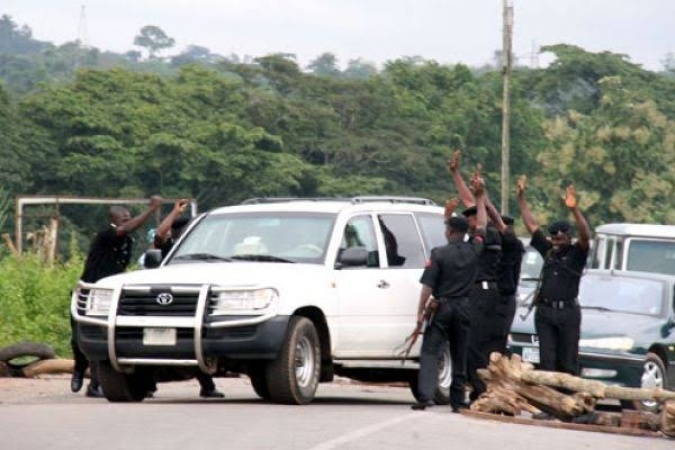
File photo: Police checkpoint
It began as an ordinary journey on the Lagos– Benin Expressway and ended as a video that travelled faster than any official explanation could. In it, police officers confront a motorist, accuse and intimidate, and one officer lets slip that the man would have been detained had he been Igbo. Four officers now face an orderly-room trial and the Inspector-General of Police has ordered a full investigation. But the footage has done more than embarrass the Force: it has forced Nigerians to confront a question they rarely ask aloud — how often does a person’s name, accent, language or state of origin decide how they are treated long before any evidence of wrongdoing exists? SOLA SHITTU writes
The journey may have started like any other road trip, but the atmosphere changed when the police officers stopped the vehicle on the Lagos–Benin Expressway. What followed was captured on video: a heated exchange between the officers and a motorist, allegations of intimidation and ethnic profiling, and a remark by one of the officers suggesting that the motorist would have been detained if he had been Igbo.
The video travelled much faster than any official explanation could have done. Nigerians watched, argued and interpreted the encounter through the lens of their own experiences of security checkpoints and ethnic suspicion.
For the Nigeria Police Force, however, the matter was serious enough to warrant disciplinary action. Four officers were identified and detained pending an orderly-room trial, while the Inspector-General of Police, Olatunji Disu, ordered a full investigation. The Force said the conduct displayed in the video did not represent its values and declared that ethnic profiling and disrespect towards citizens would not be tolerated.
For many Nigerians who have travelled across the country, the incident also raised a more uncomfortable question: how often does a person’s name, accent, language, state of origin or ethnicity influence how he or she is treated before any evidence of wrongdoing has been established?
The question is not limited to the police. In some communities, people have increasingly found themselves judged by the identity of those accused of crimes around them. A Hausa-speaking traveller may attract suspicion in one part of the country.
A Fulani man may be viewed with fear because of the actions of criminal groups identified as Fulani. An Igbo trader may encounter suspicion because of stereotypes about criminality or separatist agitation. A northerner living in the South may be asked to explain himself in circumstances where another citizen would not be questioned.
The danger is becoming even more complicated as ethnic militias and community-based security groups become increasingly prominent in areas experiencing recurring violence.
Plateau State offers a painful illustration.
The state has experienced another wave of attacks in recent weeks, with communities in Mangu, Barkin Ladi and other areas reporting killings. In one incident in September, five Fulani men were reportedly killed when their vehicle came under attack in Barkin Ladi.
The incident occurred amid renewed tensions involving Fulani herders and other communities, and the Plateau chapter of the Miyetti Allah Cattle Breeders Association condemned the killings and demanded an investigation.
On the other side of the conflict, residents and community organisations in Plateau have continued to report killings allegedly carried out by armed groups identified as Fulani. Four people were reported to have been killed in attacks across communities in Mangu earlier in September, with local groups calling for an investigation and stronger protection.
The two narratives can exist simultaneously. One community can genuinely fear attacks from armed groups. Another community can genuinely fear being targeted because of its ethnicity.
Both fears can produce the same dangerous consequence: people begin to see the individual standing before them not as a citizen but as a representative of a hostile group.
That is where ethnic profiling becomes particularly dangerous.
The problem is not that Nigerians notice ethnicity. Ethnicity is an important part of the country’s history and social identity. The problem begins when identity becomes a substitute for evidence.
A criminal has an ethnicity. That does not make the ethnicity criminal.
A person may belong to a community in which some criminals operate. That does not make every member of the community a criminal. Yet fear has a way of destroying that distinction.
At a checkpoint, the question may be, “Where are you from?” At another location, it may become, “What tribe are you?” Then comes the more dangerous assumption: “People from your place are the ones doing this.”
The individual has suddenly been placed on trial for something committed by someone else.
The situation becomes even more volatile on social media, where a photograph, video or allegation can be stripped of context and circulated thousands of times before the facts are established.
A suspect’s ethnic identity can become the headline. An old video can be presented as a fresh attack. An unverified allegation can be transformed into certainty. Comments beneath the post then become a virtual mob, with users assigning collective guilt to people who may have nothing to do with the incident.
A recent investigation into reprisal violence in Plateau State found that misinformation and inflammatory narratives circulating on Facebook contributed to the atmosphere surrounding the attacks between February and April 2026. In one documented case, an assumption about the ethnic and religious identity of the attackers spread before their identities had been established and was followed by reprisal violence against Muslims.
The consequences were not virtual. People died.
Among them was Haruna Ibrahim, a youth corps member and newlywed, who was killed in a reprisal attack after the circulation of inflammatory narratives online.
This is where the debate about ethnic profiling moves beyond political correctness. It becomes a question of life and death.
The danger also extends to the emergence of ethnic and community-based security structures. When citizens lose confidence in formal security institutions, they often look to their communities for protection. But community protection can become dangerous when the people being protected are defined by ethnicity and the perceived enemy is also defined by ethnicity.
The result can be a vicious cycle. One community forms a vigilante group because it believes it is under attack. Another community sees the vigilante group as an ethnic militia.
The second community begins organising its own protection. A traveller from the other group is stopped.
Questions are asked about his identity. Suspicion grows.
The next incident becomes the justification for the next round of retaliation. Nigeria has seen versions of this cycle before.
What makes the present moment more dangerous is the speed at which information travels and the ease with which unverified claims can be turned into emotionally charged narratives.
This is why the responsibility of the journalist becomes so important.
Recently, the Executive Director of the International Centre for Investigative Reporting (ICIR), Mr Dayo Aiyetan, posed a fundamental question to journalists discussing conflict reporting: “If an individual commits a crime, is the factor of ethnicity relevant to the report?”
His answer was not that ethnicity should never be mentioned. Rather, he warned that journalists must avoid using identity to explain behaviour without evidence. Ethnicity may be relevant when properly established and genuinely necessary to understanding a story, but using it to fuel collective blame is irresponsible journalism. “A careless description can travel much further than the original story,” Aiyetan warned.
That warning goes to the heart of the problem. Ethnic profiling does not always begin with hatred. Sometimes it begins with a journalist’s assumption that a detail is harmless.
Why mention the tribe? Because the suspect is Fulani.
Why mention the state of origin? Because it is interesting.
Why mention religion? Because the incident occurred in a community associated with that religion. But every additional identity label can change the way a reader understands a story.
The Publisher of PREMIUM TIMES, Mr Dapo Olorunyomi, has similarly warned that “narratives have now become a weapon; the same pen that records testimony can distort it.” He urged journalists to understand that language can shape situations and stressed the importance of context in conflict reporting. “Language can shape a situation; misnaming and appropriate naming are important,” he said.
For Olorunyomi, context is not an academic luxury. It can reduce the danger associated with reporting violent events.
His warning is particularly relevant in Nigeria, where a headline can reach a frightened population before the facts have been fully established.
The Editor-in-Chief of PREMIUM TIMES, Mr Musikilu Mojeed, took the argument further, warning journalists: “Peace is important. If you stoke a crisis, you might not know how it will end.” He urged media organisations not to amplify hate propagandists and stressed the importance of distinguishing legitimate criticism from hate-filled rhetoric.
The three media leaders were effectively talking about the same problem from different angles: the mindset of the journalist.
Before a reporter writes “Fulani kidnappers”, is the ethnic identity established and relevant?
Before an editor publishes “Igbo criminals”, what evidence supports the collective description?
Before a headline says “Muslim attackers” or “Christian attackers”, has the identity of the perpetrators been independently verified, and does it explain the crime?
And if the answer is no, why is the identity there? These are questions that Nigerian newsrooms must ask more frequently.
This does not mean journalists should sanitise reality. If an armed group has an established ethnic, religious or ideological identity that is relevant to understanding its activities, that fact should be reported. If victims identify their attackers and credible investigations corroborate the claim, it should not be suppressed simply because it is uncomfortable.
But there is a difference between identifying a perpetrator and criminalising a population. That distinction is crucial in reporting the Fulani question.
There are communities in Nigeria that have suffered attacks attributed to armed groups whose members were identified as Fulani. Their experiences should not be dismissed. Their dead deserve justice, their displaced deserve protection and their fears deserve to be heard.
But the existence of criminal elements within a community does not turn every member of that community into a suspect.
The same principle must apply to every Nigerian ethnic group. The current Plateau crisis demonstrates why.
Recent attacks have continued despite government efforts, security deployments and a dusk-to-dawn curfew in some affected areas. The Plateau Police Command confirmed the killing of a senior police officer and civilians in separate attacks in Barkin Ladi, while community groups reported additional killings.
The Plateau State Government has repeatedly urged residents to avoid reprisals, while the Inspector-General of Police, during a September visit to the state, stressed community engagement and intelligence gathering.
Those measures are important because security cannot be built solely around military or police deployments.
It also requires trust. A citizen who believes that the police will judge him according to his tribe may hesitate to co-operate with them. (Saturday Independent)