Updating your news feed...
NEWS EXPRESS is Nigeria’s leading online newspaper. Published by Africa’s international award-winning journalist, Mr. Isaac Umunna, NEWS EXPRESS is Nigeria’s first truly professional online daily newspaper. It is published from Lagos, Nigeria’s economic and media hub, and has a provision for occasional special print editions. Thanks to our vast network of sources and dedicated team of professional journalists and contributors spread across Nigeria and overseas, NEWS EXPRESS has become synonymous with newsbreaks and exclusive stories from around the world.


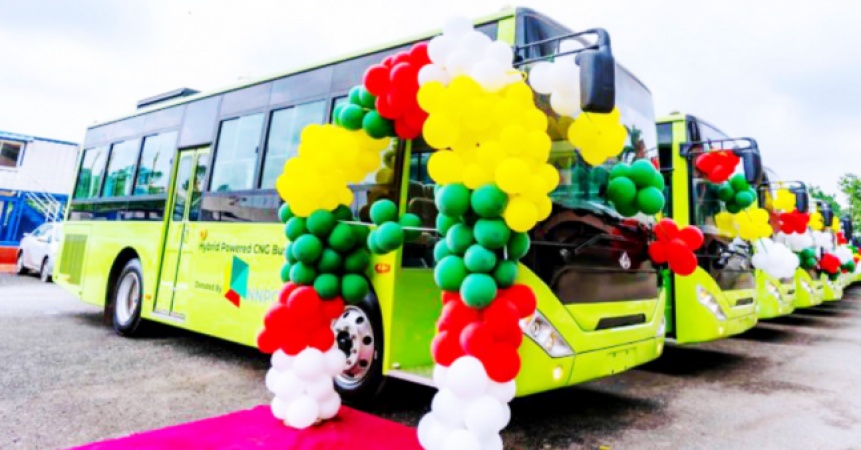



Photo of CNG luxury buses courtesy of The Nation
More states are in the process of deploying additional Compressed Natural Gas ((CNG) buses for cheaper public transportation as the October 1 cut in fares initiative of the federal government begins to take shape.
Some others are either about to take delivery of more of such buses or place order for them, according to reports from our correspondent across the states yesterday.
But the possibility that all the states will meet the October 1 deadline looked unlikely last night.
President Bola Tinubu had, in a September 18 directive, asked state governments to accelerate the deployment of CNG and electric mass transit systems with a view to delivering measurable reductions in transportation fares from October 1.
The President, in an update on the National Affordable CNG Transit Programme yesterday, had said Nigeria, as a gas-rich country, must insulate itself from volatility in the international energy market by expanding cheaper domestic alternatives rather than reverting to petrol subsidies, which he said consumed trillions of naira and left the economy vulnerable to movements in global oil prices.
He said more than 120,000 vehicles have already been converted to CNG under the programme, while over 400 certified conversion centres and more than 90 CNG refueling stations are currently operational across the states and the Federal Capital Territory (FTC).
Kano State, which launched 222 CNG and electric vehicles for public transportation back in May, has now been joined by Akwa Ibom and Cross River which have deployed 50 and 10 buses respectively.
Ondo State is awaiting the delivery of 100 CNG buses and Delta 50 while Edo prepares to unveil 50 on October 15.
Scheduled to perform the ceremony is First Lady Oluremi Tinubu.
Vice President Kashim Shettima, represented by the Deputy Chief of Staff to the President, Senator Ibrahim Hadejia, said at the launching of the vehicles in Kano that the initiative was aimed at building a more resilient and economically competitive Nigeria.
According to him, the adoption of CNG and electric mobility had become necessary to reduce transportation costs and lessen dependence on expensive traditional fuel systems despite Nigeria’s huge gas reserves.
“Transportation costs affect food prices, businesses, manufacturing, logistics and ultimately the lives of ordinary Nigerians. President Bola Tinubu understood that Nigeria could not continue to depend entirely on expensive traditional fuel systems while sitting on over 200 trillion cubic feet of gas reserves,” he said.
Shettima described Kano as the ideal location for the northern rollout of the initiative, noting that the state remains a major commercial and transportation hub linking markets across Northern Nigeria and neighbouring countries.
He commended the leadership of PI-CNG & EV under Barrister Ismaeel Ahmed for driving the programme and expanding its mandate to include electric vehicles in line with global transport innovation.
The Vice President also disclosed that private firms including Greenville LNG, AY Shafa, NIPCO, AA Rano, Rolling Energy and others were already investing heavily in gas infrastructure across Northern Nigeria.
In his remarks, Kano State Governor, Abba Yusuf, described the initiative as a bold intervention that would ease transportation challenges and create economic opportunities for residents.
He said Kano embraced the programme because transportation remains central to the state’s economy and commercial activities.
Akwa Ibom crashes transport fares with 50 CNG buses
Akwa Ibom Information Commissioner Aniekan Umanah said in Uyo that the CNG buses were operational in the state’s 31 local government areas to ease public transportation.
“Governor Umo Eno is very intentional and committed to the holistic implementation of his ARISE Agenda as regards easing the transportation burden faced by residents of the state,” he said.
He added: “The removal of fuel subsidy by the President Bola Tinubu administration is a welcome development and it has brought quantum benefits to the nation’s economy but some discomfort on commuters.
“This informed the Governor’s decision to bring in the CNG buses, fifty of them, to ease the burden. Akwa Ibom State is a model in terms of transportation and ease of movement.
“Every nook and cranny of the state is linked by good roads and I trust that residents of the state would not have any challenges with regards to human and vehicular movements.”
Govt intervention still unraveling in C-River, says commissioner
Transport Commissioner Kingsley Egomi said the Cross River State government has in its possession 10 CNG buses for the take-off of the initiative.
Further details will unfold in due course, he told The Nation.
“When I came back from Abuja from the stakeholders meeting on CNG, I tried to brief the Governor, but later on he travelled. It’s only when he comes back that I’ll know the state’s position fully.
“Actually, the intervention aims to reduce transportation costs, so our first port of call is the CNG conversion centres because without the conversion centres, you’ve done nothing.
“We’ve started the conversion centers already. Also, for the Electronic vehicles, we have about 10 already, so I need to meet with my boss (the governor) before I can have a full brief.
Abia State to increase CNG bus fleet to 60
The Abia State Government plans to increase its CNG bus fleet to 60 by the end of the year to take the total to 100.
Governor Alex Otti commissioned the first 20 last December and another 20 last month.
The buses currently operate mainly in Umuahia the state capital and the commercial city of Aba.
The bus service is to be expanded to cover Umuahia–Bende–Arochukwu, Umuahia–Umunneochi, Umuahia–Okigwe–ABSU, Umuahia–Michael Okpara University–Ikwuano, Aba–Ukwa and Aba–Owerri among other routes.
Fares on the Green shuttle from Umuahia to Arochukwu is N2,000 while private operators charge N5,000 for the same journey.
Benue Gov’s CPS: We’re on track
The Benue State Government said it is working round the clock to make the scheme a success in the state.
It has placed order for more buses including CNG vehicles for public transportation, Kula Tersoo, the Chief Press Secretary to Governor Hyacinth Alia told The Nation. SubscribeTo News
He said government had earlier procured 100,100 Toyota buses for the state-owned transport company, Benue Links Nigeria Limited.
When the additional buses arrive and are put into use, the transport sector will be heavily subsidized, leading to a significant reduction in transport fares across the state, Tersoo said.
Afegbua: The buses will be near-free in Edo
Edo State Government said its planned roll out of 50-CNG buses into the state transport ecosystem will force down transport fares across the state.
Information and Strategy Commissioner Kassim Afegbua said the buses would be distributed across the three senatorial districts and the 18 local government areas.
“The buses will be near-free because of the very cheap fare that would be charged per commuter,” he said.
“The very low fare will force other public transporters to cut down on their fares.”
Delta awaits 50 CNG buses as Asaba, Warri terminals near completion
The Delta State Government is awaiting the arrival of 50 CNG-powered buses approved for the pilot phase of its MORE Mass Transit Scheme, Commissioner for Transport, Mr Onoriode Agofure, has said.
Agofure said the government is currently constructing bus terminals in Asaba and Warri.
The buses are scheduled to arrive once the terminals are completed.
He said the initiative was part of the state government’s efforts to provide safer, more affordable and efficient public transportation while addressing the growing demand for organised mass transit.
According to him, the government’s assessment of public transportation patterns in seven major cities of Asaba, Warri, Ughelli, Agbor, Sapele, Abraka and Oleh showed that about 80 per cent of residents depend on public transport.
He said the finding underscored the need for a more structured and dependable transport system capable of meeting the daily mobility needs of workers, students, traders and other residents.
Agofure said the 50 CNG buses would constitute the pilot fleet for the MORE Mass Transit Scheme and would provide both inter-city and intra-city transportation services.
He said the scheme was expected to ease the burden of daily commuting, improve mobility and contribute to a more efficient public transportation system across the state.
The commissioner said the development of the bus terminals was an important component of the scheme, as the facilities would provide designated points for the operation and coordination of the new mass transit services.
Ondo seeks 100 CNG buses to cut transport costs
The Ondo State Government has requested 100 Compressed Natural Gas (CNG)-powered buses from the Federal Government as part of measures to reduce transportation costs and cushion the impact of rising fares on residents.
The state also requested 100 CNG-powered tricycles.
The Special Adviser to Governor Lucky Aiyedatiwa on Transport, Muyiwa Ogunyemi, told The Nation that the requests followed a meeting in Abuja involving commissioners of transport from the 36 states, the Presidential Implementation Committee on CNG and Electric Vehicles and the Nigerian Governors’ Forum.
He said the state submitted its report and requests following the meeting, although there was no guarantee it would receive the full number of vehicles requested.
“We requested for 100 CNG buses. We also made 100 requests for tricycles. Even though it was just a request, we don’t know if they will give us up to that,” he said.
Mr Ogunyemi said the success of the programme would be measured by its impact on commuters rather than the number of vehicles acquired by the government.
According to him, the lower operating cost of CNG-powered vehicles should reflect in transport fares rather than become another reason for operators to increase charges.
“The buses that governments purchase or buy, how do they cushion the effect of transportation that translates to the reduction of transportation fees?” he said.
He revealed that the state was also exploring partnerships with private-sector operators and vehicle dealers to ensure that buses acquired under the programme were CNG-compatible.
Ogunyemi said the state was already engaging private companies on the establishment of facilities for converting existing petrol-powered vehicles to CNG.
He explained that the state needed adequate conversion workshops, trained personnel and reliable gas-supply infrastructure before the CNG programme could operates effectively.
“Do we have a workshop where they can convert those buses? Those that have existing fuel-driven automobiles, both private and commercial, can go there to convert their existing vehicles,” he said.
The Special Adviser said the government was considering setting up a conversion and training facility while encouraging private investors to establish similar facilities in the state.
He said the government’s role should principally be to create an enabling environment for private-sector participation rather than permanently run the business.
Ogunyemi also said the state was engaging “Matrix Oil” on the expansion of CNG infrastructure, saying the company had indicated plans to visit the state to discuss a possible partnership with the state government.
He added that Ondo already had a CNG facility in Ore where motorists could access gas, but additional infrastructure would be required if the number of CNG-powered vehicles increased substantially.
Lagos: We’re still discussing with FG
Lagos State, which has the most extensive public transport system in the country, is understood to be still in talks with the Federal Government on the cut in public transport fare.
“Lagos State believes in the bold reforms initiated by the President Bola Tinubu administration and will support all efforts to enhance the living conditions of our citizens,” Information and Strategy Commissioner Gbenga Omotosho said yesterday, giving no further details.
Ebonyi, Imo, Anambra, Ogun and Osun state governments are in a similar situation.
Ebonyi State Transport Commissioner Collins Igboke said the state government was working with transporters and other stakeholders on ways to cut down the cost of transportation across the state in line with the President’s directive.
The newly appointed Deputy Chief of Staff to the Imo State Governor, Chief Enyinnaya Onuegbu, said that apart from the provision of free transport for civil servants the state government has also revived the moribund Imo Transport Company (ITC), which he described as an important component of the state’s public transportation system.
“Imo State Government under Senator Hope Uzodimma resuscitated the moribund Imo Transport Company. It is no longer being hijacked by franchise owners; it is now run as a profitable company in Imo State,” he said.
The Deputy Chief of Staff also said the state was working towards expanding the use of Compressed Natural Gas (CNG)-powered vehicles as part of measures to reduce transportation costs, although he did not disclose the number of vehicles involved, routes targeted or when the scheme would become operational.
Chairman of the Academic Staff Union of Universities (ASUU), FUTO chapter, Dr Chinedu Ihejirika, said the university was also making efforts to take advantage of the CNG infrastructure to reduce transportation costs within the institution and promote cleaner energy.
Ihejirika told The Nation that FUTO has acquired CNG-compatible vehicles and tricycles to be deployed within the university community, adding that the initiative will provide a cheaper transportation option for students, staff and other members of the institution.
He said the university authorities have also been working to strengthen the CNG facility and ensure that the vehicles acquired for the institution could operate within the campus using the alternative fuel.
The FUTO development provides a practical component to the wider CNG transition in Imo, with the institution deepening its partnership with the Presidential Initiative on CNG and Electric Vehicles.
The university has said its technological orientation, research capacity and skilled personnel position it to support cleaner energy, affordable transportation and environmental sustainability.
We’ll soon unveil our plan, says Anambra commissioner
Anambra State Transport Commissioner Edward Obiefuna Ibuzo said the state government was seeking collaboration with private investors to ease public transportation.
“We’re seriously on it. Last week, we organised 1000 skills acquisition programmes for youths on electric vehicles, especially the CNG for clean and green energy,” he said..
“We’re also meeting with private investors for collaboration. We’re currently in communication with Innoson Motors. We will unveil our own soonest.”
Ogun to expand CNG, electric vehicle adoption to crash transport fare
Ogun State said it was working to expand the adoption of CNG and electric vehicles as part of efforts to reduce transportation costs, cut dependence on petrol and diesel, and promote cleaner mobility across the state.
The Special Adviser to Governor Dapo Abiodun on Information and Strategy, Mr. Kayode Akinmade, told The Nation that the Presidential CNG Initiative (Pi-CNG) in collaboration with the Nigeria Governors’ Forum (NGF) is driving the implementation of the initiative across the country, with Ogun State actively engaging relevant stakeholders to ensure its effective and sustainable execution.
“The Presidential CNG Initiative (Pi-CNG), in collaboration with the Nigeria Governors’ Forum (NGF), is driving the implementation of the initiative across the country. Ogun State, alongside other participating states, is actively engaging with the relevant stakeholders to ensure that the policy is effectively and sustainably implemented.”
He said Governor Abiodun has directed the introduction of electric vehicles, including cars and motorcycles, as part of the state’s wider commitment to cleaner and more affordable transportation.
According to him, work is already underway to fast-track the programme and establish the necessary framework to support the transition to cleaner forms of mobility.
Akinmade said the initiative was expected to have direct economic benefits for residents, particularly transport operators and commuters, by reducing fuel and running costs.
He explained that lower operating costs could ultimately translate into more affordable transportation fares, while increased adoption of CNG and electric vehicles would reduce dependence on conventional petrol and diesel-powered vehicles.
He added that the use of cleaner vehicles would also help reduce smoke and harmful emissions on roads across the state.
For the people, the benefits are practical and immediate: lower fuel and running costs for transport operators can translate into more affordable fares; greater use of CNG and electric vehicles will reduce dependence on petrol and diesel; and cleaner vehicles will help reduce smoke and harmful emissions on our roads.”
Osun govt awaits FG’s team
The Osun State Government is expecting a Federal Government delegation later this week to fine-tune plans for the introduction of CNG-powered buses and reduction of transportation fares in the state.
The State Commissioner for Transportation, Sesan Oyedele, told our correspondent on the phone that the Federal Government team would visit Osun as part of its engagement with the states on the CNG initiative.
The commissioner said the state has also developed a blueprint for reducing transportation fares.
The relevant documents on the issue are currently in his ministry, he said.
Oyedele, however, explained that effective regulation of transport fares would depend largely on the availability of CNG buses, in view of the current high price of fuel.
Kaduna ahead in provision of free transportation, says commissioner
Kaduna State Information and Culture Commissioner, Ahmed Maiyaki, said the Uba Sani Administration is already providing free transportation for residents with the CNG buses donated to the states by the Federal Government.
Maiyaki said the initiative commenced on July 7, 2025, initially targeting civil servants, retirees and students from primary to tertiary institutions, but was later expanded to cover other commuters travelling along designated routes across the state. EnrollIn Courses
He explained that the state deployed the CNG buses for the free mass transit programme following their commissioning in Kaduna by President Bola Tinubu on June 19, 2025, adding that the use of CNG has also helped to provide a more cost-effective means of mass transportation.
The commissioner said 3.2 million passengers have so far benefited from the free transportation service, while citizens have collectively saved an estimated N3.5 billion in transportation costs since the commencement of the initiative.
According to him, the buses initially operated on major routes including Rigachikun-Kawo-Kasuwa-Sabo, Rigachikun-Kawo-Independence Way-Yakowa Road and Tudun Wada-Poly Road-Sokoto Road-Kawo, before the service was expanded to other parts of Kaduna metropolis, Zaria and Kafanchan.
Maiyaki said about 30 CNG buses were currently operating daily, serving approximately 200 bus stops between 7am and 6pm, adding that the state government was also constructing 200 modern bus stops to improve the efficiency and accessibility of the transportation system.
He said the free CNG mass transit programme was separate from the Kaduna Bus Rapid Transit project, stressing that while the free buses were introduced primarily as a cost-of-living intervention to reduce the burden of transportation on citizens, the BRT project was designed as a long-term urban transportation infrastructure programme.
Niger, Nasarawa and Katsina state governments were mute on their plans for now while the Kogi State Government plans to meet with the state chapter of the
National Union of Road Transport Workers (NURTW) on Wednesday with the issue as one of the items on the agenda.
NADDC moves to standardise CNG, EV training for technicians
The National Automotive Design and Development Council (NADDC) has commenced the technical validation of training manuals designed to standardise the training and certification of technicians working on Compressed Natural Gas (CNG) and Electric Vehicle (EV) technologies in Nigeria.
The Council said the exercise was necessary to ensure that personnel handling the emerging automotive technologies acquire the practical competencies required to install, maintain, diagnose, repair and service CNG- and electric-powered vehicles safely.
The validation workshop, held in Lagos brought together automotive experts and other stakeholders to scrutinise draft instructional manuals developed from approved National Occupational Standards (NOS) for CNG and EV technologies.
Speaking at the workshop, the Director-General/Chief Executive Officer of NADDC, Otunba Oluwemimo Joseph Osanipin, represented by the Director, Industrial Infrastructure Department, Mrs Joke Onireti, said the quality of the manuals would determine the effectiveness of training and certification in the rapidly changing automotive sector.
Osanipin said the manuals were being subjected to technical review before their wider application to ensure that they were accurate, practical, current, competency-based and relevant to Nigeria’s automotive environment.
He said the development of the manuals was particularly important as the global automotive industry undergoes a major technological shift towards alternative propulsion systems, including CNG and electric mobility.
According to him, the transition presents Nigeria with opportunities for industrial development, job creation, youth empowerment, technology transfer, local content development and investment.
He, however, said the country could only benefit fully from the transition if it developed a workforce with the technical knowledge and practical skills required to work safely with the technologies.
“This is why the validation of these manuals is particularly significant,” he said.
Osanipin explained that the National Occupational Standards set out the competencies required for specific occupations, while instructional manuals provide the practical framework through which those competencies are taught, acquired and assessed.
He urged the experts participating in the validation exercise to scrutinise the manuals for gaps, ambiguities and inconsistencies, stressing that the documents must reflect current industry practices and technological developments.
He identified technical content, sequencing, learning outcomes, practical exercises, safety requirements, assessment components, terminology, illustrations and overall usability as areas requiring close examination.
Particular attention, he said, must be paid to occupational health and safety because of the risks associated with high-pressure CNG systems, high-voltage EV systems, battery technology, charging infrastructure, vehicle diagnostics and maintenance procedures.
“Safety must remain a fundamental component of competency in these emerging technologies,” Osanipin said.
He added that the manuals should be sufficiently practical to support trainers, assessors and different categories of learners, rather than serving merely as reference documents.
The NADDC boss also urged stakeholders to ensure that the materials reflected the realities of Nigerian training institutions, workshops, automotive businesses, conversion centres and other industry operators.
He said the Council expected the final documents to serve as credible national reference materials while remaining adaptable to future developments in automotive technology.
The President of the Automotive Sector Skills Council (SSC), Engr. Best Nnodim, said the development of the manuals had become necessary because of the rapid changes in Nigeria’s automotive industry.
Nnodim said the increasing adoption of CNG-powered vehicles, electric mobility and other electronically controlled vehicle systems required technicians who were not only knowledgeable but also practically competent and capable of working safely.
He said the manuals should therefore go beyond theoretical instruction and become practical tools for instructors, trainers, assessors and technicians.
According to him, CNG training must adequately cover gas systems, installation, inspection, leak detection, maintenance, diagnostics and safety. (The Nation, but headline reworked)