Updating your news feed...
NEWS EXPRESS is Nigeria’s leading online newspaper. Published by Africa’s international award-winning journalist, Mr. Isaac Umunna, NEWS EXPRESS is Nigeria’s first truly professional online daily newspaper. It is published from Lagos, Nigeria’s economic and media hub, and has a provision for occasional special print editions. Thanks to our vast network of sources and dedicated team of professional journalists and contributors spread across Nigeria and overseas, NEWS EXPRESS has become synonymous with newsbreaks and exclusive stories from around the world.







Loading banners
Loading banners...

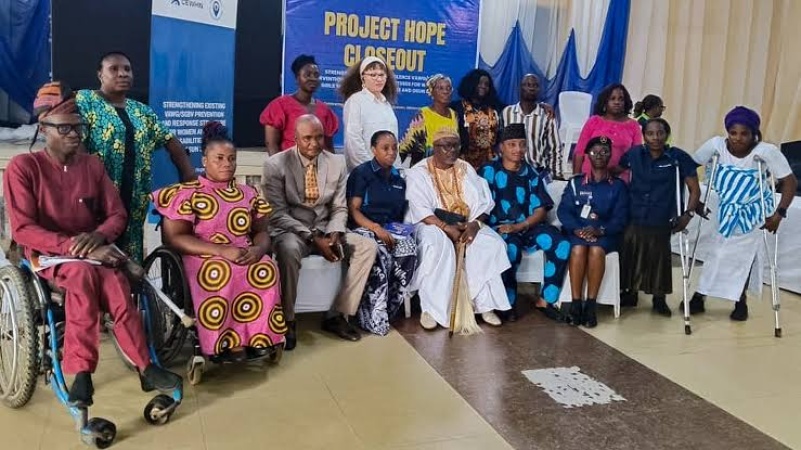
Women with disabilities
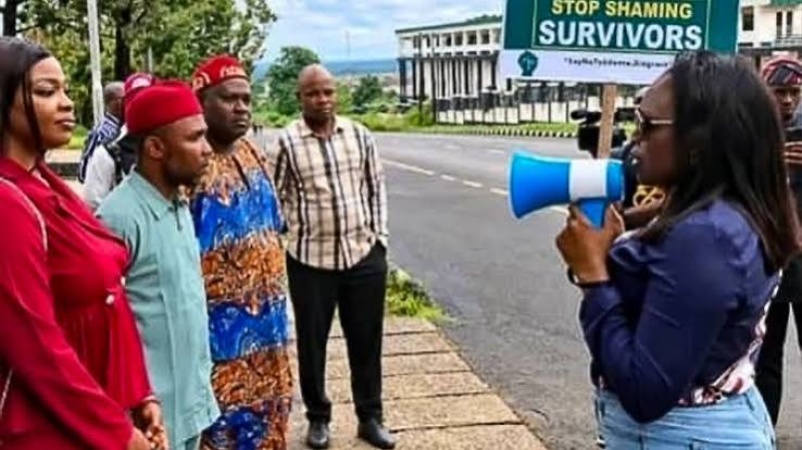
Girls and women with disabilities in Osun State have shared emotional testimonies of transformation and empowerment as stakeholders gathered to mark the close-out of Project Hope, a three-year programme implemented by the Centre for Women’s Health and Information (CEWHIN).
The programme, which focused on preventing and responding to gender-based violence against women and girls with disabilities, brought together disability clusters, service providers, security agencies, government Ministries, Departments and Agencies, community leaders and civil society organisations to strengthen existing systems of response in Osun and Lagos States.
The programme was supported by the UN Trust Fund to End Violence against Women (UNTF) Project HOPE. At the event, key stakeholders reflected on the achievements and lessons from Project HOPE as the girls and women with disabilities declared that they have been empowered to know their rights and resist any form of abuse.
While recognising the contributions of partners and stakeholders who supported the project and contributed to strengthening prevention and response to violence against women and girls with disabilities, collaborators at the event pledged to sustain the tempo and ensure that the referral pathways already established are not abandoned.
Reminiscing on efforts put in place to fight for the rights of PWDs, stakeholders listed many achievements and lessons from Project HOPE, identifying how existing structures can continue supporting women and girls with disabilities beyond the project period.
The importance of survivor-centred and disability-inclusive approaches to responding to violence was also highlighted as project partners, stakeholders, and community actors vowed to deepen synergy and ensure that challenges already tackled do not recur.
Speaking at the event, the Executive Director of CEWHIN, Atinuke Odukoya, said the organisation achieved far beyond what it set out to achieve at the inception of the project.
“We have achieved a lot, both what we set out to achieve and beyond what we set out to achieve. What we set out to achieve was to strengthen existing systems that respond to gender-based violence; we wanted to strengthen them with the ability to respond to and prevent violence against women and girls with disabilities, and we are delighted that this was achieved,” Odukoya said.
She explained that CEWHIN’s approach was anchored on collaboration and building on what already exists on the ground, working with both actors already in the gender-based violence space and those who were not, but had the potential to become responders if their capacity was strengthened.
According to her, every organisation partnered under Project Hope has now integrated issues of women and girls with disabilities into its work, with some even writing dedicated proposals to sustain the intervention.
Odukoya said the impact was particularly visible in the government sector, noting that several agencies that were previously not responding to women with disabilities are now doing so actively.
In Osun State, she said Project Hope was instrumental to the reopening and revitalisation of the Sexual Assault Referral Centre, SARC, as well as building the capacity of its staff and its steering committee comprising Ministries of Justice, Women Affairs and Health.
“Not only was Project Hope instrumental in the SARC being reopened and functioning, but we also supported them to respond to girls and women with disabilities. We trained their staff on their own work because if they don’t do it, they won’t be able to respond to women and girls with disabilities. We were also able to strengthen the capacity of their steering committee,” she said.
She also highlighted the emergence of the Community Task Force in Osun, which she described as an unexpected but powerful outcome of the project. The Task Force, made up of volunteers, has been responding to cases, writing reports and following up on abuses even without payment.
“The community task force in Osun state, they came up with it in their own free volition. There were people that were not paid like Mr Timothy, there was always one case or the other. That was the fallout of all of this,” she said.
Odukoya added that women with disabilities themselves have become agents of change, with the Deaf Associations in both Lagos and Osun stepping down trainings to their members and conducting community sensitization.
She said through the collaborative, community-based, top-bottom and bottom-up approach, the project was able to reach over one million people in three years.
“To think we were able to reach over a million people, that is wow. Three years, over one million from a collaborative approach, a community-based approach,” she noted.
The CEWHIN boss also cited the inclusion of the School of Special Needs, where young people were trained on psychosocial first aid and self-safeguarding, and their teachers trained on safeguarding protocols, as another stream that has continued to run on its own.
On sustainability, Odukoya expressed confidence that the structures put in place will outlive the project.
“The structures are simple. The community task force will continue with or without us, the SARC will continue with or without us. CEWHIN isn’t going to remain silent, will continue to engage. Our joy is that the people we have trained will continue,” she said.
She revealed that partner organizations like CAI4SR already have ongoing programmes focusing on women and girls with disabilities as a direct fallout of Project Hope, while women’s economic empowerment groups now mandatorily include women and girls with disabilities in all their activities.
“A number of women beyond the violence, beyond the abuse, are now being able to fend for themselves and get something to eat, all thanks to this programme,” she added.
Also speaking, the Desk Officer for Persons with Disabilities at the Nigeria Security and Civil Defence Corps, NSCDC, Osun State Command, DSC Rita Olaniru, described the three-year journey as eventful and impactful.
“It has been quite a great opportunity for us to be part of the Project Hope programme in Osun State for the past three years. It has been eventful; it has been impactful,” Olaniru said.
She said CEWHIN collaborated with the Corps to train its desk officers and facilitated sessions with parents of children with disabilities on gender-based violence, as well as joint capacity-building workshops with other security agencies in the state.
The workshop, the capacity building that CEWHIN has given to us, has equipped us to do more. Even as the programme is coming to an end, we have learned a lot from them,m and we are going to put them into practice in the line of our duties,” she said.
Olaniru assured that the NSCDC will sustain the gains and intensify efforts in responding to abuse against women and girls with disabilities.
For one of the beneficiaries, Precious Adebayo, a woman with disability, Project Hope has given her the knowledge of her rights and the courage to defend herself and others.
“Through this programme I have been enlightened to know my rights and to know my people’s rights as people living with disabilities, especially women and girls, because before, those able-bodied people used to abuse us and call us abusive names,” Precious said.
She said she now stands boldly against discrimination and abuse, encouraging other women with disabilities to speak out and seek justice.
“After this programme, I have decided that if anybody calls us by a derogatory name, they will find themselves to be blamed, and I now stand on my feet to defend myself and other persons with disabilities. Anybody who abuses them or calls them anything that is contrary to the law, they should let us know. We have people to fight for us; the law will fight for us,” she said.
She cited the case of a woman with disability abandoned by her husband with three children, which was taken up by their leaders through the platform created by Project Hope.
Stakeholders at the event jointly committed to sustaining the referral pathways, continuing community sensitisation, and ensuring that women and girls with disabilities are no longer left behind in the fight against gender-based violence in Osun State. (The Guardian)