Updating your news feed...
NEWS EXPRESS is Nigeria’s leading online newspaper. Published by Africa’s international award-winning journalist, Mr. Isaac Umunna, NEWS EXPRESS is Nigeria’s first truly professional online daily newspaper. It is published from Lagos, Nigeria’s economic and media hub, and has a provision for occasional special print editions. Thanks to our vast network of sources and dedicated team of professional journalists and contributors spread across Nigeria and overseas, NEWS EXPRESS has become synonymous with newsbreaks and exclusive stories from around the world.








.webp)







.webp)


Loading banners
Loading banners...

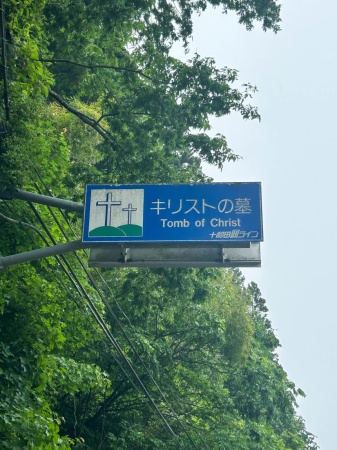
Deep in the misty, wooded hills of Aomori prefecture, the drive toward Lake Towada is a classic scene of rural Japan. There are terraced rice paddies, quiet farmhouses and endless greenery.
Then, just past the village of Shingo, a small, blue highway sign appears overhead that’s unusual enough to make some travelers hit the brakes.
Printed in bold English lettering, it reads: Tomb of Christ.
Yes, that Christ. Jesus of Nazareth.
It’s not a version of history found anywhere in the Bible or entertained by the Catholic Church, but local legend has it that instead of dying on a cross in Jerusalem, Jesus escaped to Shingo, became a farmer, got married, had kids and lived to a ripe old age in the lush Japanese countryside.
That version of his story is recorded in a mysterious set of manuscripts referred to as the Takenouchi Documents, which were supposedly written thousands of years ago and rediscovered in the 1930s. And though these “ancient” papers and their contents have been widely debunked as a hoax — no theologian worth their Ph.D. would jump to support these claims — the legend lives on in Shingo.
For more than 60 years, the village has embraced the folklore not as religious dogma, but as an opportunity for community building, the preservation of local traditions and one of the most unusual annual festivals in the country.
At the heart of it all is Christ Park, where two burial mounds sit on a quiet hillside, and an onsite Christ Village Tradition Museum tells the whole story.
“Christ visited Japan twice,” museum director Hidenobu Kadogishi tells CNN, explaining the timeline laid out in the Takenouchi Documents. According to the legend, he says, Jesus initially visited Toyama prefecture, farther south, working for the country’s Imperial family, before heading back to Judea, where he “spread the word of the divine land, Japan.”
The documents claim that years later, when Christ was about to be crucified, his brother Isukiri — whose existence also fails to rate a mention in the Bible — took his place on the cross instead, explains Kadogishi.
“Christ then made a second journey back to Japan, where he lived until the age of 106, fathered three children, and passed away,” says the director.
Centuries later, in 1935, a religious leader named Kiyomaro Takenouchi claimed to have discovered the grave of Iesu Kirisuto, as Jesus Christ is known in Japan.
He credited those mysterious documents for leading him to Shingo, then known as Herai, where some locals were able to take him to the burial mounds. Conveniently, the original texts, which make other intriguing claims about Japan’s role in global history, were allegedly destroyed during World War II, leaving only copies behind. Reproductions are on display in the museum, along with other items connected to the legend, but taking photos and videos is prohibited.
“The tomb of Christ itself had always been here, but there was nothing that properly explained it,” says Kadogishi. “So, in 1996, we built this museum and put together the exhibition.”
On a hill just steps away from the museum are two large mounds of earth encircled by short white fences and marked by large wooden crosses.
One is said to be the grave of Jesus, the other holds the interred ear of his brother.
Despite the obvious intrigue of such a tale, the museum usually attracts only a handful of visitors each day, and they’re closed for the winter months, says director Hidenobu.
But on one day in early summer, the parking lot outside is full by 9:30 a.m., with crowds being bused in from an overflow lot.
Everyone is here for the Kirisuto Matsuri, or Christ Festival, which has been held annually on the first Sunday of June since the 1960s. The event is equal parts sacred tribute, joyous community shindig and delightful theological conundrum.
As the opening ceremony kicks off, local dignitaries, many in suits, line the VIP chairs in front of a shrine devoted to Jesus, near the graves.
A Shinto priest — practicing Japan’s ancient, nature-focused belief system — recites prayers and offers sacred tree branches, called tamagushi, to the shrine and visiting dignitaries. Local performers stage a lion dance, known as shishimai, as a traditional band plays. Then, women dressed in kimonos perform a traditional Nanyadoyara, a sort of folk dance, around the burial mounds.
Afterward, everyone is invited to take part in a dance in front of the museum under the overcast sky. Dozens of visitors join the circle, smiling and letting their arms flow as the traditional music plays.
Mayor Kazutomo Sato, 57, has only been in office for about a year, but as a lifelong resident he’s excited by the festival turnout.
“This year’s numbers are higher than last year’s,” he tells CNN from the sidelines of the celebrations. “Shingo village has been putting real effort into getting the word out through social media, and more and more young people, like middle schoolers, are joining in the Nanyadoyara dance.”
Festivities aside, virtually no one here seems concerned with verifying the lofty theological claims that brought them together — or whether Jesus Christ actually lived and died in Shingo.
Inquiries are met with slight smiles and the occasional shrug, nobody wanting to shatter the veneer of mystery that keeps the origin story alive, yet not willing to declare themselves as true believers.
“The tomb of Christ has always been here for as long as anyone can remember,” Shingo resident Koshi Nagano, 26, a volunteer at the festival, tells CNN, standing steps away from the grave.
“I’ve grown up hearing that Christ is actually buried there, and the whole time, I’ve been living wondering if it really is true. But when I hear from people of the village how these stories have been handed down over years, I come to feel that if anyone should believe in them, it’s the villagers themselves.”
Even the museum director says visitors are told not to ask whether it’s true or false, but to “treat this strictly as a legend.”
Antonio Fernández, from Spain, was among several foreign visitors at this year’s festival. A religion student at Tohoku University in nearby Sendai, he came with a group of classmates eager to dive into the legend’s origins.
“Well, the historical truth aside, I think it’s wonderful, like the atmosphere and how people come here to have just fun,” he says with a smile.
“The legend doesn’t make any sense, but it’s interesting to see how most of the people here … I think they know it’s not true, but they just come here to have fun. I think that’s the key to the festival.”
Paulina Kralka, from Poland, holds a similar view. As a Christian, she admits the claims are surprising, but she says the event is “quite a special and extraordinary thing.”
These types of festivals in rural Japan offer unique insights into Japanese culture and help open foreign travelers’ perspectives, she adds.
“If we take the religious aspect out, I think that the people here have their own special connection to the tradition, and I don’t personally think there’s anything particularly wrong with that.”
The mayor agrees. “Don’t overthink it,” he says, smiling.
“Setting aside the question of truth, the tomb of Christ is here, and we enshrine it. That is our reality, and it is something we have protected as a tradition passed down from our ancestors.
“In Shingo Village, you won’t find anyone particularly fixated on the deeper implications, and no one is asking something like ‘but what does it all mean?’ Through the Nanyadoyara dance, Christ, and all of the other traditions, the people of Shingo come together, enjoy themselves, and keep lifting the village up, going forward.”
He’s not exaggerating about the lure of the cultural aspects associated with the festival. Three kimono-clad women attending from Tokyo tell CNN it’s not Jesus that drew them to Shingo, but dance.
“The Christ legend is interesting to us, but it doesn’t really have much to do with why we’re here,” says one of the women.
“We love the Nanyadoyara dance … We love it so much that we even hold practice sessions back in Tokyo. Wherever there’s a place where we can dance the Nanyadoyara, we jump at the opportunity.”
The trio came to Shingo three years ago in the wake of pandemic travel restrictions, when the festival was more sparsely attended.
“I really hope it keeps growing,” she adds. “Seeing so many people here just makes me so happy.”
After the dance is over, a ramen noodle event featuring local vendors near the parking lot lures huge lines to the various stalls as the crowds around the museum and graves disperse.
Meanwhile, the museum director is in a happy mood. In the end, around 1,000 people showed up for this year’s festival, a record. And with international interest growing, he says they’re making things more visitor-friendly.
“We’ve already added English translations to all the written exhibits, but I do think it would be worth having English subtitles on the video content as well,” adds Hidenobu.
He says he wants Christian visitors to know their faith is treated with caution and respect there. In a country where Christians make up less than 2% of the population, the reverence shown at the site is all the more remarkable.
“When I look through the guestbook, the most common thing people write is something like ‘I’m deeply moved to have finally visited this sacred site.’ It’s really taken on the feel of a pilgrimage,” he says.
“We do treat it all with genuine care. There’s absolutely no sense, even from Christian visitors, that we’re making a mockery of anything.”
Japanese professor Ryosuke Okamoto visited the Tomb of Christ in Shingo about a decade ago.
As a teacher of both theology and tourism at Hokkaido University, he says he always found the Jesus legend fascinating, but visiting the site and seeing its contradictions firsthand was truly eye-opening.
“What surprised me most was how calm and ordinary it was,” he says. “Not a large theme park like Disneyland, and it did not feel like a joke … There is no reliable historical evidence that they are the graves of Jesus and his brother. His brother Isukiri is not mentioned anywhere in the Bible, so most of the residents do not believe that Jesus was literally buried there.”
That said, he stresses the village places great importance on continuing the tradition out of respect for the past, keeping the legend alive as a sort of collective, shared memory.
“The annual Christ Festival began in 1964 and has now continued for more than 60 years,” he says.
“The legend does not survive because everyone believes it is historically true. It survives because people value the place, the festival and their connection with previous generations.”
And he cautions against simply looking at it as a syncretism — a blend of Christianity and Shintoism. The festival is not organized by a Christian church, and it does not include normal Christian worship such as Bible readings.
“The central ceremony is a Shinto memorial ritual performed by a local Shinto priest,” he says, noting the priest even explains during his speech that the exact identity of the person in the grave was not an important question. What’s important is to comfort and remember the dead.
“In Japan, we have eight million gods, so Christian and Shinto doctrines have not been mixed together to create a new religion.
“Instead, the name and story of Christ came from outside, and the local community placed them inside a familiar form of memorial ritual.”
Because most travelers who are serious about visiting Shingo wait for the annual festival, the economic effect of having such a big name attached to the village is low, even if that name is Jesus.
But it does add to the region’s other charms.
“The tomb’s greatest contribution is probably not large amounts of money; it is visibility and a memorable story that allows a village to explain itself to the outside world,” says Okamoto.
And that’s a good thing, he notes. Shingo, which is home to around 2,000 people, has limited options for accommodations, transport and food — most visitors stay in nearby tourist areas or in the coastal city of Hachinohe, an hour away.
“I think it’s important to introduce places such as Shingo village to international visitors,” he says, acknowledging the need to lure tourists to less-visited parts of Japan to ease overtourism pressures. But he stresses it shouldn’t be your sole reason for visiting Aomori prefecture.
Rather, treat it as a stop to hear the “surprising story of the Tomb of Christ” as part of a greater trip through the region during the warmer months, taking in its dramatic landscapes at places like the stunning Oirase Gorge and Lake Towada, and spend a couple of days discovering the port city of Hachinohe, which is under three hours from Tokyo by bullet train.
Mayor Sato says that, like many parts of Japan, Shingo is facing a population decline so his focus right now is “first and foremost ensuring that the people who already live here can live healthy, fulfilling lives. The goal is to naturally make this a village people want to live in.”
But he does hope travelers consider adding it to their plans, too.
“For anyone seeking an out-of-the-ordinary experience in a village full of mystery, and there’s an abundance of nature here too, I’d love for people to come and take it all in.”
That version of his story is recorded in a mysterious set of manuscripts referred to as the Takenouchi Documents, which were supposedly written thousands of years ago and rediscovered in the 1930s. And though these “ancient” papers and their contents have been widely debunked as a hoax — no theologian worth their Ph.D. would jump to support these claims — the legend lives on in Shingo.
For more than 60 years, the village has embraced the folklore not as religious dogma, but as an opportunity for community building, the preservation of local traditions and one of the most unusual annual festivals in the country.
At the heart of it all is Christ Park, where two burial mounds sit on a quiet hillside, and an onsite Christ Village Tradition Museum tells the whole story.
“Christ visited Japan twice,” museum director Hidenobu Kadogishi tells CNN, explaining the timeline laid out in the Takenouchi Documents. According to the legend, he says, Jesus initially visited Toyama prefecture, farther south, working for the country’s Imperial family, before heading back to Judea, where he “spread the word of the divine land, Japan.”
The documents claim that years later, when Christ was about to be crucified, his brother Isukiri — whose existence also fails to rate a mention in the Bible — took his place on the cross instead, explains Kadogishi.
“Christ then made a second journey back to Japan, where he lived until the age of 106, fathered three children, and passed away,” says the director.
Centuries later, in 1935, a religious leader named Kiyomaro Takenouchi claimed to have discovered the grave of Iesu Kirisuto, as Jesus Christ is known in Japan.
He credited those mysterious documents for leading him to Shingo, then known as Herai, where some locals were able to take him to the burial mounds. Conveniently, the original texts, which make other intriguing claims about Japan’s role in global history, were allegedly destroyed during World War II, leaving only copies behind. Reproductions are on display in the museum, along with other items connected to the legend, but taking photos and videos is prohibited.
“The tomb of Christ itself had always been here, but there was nothing that properly explained it,” says Kadogishi. “So, in 1996, we built this museum and put together the exhibition.”
On a hill just steps away from the museum are two large mounds of earth encircled by short white fences and marked by large wooden crosses.
One is said to be the grave of Jesus, the other holds the interred ear of his brother.
Despite the obvious intrigue of such a tale, the museum usually attracts only a handful of visitors each day, and they’re closed for the winter months, says director Hidenobu.
But on one day in early summer, the parking lot outside is full by 9:30 a.m., with crowds being bused in from an overflow lot.
Everyone is here for the Kirisuto Matsuri, or Christ Festival, which has been held annually on the first Sunday of June since the 1960s. The event is equal parts sacred tribute, joyous community shindig and delightful theological conundrum.
As the opening ceremony kicks off, local dignitaries, many in suits, line the VIP chairs in front of a shrine devoted to Jesus, near the graves.
A Shinto priest — practicing Japan’s ancient, nature-focused belief system — recites prayers and offers sacred tree branches, called tamagushi, to the shrine and visiting dignitaries. Local performers stage a lion dance, known as shishimai, as a traditional band plays. Then, women dressed in kimonos perform a traditional Nanyadoyara, a sort of folk dance, around the burial mounds.
Afterward, everyone is invited to take part in a dance in front of the museum under the overcast sky. Dozens of visitors join the circle, smiling and letting their arms flow as the traditional music plays.
Mayor Kazutomo Sato, 57, has only been in office for about a year, but as a lifelong resident he’s excited by the festival turnout.
“This year’s numbers are higher than last year’s,” he tells CNN from the sidelines of the celebrations. “Shingo village has been putting real effort into getting the word out through social media, and more and more young people, like middle schoolers, are joining in the Nanyadoyara dance.”
Festivities aside, virtually no one here seems concerned with verifying the lofty theological claims that brought them together — or whether Jesus Christ actually lived and died in Shingo.
Inquiries are met with slight smiles and the occasional shrug, nobody wanting to shatter the veneer of mystery that keeps the origin story alive, yet not willing to declare themselves as true believers.
“The tomb of Christ has always been here for as long as anyone can remember,” Shingo resident Koshi Nagano, 26, a volunteer at the festival, tells CNN, standing steps away from the grave.
“I’ve grown up hearing that Christ is actually buried there, and the whole time, I’ve been living wondering if it really is true. But when I hear from people of the village how these stories have been handed down over years, I come to feel that if anyone should believe in them, it’s the villagers themselves.”
Even the museum director says visitors are told not to ask whether it’s true or false, but to “treat this strictly as a legend.”
Antonio Fernández, from Spain, was among several foreign visitors at this year’s festival. A religion student at Tohoku University in nearby Sendai, he came with a group of classmates eager to dive into the legend’s origins.
“Well, the historical truth aside, I think it’s wonderful, like the atmosphere and how people come here to have just fun,” he says with a smile.
“The legend doesn’t make any sense, but it’s interesting to see how most of the people here … I think they know it’s not true, but they just come here to have fun. I think that’s the key to the festival.”
Paulina Kralka, from Poland, holds a similar view. As a Christian, she admits the claims are surprising, but she says the event is “quite a special and extraordinary thing.”
These types of festivals in rural Japan offer unique insights into Japanese culture and help open foreign travelers’ perspectives, she adds.
“If we take the religious aspect out, I think that the people here have their own special connection to the tradition, and I don’t personally think there’s anything particularly wrong with that.”
The mayor agrees. “Don’t overthink it,” he says, smiling.
“Setting aside the question of truth, the tomb of Christ is here, and we enshrine it. That is our reality, and it is something we have protected as a tradition passed down from our ancestors.
“In Shingo Village, you won’t find anyone particularly fixated on the deeper implications, and no one is asking something like ‘but what does it all mean?’ Through the Nanyadoyara dance, Christ, and all of the other traditions, the people of Shingo come together, enjoy themselves, and keep lifting the village up, going forward.”
He’s not exaggerating about the lure of the cultural aspects associated with the festival. Three kimono-clad women attending from Tokyo tell CNN it’s not Jesus that drew them to Shingo, but dance.
“The Christ legend is interesting to us, but it doesn’t really have much to do with why we’re here,” says one of the women.
“We love the Nanyadoyara dance … We love it so much that we even hold practice sessions back in Tokyo. Wherever there’s a place where we can dance the Nanyadoyara, we jump at the opportunity.”
The trio came to Shingo three years ago in the wake of pandemic travel restrictions, when the festival was more sparsely attended.
“I really hope it keeps growing,” she adds. “Seeing so many people here just makes me so happy.”
After the dance is over, a ramen noodle event featuring local vendors near the parking lot lures huge lines to the various stalls as the crowds around the museum and graves disperse.
Meanwhile, the museum director is in a happy mood. In the end, around 1,000 people showed up for this year’s festival, a record. And with international interest growing, he says they’re making things more visitor-friendly.
“We’ve already added English translations to all the written exhibits, but I do think it would be worth having English subtitles on the video content as well,” adds Hidenobu.
He says he wants Christian visitors to know their faith is treated with caution and respect there. In a country where Christians make up less than 2% of the population, the reverence shown at the site is all the more remarkable.
“When I look through the guestbook, the most common thing people write is something like ‘I’m deeply moved to have finally visited this sacred site.’ It’s really taken on the feel of a pilgrimage,” he says.
“We do treat it all with genuine care. There’s absolutely no sense, even from Christian visitors, that we’re making a mockery of anything.”
Japanese professor Ryosuke Okamoto visited the Tomb of Christ in Shingo about a decade ago.
As a teacher of both theology and tourism at Hokkaido University, he says he always found the Jesus legend fascinating, but visiting the site and seeing its contradictions firsthand was truly eye-opening.
“What surprised me most was how calm and ordinary it was,” he says. “Not a large theme park like Disneyland, and it did not feel like a joke … There is no reliable historical evidence that they are the graves of Jesus and his brother. His brother Isukiri is not mentioned anywhere in the Bible, so most of the residents do not believe that Jesus was literally buried there.”
That said, he stresses the village places great importance on continuing the tradition out of respect for the past, keeping the legend alive as a sort of collective, shared memory.
“The annual Christ Festival began in 1964 and has now continued for more than 60 years,” he says.
“The legend does not survive because everyone believes it is historically true. It survives because people value the place, the festival and their connection with previous generations.”
And he cautions against simply looking at it as a syncretism — a blend of Christianity and Shintoism. The festival is not organized by a Christian church, and it does not include normal Christian worship such as Bible readings.
“The central ceremony is a Shinto memorial ritual performed by a local Shinto priest,” he says, noting the priest even explains during his speech that the exact identity of the person in the grave was not an important question. What’s important is to comfort and remember the dead.
“In Japan, we have eight million gods, so Christian and Shinto doctrines have not been mixed together to create a new religion.
“Instead, the name and story of Christ came from outside, and the local community placed them inside a familiar form of memorial ritual.”
Because most travelers who are serious about visiting Shingo wait for the annual festival, the economic effect of having such a big name attached to the village is low, even if that name is Jesus.
But it does add to the region’s other charms.
“The tomb’s greatest contribution is probably not large amounts of money; it is visibility and a memorable story that allows a village to explain itself to the outside world,” says Okamoto.
And that’s a good thing, he notes. Shingo, which is home to around 2,000 people, has limited options for accommodations, transport and food — most visitors stay in nearby tourist areas or in the coastal city of Hachinohe, an hour away.Shingo
“I think it’s important to introduce places such as Shingo village to international visitors,” he says, acknowledging the need to lure tourists to less-visited parts of Japan to ease overtourism pressures. But he stresses it shouldn’t be your sole reason for visiting Aomori prefecture.
Rather, treat it as a stop to hear the “surprising story of the Tomb of Christ” as part of a greater trip through the region during the warmer months, taking in its dramatic landscapes at places like the stunning Oirase Gorge and Lake Towada, and spend a couple of days discovering the port city of Hachinohe, which is under three hours from Tokyo by bullet train.
Mayor Sato says that, like many parts of Japan, Shingo is facing a population decline so his focus right now is “first and foremost ensuring that the people who already live here can live healthy, fulfilling lives. The goal is to naturally make this a village people want to live in.”
But he does hope travelers consider adding it to their plans, too.
“For anyone seeking an out-of-the-ordinary experience in a village full of mystery, and there’s an abundance of nature here too, I’d love for people to come and take it all in.” (CNN)