Updating your news feed...
NEWS EXPRESS is Nigeria’s leading online newspaper. Published by Africa’s international award-winning journalist, Mr. Isaac Umunna, NEWS EXPRESS is Nigeria’s first truly professional online daily newspaper. It is published from Lagos, Nigeria’s economic and media hub, and has a provision for occasional special print editions. Thanks to our vast network of sources and dedicated team of professional journalists and contributors spread across Nigeria and overseas, NEWS EXPRESS has become synonymous with newsbreaks and exclusive stories from around the world.

























Loading banners
Loading banners...

By BONIFACE AKARAH
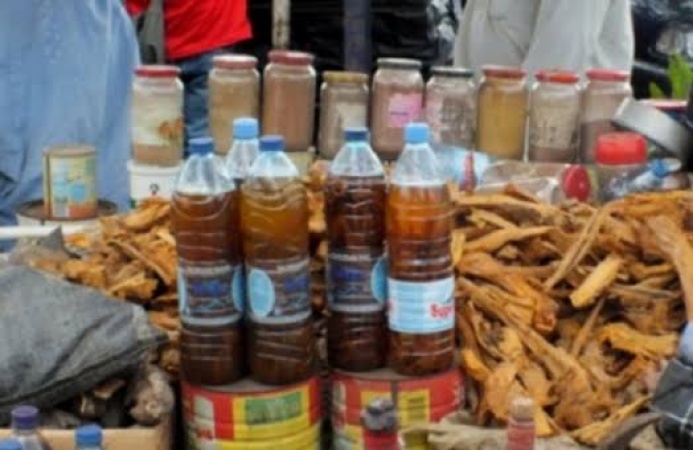
Resistance Against Oppression, Sexual Harassment and Anti-Poor Policies (ROSA-Nigeria) has blamed what it described as government neglect and weaknesses in Nigeria’s healthcare and regulatory systems for the deaths linked to a suspected toxic herbal drink in Ondo State.
The organisation, In a statement signed by its National Coordinator, Jimoh Abibat, said the death toll had risen to 49, with about 170 people reportedly affected across Odigbo, Irele and Araromi-Obu, describing the incident as a major public health crisis.
ROSA-Nigeria said the tragedy had exposed what it described as the difficult conditions facing Nigerians seeking healthcare, particularly amid rising living costs and inadequate access to affordable medical services.
“These deaths have exposed once again the terrible condition of healthcare in Nigeria, the government’s neglect and the ineffectiveness of agencies like National Agency for Food and Drug Administration and Control (NAFDAC), and the desperat’ situation facing millions of ordinary people,” the organisation said.
The group argued that increasing reliance on herbal medicines and other informal treatments could not be separated from the cost and accessibility of conventional healthcare.
It said: “When a worker, farmer, trader, student, or unemployed young person falls sick, the question is often not only, ‘What treatment do I need?’ It is also, ‘Can I pay for the hospital card? Can I afford the consultation? Can I pay for the test? Can I afford the drugs? Can I afford transport to the hospital? Will there be doctors or nurses to attend to me?’”
ROSA-Nigeria said this did not mean every traditional medicine was dangerous, noting Nigeria’s long history of traditional medical practices, but argued that inadequate regulation and poverty could expose vulnerable consumers to unsafe products.
The organisation also raised concerns about Nigeria’s healthcare workforce and infrastructure, citing figures it attributed to the Federal Ministry of Health’s 2024 State of Health of the Nation report.
According to ROSA-Nigeria, the report put Nigeria’s doctor-to-population ratio at 2.9 doctors per 10,000 people, compared with a World Health Organisation reference level of 17 doctors per 10,000.
The group said the report estimated that Nigeria would require about 391,230 doctors to meet the reference level, compared with approximately 66,241 doctors available at the time.
ROSA-Nigeria also cited the uneven distribution of healthcare professionals and the migration of qualified medical workers as additional challenges confronting the country’s health system.
It said: “There are thousands of primary healthcare centres across Nigeria, but having a building does not mean having a functioning health facility. Many centres lack enough doctors, nurses, drugs, equipment, electricity, and other basic requirements. In many rural communities, the distance to a properly equipped hospital is itself a major barrier.”
On herbal medicines, the organisation accused regulators of failing to adequately monitor a rapidly expanding market, alleging that some products reach consumers without sufficient testing, clear labelling or quality control.
It called for stronger enforcement by NAFDAC and other relevant agencies, including regular inspections, laboratory testing and the removal of unsafe products from the market.
ROSA-Nigeria said: “A product can be prohibited on paper and still find its way into markets and communities. There must be regular inspections, proper laboratory testing, and a system that allows unsafe products to be identified and removed before people are harmed.”
The organisation also called for regulatory scrutiny that extends beyond small-scale producers, alleging that there had been cases involving larger drug and food-related companies producing substandard products.
It urged the government to move beyond public statements and begin what it described as urgent investigations and enforcement activities.
The group linked the issue to the broader economic difficulties facing working-class Nigerians, saying rising costs of food, housing, transport, medicines and education were placing increasing pressure on household finances.
“When hospital consultations, tests and medicines become too expensive, an herbal mixture sold cheaply can look like the only realistic option for someone struggling to survive. That is why this issue is also connected to poverty,” it said.
ROSA-Nigeria rejected the suggestion that the Ondo incident should be viewed simply as a case of uninformed consumers or the actions of a single producer.
The organisation demanded increased public funding for healthcare, urgent investment in primary healthcare centres, improved working conditions for health professionals and stronger regulation of herbal medicines.
It also called for scientific research into traditional medicine, arguing that potentially useful traditional practices should be subjected to proper scientific assessment rather than simply dismissed.
“Most importantly, demand that public health must come before profit,” ROSA-Nigeria said.
The group further called on the Nigeria Labour Congress (NLC), Trade Union Congress (TUC), National Association of Resident Doctors (NARD) and other health professional unions to organise and demand increased funding for healthcare and greater involvement of health workers in decisions affecting the sector.
ROSA-Nigeria concluded by insisting that the Ondo tragedy should prompt broader action on healthcare access, poverty, regulation of medicines and the conditions under which Nigerians seek treatment.