Updating your news feed...
NEWS EXPRESS is Nigeria’s leading online newspaper. Published by Africa’s international award-winning journalist, Mr. Isaac Umunna, NEWS EXPRESS is Nigeria’s first truly professional online daily newspaper. It is published from Lagos, Nigeria’s economic and media hub, and has a provision for occasional special print editions. Thanks to our vast network of sources and dedicated team of professional journalists and contributors spread across Nigeria and overseas, NEWS EXPRESS has become synonymous with newsbreaks and exclusive stories from around the world.













Loading banners
Loading banners...

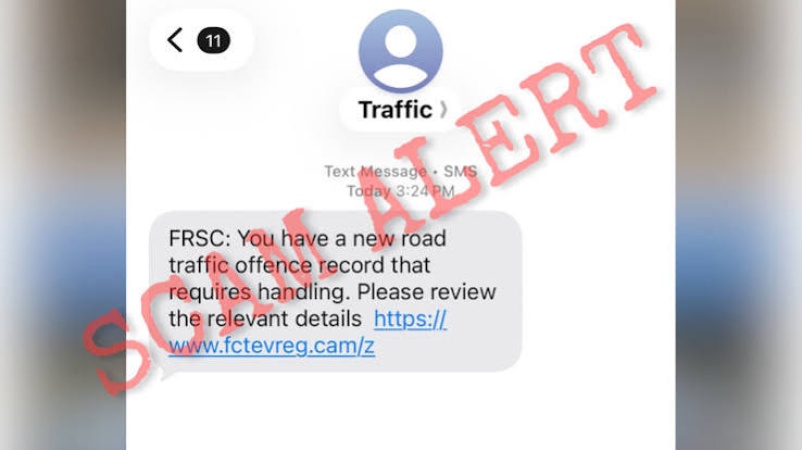
A screenshot of the fake FRSC SMS
By BABAJIDE AWOYINFA
Nigerians have taken to social media to alert the public to a fraudulent traffic offence scam in which motorists are receiving fake messages purportedly from the Federal Road Safety Corps (FRSC).
The News Agency of Nigeria (NAN) reports that the scam involves unsolicited text messages notifying recipients of a road traffic offence and directing them to click a link to review details of the alleged violation.
The link leads to a deceptive website designed to impersonate the FRSC, with the intent to obtain sensitive personal and financial information from unsuspecting victims.
However, in a statement issued by its Corps Public Education Officer, Osondu Ohaeri, the FRSC disowned the website being circulated — identified as “frscgov.top/ng” — saying it has no affiliation with the commission.
Ohaeri urged members of the public not to regard the messages or website as originating from the FRSC, stressing that the commission’s official website was “www.frsc.gov.ng’.
“The Corps official website is www.frsc.gov.ng and its verified online services operated through authorised digital channels.
“The Corps therefore unequivocally disowns the messages and the website, and members of the public should not regard such communications as originating from FRSC.
“Recipients are directed to click a link to review the relevant details. This link can be used to obtain personal information, financial details and other sensitive data from unsuspecting members.”
The FRSC warned that the links could be used to obtain personal information, financial details and other sensitive data from members of the public.
It advised Nigerians not to click suspicious links, make payments or disclose banking information, passwords, driver’s licence details, vehicle registration information or other personal data in response to unsolicited messages.
The commission further urged anyone who received such messages to preserve the evidence, avoid further engagement with the sender and report the incident through appropriate channels.
It said it would work with relevant law enforcement and cybersecurity authorities to pursue those responsible for the impersonation scheme.
Nigerian comedian, MC Monica, was among those who raised the alarm, alleging that he lost about N1.8 million after clicking a link contained in a message concerning an alleged FRSC traffic offence.
MC Monica reportedly said he clicked the link, paid N5,000 for the purported fine, but later discovered that about N1.85 million had been debited without his authorisation.
In a social media complaint, the comedian questioned how the larger transaction occurred after he had generated a one-time password (OTP) for only the N5,000 payment.
“The OTP I generated was only for the N5,000 payment, so what happened to my N1.8 million? Because I didn’t generate any OTP for that,” he wrote.
Another reported victim, actress Eva Ibiam, also took to X to warn Nigerians after alleging that she lost about N400,000 through the scam.
Ibiam said she received an SMS notifying her of an alleged traffic offence and clicked the attached link, believing it was connected to the FRSC.
She subsequently raised the alarm online and urged members of the public not to click the link.
NAN reports that the experiences have triggered wider conversations among social media users, with Nigerians sharing warnings about unsolicited messages.
Motorists have been advised to independently verify alleged traffic violations before making payments or providing personal information. (NAN)