ADAD
ADADUpdating your news feed...

NEWS EXPRESS is Nigeria’s leading online newspaper. Published by Africa’s international award-winning journalist, Mr. Isaac Umunna, NEWS EXPRESS is Nigeria’s first truly professional online daily newspaper. It is published from Lagos, Nigeria’s economic and media hub, and has a provision for occasional special print editions. Thanks to our vast network of sources and dedicated team of professional journalists and contributors spread across Nigeria and overseas, NEWS EXPRESS has become synonymous with newsbreaks and exclusive stories from around the world.








.webp)



.webp)
.webp)






.webp)

Loading banners
Loading banners...

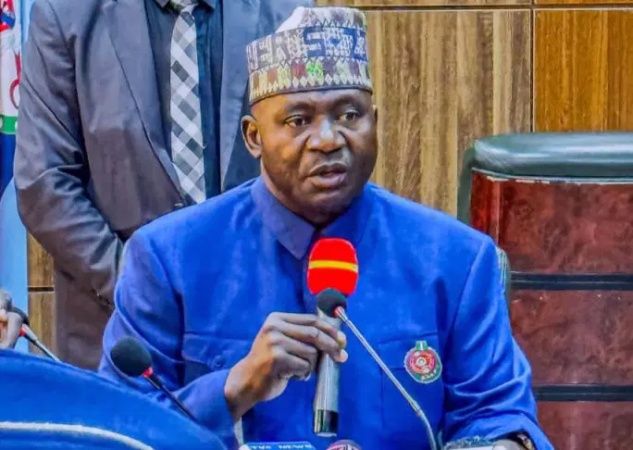
Defence Minister, Rtd Gen Musa
By LENGNAN TOBIAS/SUMAILA OGBAJE
The Minister of Defence, Rtd. Gen. Christopher Musa, says Nigeria’s defence architecture must evolve to address threats across land, maritime, air and cyber domains, while embracing emerging technologies and protecting democratic integrity.
Musa stated this on Thursday in Abuja, at the opening of the 2nd Policy Colloquium 2026.
The News Agency of Nigeria (NAN) report that the programme is themed: “Securing the Frontier: Strategic Defence Architecture, Emerging Technologies and Democratic Integrity in Nigeria.”
The minister said the current security environment demanded renewed strategic thinking, institutional adaptation and sustained national commitment.
“The complexity and changing character of contemporary threats require us to continually reassess our capabilities, strengthen our preparedness and remain ahead of developments that could affect our national interests,” he said.
He noted that Nigeria’s strategic frontier was no longer limited to physical borders but now included cyberspace, satellite networks, automated systems and information ecosystems.
According to him, addressing these challenges requires a more integrated defence posture, supported by effective intelligence coordination, joint operations and interoperability across the Armed Forces and other relevant security institutions.
Musa said technology was becoming decisive in modern warfare, with rapid advances in artificial intelligence, unmanned systems, surveillance, reconnaissance and cyber capabilities transforming military operations.
“Nigeria must therefore remain at the forefront of these developments by investing in relevant technologies and strengthening the human, doctrinal and institutional capacity required to integrate them into our defence capabilities,” he stated.
The minister added that this also underscored the need to strengthen Nigeria’s defence industrial base to reduce dependence and build local capacity.
He reaffirmed President Bola Ahmed Tinubu’s commitment to strengthening national security and equipping the armed forces to protect sovereignty, democratic institutions and drive national development.
Also speaking, Special Adviser to the Minister on Media, Leah Katung-Babatunde, said the very definition of Nigeria’s sovereign frontier was undergoing a monumental shift, with national security now extending beyond physical borders into cyberspace and information ecosystems.
According to her, for generations, national defence was defined primarily by physical borders, terrain, and kinetic force. Today, the sovereign frontier extends far beyond geography.
“It stretches into the digital domain, across automated systems, satellite networks, algorithmic landscapes, and the information ecosystems that sustain civic trust.”
She said the colloquium’s theme was “an urgent call to action” built around three interconnected pillars that would shape Nigeria’s stability for decades.
According to her, as asymmetric and multi-domain security challenges evolve, the security institutions require unprecedented agility, inter-agency cohesion, and forward-looking operational doctrines.
“Also, modern defence is no longer purely reactive; it must be predictive, integrated, and strategically resilient.
“Artificial intelligence, cyber infrastructure, geospatial analytics, and autonomous capabilities present unmatched opportunities to protect our national footprint.
“However, without clear policy governance, ethical oversight, and local technological depth, these same tools introduce novel vulnerabilities.
“Nigeria must transition from being a passive consumer of security technology to an active driver of technological sovereignty.” (NAN)