ADAD
ADAD
Updating your news feed...
NEWS EXPRESS is Nigeria’s leading online newspaper. Published by Africa’s international award-winning journalist, Mr. Isaac Umunna, NEWS EXPRESS is Nigeria’s first truly professional online daily newspaper. It is published from Lagos, Nigeria’s economic and media hub, and has a provision for occasional special print editions. Thanks to our vast network of sources and dedicated team of professional journalists and contributors spread across Nigeria and overseas, NEWS EXPRESS has become synonymous with newsbreaks and exclusive stories from around the world.
























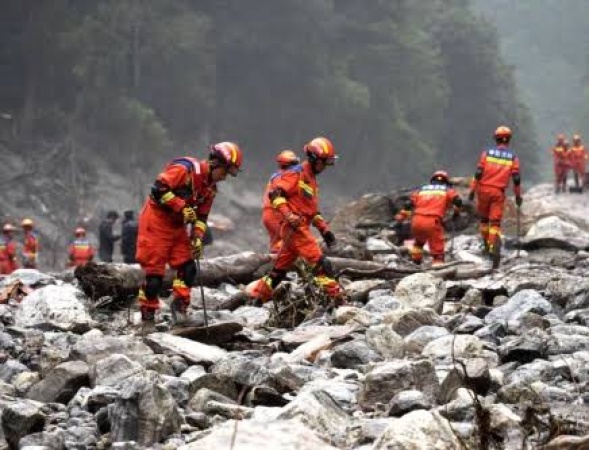
Soldiers search for bodies as rescue operations shift into search and retrieval in Nepal Photograp
The death toll from the devastating floods and landslides along the Nepal-Tibet border has risen to 750, while more than 3,000 people remain missing as rescue teams continue to search through mud and debris.
The disaster struck on Wednesday after a glacial collapse triggered a massive surge of water, ice and rocks that swept through communities and infrastructure on both sides of the Nepal-China border.
Authorities in Nepal reported 734 deaths and said 2,498 people remained unaccounted for. In Tibet, 16 deaths had been confirmed, with another 546 people still missing, bringing the combined number of missing people to 3,044.
The United States Geological Survey said the disaster was caused by a glacial collapse, while Chinese state media reported that experts had identified a glacier on the southern slope of Lirung Peak in Nepal as the source of the ice-rock avalanche.
The torrent generated a huge debris flow that travelled more than 20 kilometres before reaching Gyirong Port in Tibet, according to China’s state news agency, Xinhua.
In Nepal, soldiers and engineers continued efforts on Sunday to rescue workers believed to be trapped inside a tunnel at the Trishuli 3A hydroelectric project.
Nepal’s Home Minister, Sudan Gurung, said rescuers had successfully inserted a pipe into the tunnel and begun pumping air through a small opening in an effort to reach those trapped inside.
However, rescue operations were complicated by continued rainfall and rising river levels. The country’s disaster authorities warned rescue teams to exercise caution because of the possibility of further flooding.
The scale of the disaster has also raised concerns over the fate of thousands of people working in the region’s hydropower sector. Nepal’s disaster authority said 933 hydropower workers were among those reported missing.
Foreign nationals are also among those unaccounted for. Nepal said 589 foreigners, including trekkers and Hindu pilgrims travelling to Tibet’s Mount Kailash, remained missing.
The Isha Foundation, led by Indian spiritual leader Sadhguru, said 80 members of its group had travelled to the affected area. The organisation said there were no encouraging indications of survivors around the immigration office where some of the pilgrims were believed to have been caught.
Survivors and relatives have meanwhile been left searching desperately for missing family members as entire settlements along the affected rivers were destroyed.
“All the settlements near the river were swept away,” a survivor, Buddhi Ram Dangol, told AFP. “There is nothing left.”
International assistance has begun arriving as Nepal struggles to respond to the scale of the catastrophe. The United States and Canada have each pledged $3.6 million in humanitarian assistance, while the United Kingdom announced $6.8 million.
The United Nations has released $2.5 million in emergency funding, while the European Union pledged $2.3 million. The International Federation of Red Cross and Red Crescent Societies has allocated more than $1 million and launched an appeal for an additional $31 million.
Nepal’s Foreign Minister, Shisir Khanal, warned that rebuilding damaged communities and infrastructure could cost billions of dollars. He appealed for specialised equipment, including heavy-lift drones, forensic kits for identifying bodies and freezer units for storing remains.
Authorities are also monitoring the risk of additional flooding. The enormous volume of debris created temporary lakes in parts of the affected region, raising fears that further water releases could trigger another surge downstream.
Chinese and Nepali authorities have agreed to share satellite and hydrological information as they monitor the situation.
In Tibet, rescue operations at the worst-hit area of Gyirong were temporarily suspended because of concerns over a newly formed lake. China’s state broadcaster, CCTV, later reported that the lake was naturally draining and had been largely emptied.
Chinese authorities said more than 2,100 rescuers were deployed around the Gyirong area, while hundreds of stranded tourists and Chinese residents had been evacuated.
The disaster has also affected neighbouring India. Officials there said seven bodies believed to have been carried downstream from Nepal had been recovered from rivers.
As rescue operations continue, authorities on both sides of the border remain focused on locating survivors while preparing for possible additional flooding in the mountainous region. (The Sun)